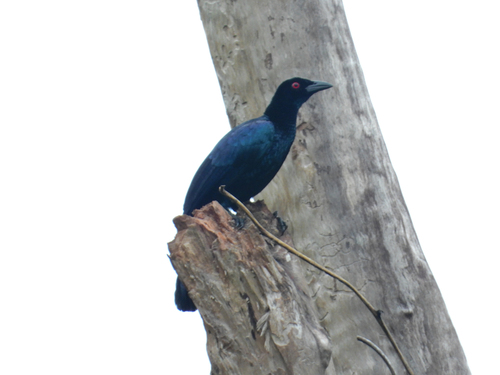
Black Butcherbird

Black Butcherbird

Melloria quoyi

Daily sighting probability ~10% · With luck
at Raja Ampat

In 3 days ~30% in a week ~50%

117 Verified sightings at Raja Ampat From 2019 to 2026
1,752 In all 3 parks
July Best month
☀️ Diurnal When it's spotted

About the Black Butcherbird

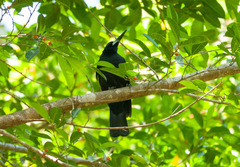
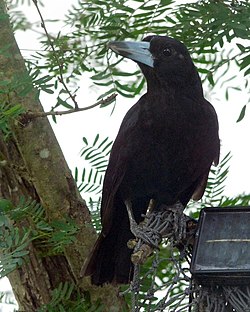
The black butcherbird (Melloria quoyi) is a species of butcherbird in the family Artamidae. It is found in Australia, Indonesia, and Papua New Guinea. Its natural habitats are subtropical or tropical dry forest, subtropical or tropical moist lowland forest, and subtropical or tropical mangrove forest.

Evidence was published in a 2013 molecular study which showed that it is closest relative to the Australian magpie (Gymnorhina tibicen). The ancestor to the two species is thought to have split from the other butcherbirds between 8.3 and 4.2 million years ago, during the late Miocene to early Pliocene, while the two species themselves diverged sometime during the Pliocene (5.8–3.0 million years ago).

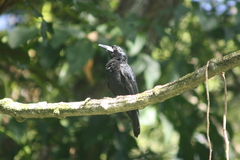
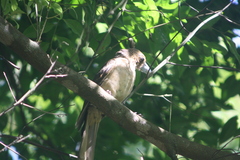
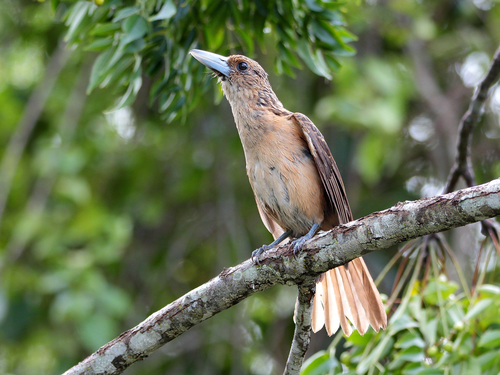
The adult is black all over except for its beak which is black-tipped grey. Most juveniles are rufous-brown. Confusingly, some juveniles are black while some brown young birds may rarely retain their brown colour into adulthood. As the only butcherbirds with wholly black bodies, they are sometimes confused with crows or currawongs, from which they are distinguished by their gray and hooked bills.

In Papua New Guinea, Black butcherbirds have... Wikipedia →
Global Distribution

Parks Where Found

# Park Country Daily sighting probability
1 Daintree National Park 🇦🇺 Australia
~70%
2 Raja Ampat 🇮🇩 Indonesia
~10%
3 Kakadu National Park 🇦🇺 Australia
<5%

Zoos & Centres Where Found

# Zoo / Centre Country
1 Detroit Zoo 🇺🇸 United States In captivity

Before you go

What are the chances of seeing a Black Butcherbird in Raja Ampat?

With luck

About 10% of wildlife watchers report a Black Butcherbird sighting in Raja Ampat on a given day, based on 117 verified sightings from GBIF citizen-science data from 2019 to 2026. It is the 92nd most-seen of the 200 birds we can rate there. Over three days the chance rises to about 30%, and over a week to about 50%, if each day is a fresh chance.

When is the best time to see a Black Butcherbird in Raja Ampat?

July

In that month about 20% of wildlife watchers report a Black Butcherbird in Raja Ampat on a given day, against under 5% in March–April and June, the lowest months. That is one of Raja Ampat's wettest months, with about 360 mm of rain against 180 mm in October.

What time of day is best to see a Black Butcherbird?

Between 3 and 6 pm

Across all the parks we cover, that three-hour window holds the most Black Butcherbird sightings with a recorded time, and about 9 in 10 of them come between 6 am and 6 pm: it is a daytime animal.

Is Raja Ampat the best place to see a Black Butcherbird?

2nd of 3

Of the 3 parks where we can rate Black Butcherbird sightings, Raja Ampat ranks 2nd at about 10%. The best odds are in Daintree National Park (Australia, about 70%).

Where does the Black Butcherbird sighting chance come from?

GBIF citizen-science records

It is estimated from how often the Black Butcherbird is recorded against all the birds logged in Raja Ampat (117 verified sightings from 2019 to 2026), calibrated against known sighting rates. Figures are rounded to the nearest 10% because citizen-science data supports honest approximations, not decimals, and months with records from fewer than five people show "—". How it works.

← Back to Raja Ampat