
Chestnut-breasted Cuckoo

Chestnut-breasted Cuckoo

Cacomantis castaneiventris

Silhouette: Nicolas Huet le Jeune and Jean-Gabriel Prêtre (vectorized by T. Michael Keesey) · PhyloPic

LCLeast ConcernNTVUENCR
Daily sighting probability <5% · Rare
at Raja Ampat

In 3 days <5% in a week ~10%

17 Verified sightings at Raja Ampat From 2019 to 2026
17 In 1 park
November Best month
☀️ Diurnal When it's spotted

About the Chestnut-breasted Cuckoo

The chestnut-breasted cuckoo (Cacomantis castaneiventris) is a species of cuckoo in the family Cuculidae. It is found in Australia, Indonesia, and Papua New Guinea. Its natural habitats are subtropical or tropical dry forests and subtropical or tropical mangrove forests.

Three subspecies are currently recognised: Cacomantis castaneiventris arfakianus (Salvadori, 1889) – Parts of western New Guinea. Cacomantis castaneiventris weiskei (Reichenow, 1900) – Eastern New Guinea. Cacomantis castaneiventris castaneiventris (Gould, 1867) – Aru Islands in Indonesia and the Cape York Peninsula in Australia.

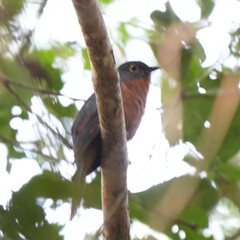
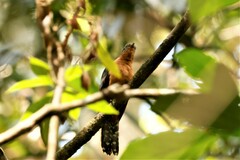
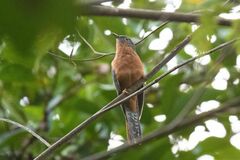
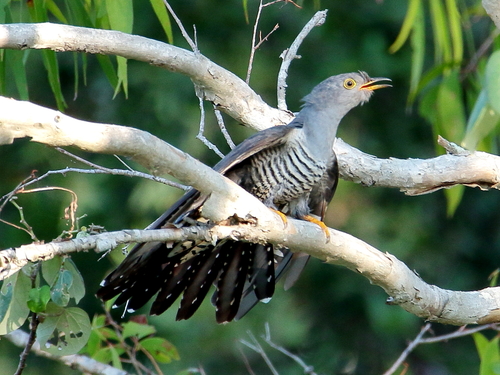
The chestnut-breasted cuckoo is about 22–25 centimetres (8.7–9.8 in) long. Adults have a dark slaty grey-blue head, back and wings, deep rufous breast and underparts and barred black and white tail. Immatures are dull greyish cinnamon on the head and wings, grading to dull mid brown on the outer parts of the wings, and pale buff or cinnamon on the breast and underparts. The tail is barred mid brown and white. Both adults and immatures have a yellow orbital eye ring.

The chestnut-breasted cuckoo is slightly smaller than the similar Sahul brush cuckoo (Cacomantis... Wikipedia →

Sounds

Call0:54

Australia · 2017

© Ken George · XC842884 · CC BY-NC-SA 4.0

Song0:30

Papua New Guinea · 1993

© Scott Connop · XC591557 · CC BY-NC-SA 4.0

Call0:56

Papua New Guinea · 2022

© Iain Woxvold · XC750388 · CC BY-NC-SA 4.0

Global Distribution

Parks Where Found

# Park Country Daily sighting probability
1 Raja Ampat 🇮🇩 Indonesia
<5%

More parks will be added in future updates.

Before you go

What are the chances of seeing a Chestnut-breasted Cuckoo in Raja Ampat?

Rare

Under 5% of wildlife watchers report a Chestnut-breasted Cuckoo sighting in Raja Ampat on a given day, based on 17 verified sightings from GBIF citizen-science data from 2019 to 2026. It is the 151st most-seen of the 200 birds we can rate there. Over three days the chance rises to under 5%, and over a week to about 10%, if each day is a fresh chance.

When is the best time to see a Chestnut-breasted Cuckoo in Raja Ampat?

November

In that month about 10% of wildlife watchers report a Chestnut-breasted Cuckoo in Raja Ampat on a given day, against under 5% in December to October, the lowest months.

What time of day is best to see a Chestnut-breasted Cuckoo?

Between 6 and 9 am

Across all the parks we cover, that three-hour window holds the most Chestnut-breasted Cuckoo sightings with a recorded time, and about 7 in 10 of them come between 6 am and 6 pm: it is a daytime animal.

Where else can you see a Chestnut-breasted Cuckoo?

Only Raja Ampat, in our data

Raja Ampat is the only park on Wallace's Line with enough records to rate Chestnut-breasted Cuckoo sightings: under 5% of wildlife watchers there report one on a given day.

Where does the Chestnut-breasted Cuckoo sighting chance come from?

GBIF citizen-science records

It is estimated from how often the Chestnut-breasted Cuckoo is recorded against all the birds logged in Raja Ampat (17 verified sightings from 2019 to 2026), calibrated against known sighting rates. Figures are rounded to the nearest 10% because citizen-science data supports honest approximations, not decimals, and months with records from fewer than five people show "—". How it works.

← Back to Raja Ampat