
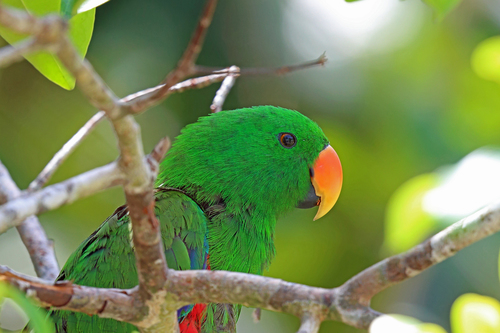
Little Bronze Cuckoo

Little Bronze Cuckoo

Chrysococcyx minutillus

Silhouette: Nicolas Huet le Jeune and Jean-Gabriel Prêtre (vectorized by T. Michael Keesey) · PhyloPic

Daily sighting probability <5% · Rare
at Raja Ampat

In 3 days ~10% in a week ~30%

44 Verified sightings at Raja Ampat From 2019 to 2026
446 In all 9 parks
September Best month
☀️ Diurnal When it's spotted

About the Little Bronze Cuckoo

The little bronze cuckoo (Chalcites minutillus) is a species of cuckoo in the family Cuculidae. It was formerly placed in the genus Chrysococcyx. It is a common brood parasite of birds from the genus Geryone. This cuckoo is found in Southeast Asia, New Guinea and some parts of Australia, where its natural habitat is subtropical or tropical moist lowland forest. It is the world's smallest cuckoo. The pied bronze cuckoo was formerly considered to be a subspecies. Other common names for the little bronze cuckoo include the red-eyed bronze cuckoo and the Malay green cuckoo. It has 11 subspecies which are generally recognized.

As the world's smallest cuckoo, the little bronze cuckoo measures 15-16 centimeters (5.9-6.3 in) in length and weighs 14.5-17.0 grams (0.51-0.60 oz). The females are slightly larger than the males. The generation length of the Little Bronze Cuckoo is approximately three years.

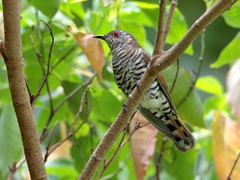
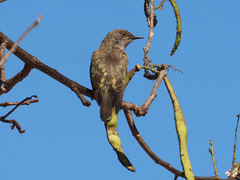
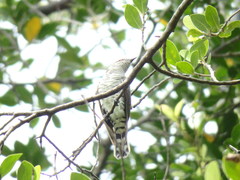
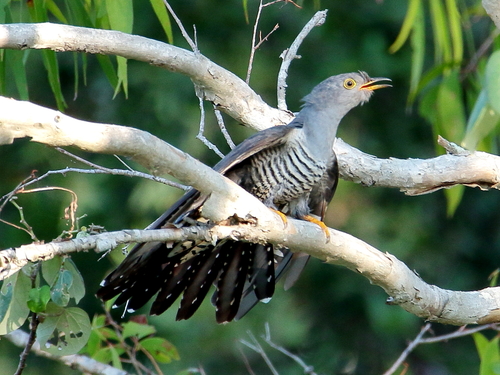
The little bronze cuckoo is characterized by its bronze-green upperparts, white underparts with dark barring, and a distinctive white spot behind the eye. It has a slender body and a long tail, allowing it to maneuver swiftly through dense vegetation. In flight, it is described... Wikipedia →

Sounds

Call0:29

Australia · 2023

© James Lambert · XC780393 · CC BY-NC-ND 4.0

Song0:11

Australia · 2013

© Marc Anderson · XC744777 · CC BY-NC-ND 4.0

Alarm call0:22

Malaysia · 2022

© Lim Ying Hien · XC738331 · CC BY-NC-ND 4.0

Global Distribution

Parks Where Found

# Park Country Daily sighting probability
1 Daintree National Park 🇦🇺 Australia
~10%
2 Kakadu National Park 🇦🇺 Australia
~10%
3 Litchfield National Park 🇦🇺 Australia
<5%
4 Way Kambas National Park 🇮🇩 Indonesia
<5%
5 Raja Ampat 🇮🇩 Indonesia
<5%
6 Taman Negara National Park 🇲🇾 Malaysia
<5%
7 Danum Valley Conservation Area 🇲🇾 Malaysia
<5%
8 Sepilok 🇲🇾 Malaysia
<5%
9 Lamington National Park 🇦🇺 Australia
<5%

Cities Where Found

# City Country Daily sighting probability
1 Davao City 🇵🇭 Philippines
~10%
2 Cebu City 🇵🇭 Philippines
<5%
3 Singapore 🇸🇬 Singapore
<5%
4 Kuala Lumpur 🇲🇾 Malaysia
<5%
5 Brisbane 🇦🇺 Australia
<5%

Before you go

What are the chances of seeing a Little Bronze Cuckoo in Raja Ampat?

Rare

Under 5% of wildlife watchers report a Little Bronze Cuckoo sighting in Raja Ampat on a given day, based on 44 verified sightings from GBIF citizen-science data from 2019 to 2026. It is the 127th most-seen of the 200 birds we can rate there. Over three days the chance rises to about 10%, and over a week to about 30%, if each day is a fresh chance.

When is the best time to see a Little Bronze Cuckoo in Raja Ampat?

August to November

In those months about 10% of wildlife watchers report a Little Bronze Cuckoo in Raja Ampat on a given day, against under 5% in December to July, the lowest months.

What time of day is best to see a Little Bronze Cuckoo?

Between 8 and 11 am

Across all the parks we cover, that three-hour window holds the most Little Bronze Cuckoo sightings with a recorded time, and about 9 in 10 of them come between 6 am and 6 pm: it is a daytime animal.

Which relatives of the Little Bronze Cuckoo live in Raja Ampat?

Same family: Cuculidae

The closest relatives of the Little Bronze Cuckoo that you can see in Raja Ampat (family Cuculidae, Cuckoos) are Rusty-breasted Cuckoo (about 20%) and Channel-billed Cuckoo (about 20%), with each one's daily chance of a sighting.

Where does the Little Bronze Cuckoo sighting chance come from?

GBIF citizen-science records

It is estimated from how often the Little Bronze Cuckoo is recorded against all the birds logged in Raja Ampat (44 verified sightings from 2019 to 2026), calibrated against known sighting rates. Figures are rounded to the nearest 10% because citizen-science data supports honest approximations, not decimals, and months with records from fewer than five people show "—". How it works.

← Back to Raja Ampat