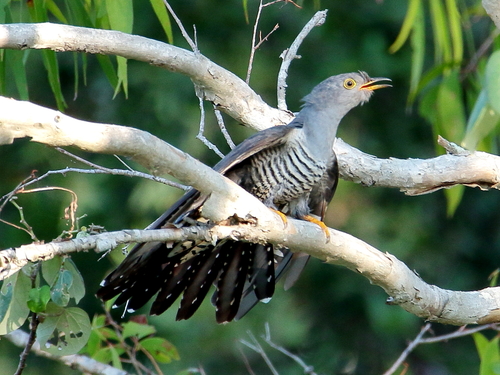
Long-billed Cuckoo

Long-billed Cuckoo

Chalcites megarhynchus

Daily sighting probability <5% · Rare
at Raja Ampat

In 3 days <5%

7 Verified sightings at Raja Ampat From 2019 to 2026
7 In 1 park
August Best month
☀️ Diurnal When it's spotted

About the Long-billed Cuckoo

The long-billed cuckoo (Chalcites megarhynchus) is a species of cuckoo in the family Cuculidae. Found in the Aru Islands and New Guinea, its natural habitats are subtropical or tropical moist lowland forests. This species was formerly placed in the genus Chrysococcyx.

The long-billed cuckoo is a medium-sized cuckoo, measuring 18 cm (7.1 in) in length and weighing approximately 31 g (1.1 oz). Adult males are characterized by dark brown upperparts, a black head, and dull greyish-brown underparts, along with a red eye-ring and iris, and a long, black bill with a drooping tip. Females differ with dark cinnamon upperparts, a dark grey-brown head, and a rufous buff, finely barred breast and belly, transitioning to cinnamon on the lower breast; their iris is dark brown with a narrow whitish outer ring. Juveniles exhibit cinnamon upperparts, a pale grey and brown face, a dark eye-ring, and a dark brown iris. Wikipedia →

Sounds

Song0:10

Papua New Guinea · 2011

© Iain Woxvold · XC558586 · CC BY-NC-SA 4.0

Global Distribution

Parks Where Found

# Park Country Daily sighting probability
1 Raja Ampat 🇮🇩 Indonesia
<5%

More parks will be added in future updates.

Before you go

What are the chances of seeing a Long-billed Cuckoo in Raja Ampat?

Rare

Under 5% of wildlife watchers report a Long-billed Cuckoo sighting in Raja Ampat on a given day, based on 7 verified sightings from GBIF citizen-science data from 2019 to 2026. It is the 182nd most-seen of the 200 birds we can rate there. Over three days the chance rises to under 5%, if each day is a fresh chance.

When is the best time to see a Long-billed Cuckoo in Raja Ampat?

Any time of year

In every month with enough records, under 5% of wildlife watchers report a Long-billed Cuckoo in Raja Ampat on a given day, so our monthly data shows no clear season.

What time of day is best to see a Long-billed Cuckoo?

Between 9 am and noon

Across all the parks we cover, that three-hour window holds the most Long-billed Cuckoo sightings with a recorded time, and about 8 in 10 of them come between 6 am and 6 pm: it is a daytime animal.

Where else can you see a Long-billed Cuckoo?

Only Raja Ampat, in our data

Raja Ampat is the only park on Wallace's Line with enough records to rate Long-billed Cuckoo sightings: under 5% of wildlife watchers there report one on a given day.

Which relatives of the Long-billed Cuckoo live in Raja Ampat?

Same family: Cuculidae

The closest relatives of the Long-billed Cuckoo that you can see in Raja Ampat (family Cuculidae, Cuckoos) are Rusty-breasted Cuckoo (about 20%) and Channel-billed Cuckoo (about 20%), with each one's daily chance of a sighting.

Where does the Long-billed Cuckoo sighting chance come from?

GBIF citizen-science records

It is estimated from how often the Long-billed Cuckoo is recorded against all the birds logged in Raja Ampat (7 verified sightings from 2019 to 2026), calibrated against known sighting rates. Figures are rounded to the nearest 10% because citizen-science data supports honest approximations, not decimals, and months with records from fewer than five people show "—". How it works.

← Back to Raja Ampat