Coconut Tree Snake

Coconut Tree Snake

Dendrelaphis calligaster

Silhouette: Alex Slavenko · PhyloPic

LCLeast ConcernNTVUENCR
Daily sighting probability ~20% · Possible
at Raja Ampat

In 3 days ~40% in a week ~70%

7 Verified sightings at Raja Ampat From 2019 to 2026
44 In all 2 parks
September Best month
🌅 Crepuscular When it's spotted

About the Coconut Tree Snake

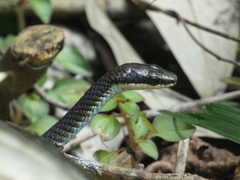
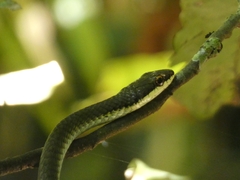
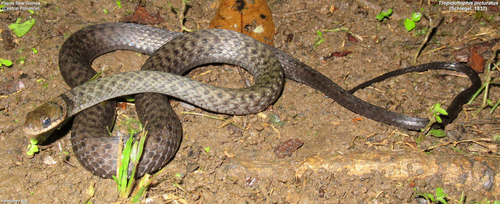
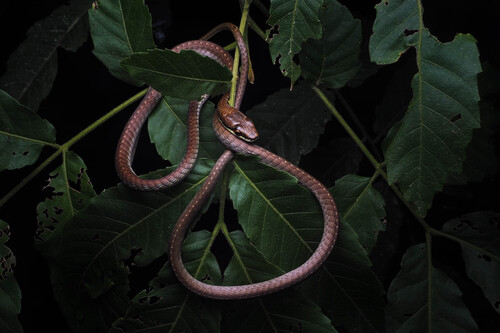
Dendrelaphis calligaster, also called green tree snake, northern green tree-snake, and northern tree snake, is a colubrid snake native to New Guinea, Australia, and Solomon Islands. It is a slender, large-eyed, non-venomous, diurnal snake, which grows up to 1.2 m in length and is greenish, brown, or greyish above with a cream or yellow belly.

This common snake is harmless, and readily recognised due to its cream to yellow belly and pronounced wide dark facial stripe passing across the eye. The specific name calligaster means "beautiful-bellied". In Australia, Dendrelaphis calligaster are found on the eastern side of the Cape York Peninsula (Queensland) as far south as Mackay. On the western side, their range is poorly mapped. They also occur on many of the Torres Strait Islands. On the New Guinea mainland, they are widespread at elevations below 1,150 m (3,770 ft) in both Indonesian and Papua New Guinean parts of the island. They occur also on many nearby islands. The Reptile Database also lists this species from the Solomons.

Dendrelaphis calligaster is primarily arboreal but can also forage on the ground. It can be found in rainforest... Wikipedia →
Global Distribution

Parks Where Found

# Park Country Daily sighting probability
1 Daintree National Park 🇦🇺 Australia
~20%
2 Raja Ampat 🇮🇩 Indonesia
~20%

Zoos & Centres Where Found

# Zoo / Centre Country
1 Allwetterzoo Münster 🇩🇪 Germany In captivity
2 Münster Zoo 🇩🇪 Germany In captivity

Before you go

What are the chances of seeing a Coconut Tree Snake in Raja Ampat?

Possible

About 20% of wildlife watchers report a Coconut Tree Snake sighting in Raja Ampat on a given day, based on 7 verified sightings from GBIF citizen-science data from 2019 to 2026. It is the 26th most-seen of the 33 reptiles we can rate there. Over three days the chance rises to about 40%, and over a week to about 70%, if each day is a fresh chance.

When is the best time to see a Coconut Tree Snake in Raja Ampat?

February and September–October

In those months about 30% of wildlife watchers report a Coconut Tree Snake in Raja Ampat on a given day, against under 5% in March–June, August and December–January, the lowest months.

What time of day is best to see a Coconut Tree Snake?

Between 3 and 6 am

Across all the parks we cover, that three-hour window holds the most Coconut Tree Snake sightings with a recorded time, and about 6 in 10 of them come between 6 pm and 6 am: it is most active around dawn and dusk.

Is Raja Ampat the best place to see a Coconut Tree Snake?

Among the best

Of the 2 parks where we can rate Coconut Tree Snake sightings, Raja Ampat ranks 2nd at about 20%, level with the leaders once rounded. The best odds are in Daintree National Park (Australia, about 20%).

Which relatives of the Coconut Tree Snake live in Raja Ampat?

Same family: Colubridae

The closest relatives of the Coconut Tree Snake that you can see in Raja Ampat (family Colubridae, Colubrid Snakes) are Brown Tree Snake (about 30%), Rainbow Ground Snake (about 20%) and Painted keelback (about 10%), with each one's daily chance of a sighting.

Where does the Coconut Tree Snake sighting chance come from?

GBIF citizen-science records

It is estimated from how often the Coconut Tree Snake is recorded against all the reptiles logged in Raja Ampat (7 verified sightings from 2019 to 2026), calibrated against known sighting rates. Figures are rounded to the nearest 10% because citizen-science data supports honest approximations, not decimals, and months with records from fewer than five people show "—". How it works.

← Back to Raja Ampat