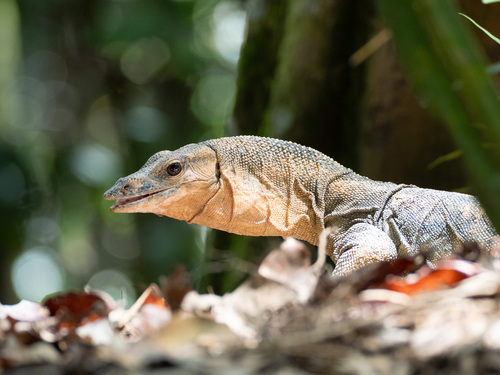
Ikaheka Snake

Ikaheka Snake

Micropechis ikaheca

Silhouette: SeismicShrimp · PhyloPic

Daily sighting probability ~10% · With luck
at Raja Ampat

In 3 days ~30% in a week ~60%

6 Verified sightings at Raja Ampat From 2019 to 2026
6 In 1 park
March Best month
☀️🌙 Day & Night When it's spotted

About the Ikaheka Snake

Micropechis ikaheca, commonly known as the New Guinea small-eyed snake or Ikaheka snake, is a highly venomous elapid, the only species in the genus Micropechis. The holotype was collected at Doré (modern day Manokwari) on the Vogelkop of Netherlands New Guinea, and described in 1829, by the naturalist on board the French Navy vessel La Coquille, ship's surgeon René Primevère Lesson, in a volume of the three-year circumnavigation (1922-1925) by Louis Isidore Duperrey, captain of La Coquille. Lesson's holotype is housed in the collection of the Muséum National d'Histoire Naturelle, in Paris, with the museum accession no. MNHN 7669.

It is known as sataw in the Kalam language of Papua New Guinea. Micropechis ikaheca is endemic to New Guinea and adjacent islands, notably Karkar Island, Madang Province, in Papua New Guinea, where it is particularly common and referred to as the "white snake" due to its pale coloring. It is also found on neighboring Manam Island, and Walis Island in East Sepik Province, Papua New Guinea. In Indonesia, other than Western New Guinea, they can also be found on the Biak Islands, Raja Ampat Islands, and Aru Islands. Wikipedia →


Global Distribution

Parks Where Found

# Park Country Daily sighting probability
1 Raja Ampat 🇮🇩 Indonesia
~10%

More parks will be added in future updates.

Zoos & Centres Where Found

# Zoo / Centre Country
1 Downtown Aquarium, Houston 🇺🇸 United States In captivity

Before you go

What are the chances of seeing an Ikaheka Snake in Raja Ampat?

With luck

About 10% of wildlife watchers report an Ikaheka Snake sighting in Raja Ampat on a given day, based on 6 verified sightings from GBIF citizen-science data from 2019 to 2026. It is the 30th most-seen of the 33 reptiles we can rate there. Over three days the chance rises to about 30%, and over a week to about 60%, if each day is a fresh chance.

When is the best time to see an Ikaheka Snake in Raja Ampat?

March

In that month about 30% of wildlife watchers report an Ikaheka Snake in Raja Ampat on a given day, against under 5% in April, June–July, September–October and December–February, the lowest months.

What time of day is best to see an Ikaheka Snake?

Between 8 and 11 pm

Across all the parks we cover, that three-hour window holds the most Ikaheka Snake sightings with a recorded time, and about 6 in 10 of them come between 6 pm and 6 am: it is seen both by day and at night.

Where else can you see an Ikaheka Snake?

Only Raja Ampat, in our data

Raja Ampat is the only park on Wallace's Line with enough records to rate Ikaheka Snake sightings: about 10% of wildlife watchers there report one on a given day.

Where does the Ikaheka Snake sighting chance come from?

GBIF citizen-science records

It is estimated from how often the Ikaheka Snake is recorded against all the reptiles logged in Raja Ampat (6 verified sightings from 2019 to 2026), calibrated against known sighting rates. Figures are rounded to the nearest 10% because citizen-science data supports honest approximations, not decimals, and months with records from fewer than five people show "—". How it works.

← Back to Raja Ampat