Northern Cassowary

Northern Cassowary

Casuarius unappendiculatus

Silhouette: PhyloPic

LCLeast ConcernNTVUENCR
Daily sighting probability <5% · Rare
at Raja Ampat

In 3 days <5%

5 Verified sightings at Raja Ampat From 2019 to 2026
5 In 1 park
March Best month
☀️ Diurnal When it's spotted

About the Northern Cassowary

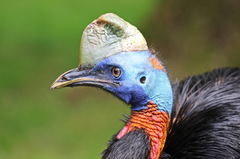
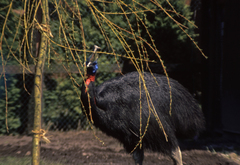
The northern cassowary (Casuarius unappendiculatus), also known as the one-wattled cassowary, single-wattled cassowary, or golden-necked cassowary, is a large, stocky flightless bird of northern New Guinea. It is one of the three living species of cassowary, alongside the dwarf cassowary and the southern cassowary. It is a ratite, a polyphyletic group of flightless Paleognaths, which includes birds like the ostrich and emu.

Edward Blyth first identified the northern cassowary from a specimen from an aviary located in Calcutta, India, in 1860. It is the most recently discovered of all the cassowary species. The genus name Casuarius is derived from the Malay word kesuari "cassowary", while the species name unappendiculatus refers to the species' single wattle. Officially, there are no subspecies, though some authors list several subspecies.

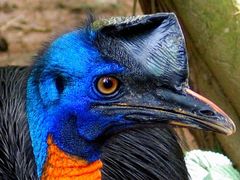
The northern cassowary has a hard and stiff black plumage, blue facial skin and a casque on top of the head. In 2026, scientists discovered that northern cassowary casques glow under UV light, and in different pattterns than southern cassowary casques. It has a bright red or yellow coloured neck and wattle. The feet... Wikipedia →

Sounds

Call0:30

Indonesia · 2019

© Marc Anderson · XC498017 · CC BY-NC-ND 4.0

Call0:10

Papua New Guinea · 2011

© Iain Woxvold · XC558583 · CC BY-NC-SA 4.0

Call0:07

Indonesia · 2013

© Frank Lambert · XC209609 · CC BY-NC-ND 4.0

Global Distribution

Parks Where Found

# Park Country Daily sighting probability
1 Raja Ampat 🇮🇩 Indonesia
<5%

More parks will be added in future updates.

Zoos & Centres Where Found

# Zoo / Centre Country
1 Walsrode World Bird Park 🇩🇪 Germany In captivity
2 Taman Safari Indonesia 🇮🇩 Indonesia In captivity
3 Taman Safari Bogor 🇮🇩 Indonesia In captivity
4 Khao Kheow Open Zoo 🇹🇭 Thailand In captivity
5 Parque y Zoológico Nacional Arquitecto Manuel Valverde Podestá 🇩🇴 Dominican Republic In captivity
6 Safari World 🇹🇭 Thailand In captivity
7 Fonghuanggu Bird and Ecology Park 🇹🇼 Taiwan In captivity
8 Dierenpark Hoenderdaell 🇳🇱 Netherlands In captivity
9 Europaradise Park 🇵🇹 Portugal In captivity
10 Bandung Zoo 🇮🇩 Indonesia In captivity
11 Bird Paradise 🇸🇬 Singapore In captivity
12 Rainforest Wild Asia 🇸🇬 Singapore In captivity
13 Avilon Zoo 🇵🇭 Philippines In captivity
14 Rainforest Habitat 🇵🇬 Papua New Guinea In captivity
15 Bali Bird Park 🇮🇩 Indonesia In captivity
16 Davao Crocodile Park & Zoo 🇵🇭 Philippines In captivity
17 Sea World Indonesia 🇮🇩 Indonesia In captivity
18 Port Moresby Nature Park 🇵🇬 Papua New Guinea In captivity

Before you go

What are the chances of seeing a Northern Cassowary in Raja Ampat?

Rare

Under 5% of wildlife watchers report a Northern Cassowary sighting in Raja Ampat on a given day, based on 5 verified sightings from GBIF citizen-science data from 2019 to 2026. It is the 191st most-seen of the 200 birds we can rate there. Over three days the chance rises to under 5%, if each day is a fresh chance.

When is the best time to see a Northern Cassowary in Raja Ampat?

Any time of year

In every month with enough records, under 5% of wildlife watchers report a Northern Cassowary in Raja Ampat on a given day, so our monthly data shows no clear season.

What time of day is best to see a Northern Cassowary?

Between 7 and 10 am

Across all the parks we cover, that three-hour window holds the most Northern Cassowary sightings with a recorded time, and about 8 in 10 of them come between 6 am and 6 pm: it is a daytime animal.

Where else can you see a Northern Cassowary?

Only Raja Ampat, in our data

Raja Ampat is the only park on Wallace's Line with enough records to rate Northern Cassowary sightings: under 5% of wildlife watchers there report one on a given day.

Where does the Northern Cassowary sighting chance come from?

GBIF citizen-science records

It is estimated from how often the Northern Cassowary is recorded against all the birds logged in Raja Ampat (5 verified sightings from 2019 to 2026), calibrated against known sighting rates. Figures are rounded to the nearest 10% because citizen-science data supports honest approximations, not decimals, and months with records from fewer than five people show "—". How it works.

← Back to Raja Ampat