Fanaloka

Fanaloka

Fossa fossana

Silhouette: Margot Michaud · PhyloPic

LCNTVUVulnerableENCR Endemic
Daily sighting probability ~40% · Likely
at Ranomafana National Park

In 3 days ~80% in a week >90%

27 Verified sightings at Ranomafana National Park From 2019 to 2026
27 In 1 park
October Best month
☀️ Diurnal When it's spotted

About the Fanaloka

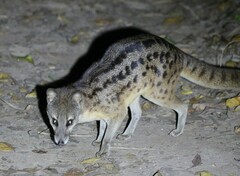
The Malagasy civet or striped civet (Fossa fossana), also known as the spotted fanaloka or simply fanaloka (Malagasy, [fə̥ˈnaluk]) or jabady, is an euplerid endemic to Madagascar. It is the only species in genus Fossa. The Malagasy civet is a small mammal, about 47 centimetres (19 in) long excluding the tail (which is only about 20 centimetres (7.9 in)). It can weigh 1.5 to 2.0 kilograms (3.3 to 4.4 lb). It is endemic to the tropical forests of Madagascar. Malagasy civets are nocturnal. It eats small vertebrates, insects, aquatic animals, and eggs stolen from birds' nests. The mating season of the Malagasy civet is August to September and the gestation period is three months, ending with the birth of one young. The Malagasy civet is listed as Vulnerable by International Union for Conservation of Nature (IUCN).

The Malagasy name fanaloka is related to the Malay word pelanduk "mousedeer" (via metathesis) likely due to their similar sizes and silhouette. The Malagasy civet was to be placed in the subfamily Hemigalinae with the banded palm civets and then in its own subfamily, Fossinae, because of similarities with others in the group pointed out by Gregory, but it... Wikipedia →

Global Distribution

Parks Where Found

# Park Country Daily sighting probability
1 Ranomafana National Park 🇲🇬 Madagascar
~40%

More parks will be added in future updates.

Zoos & Centres Where Found

# Zoo / Centre Country
1 Nashville Zoo at Grassmere 🇺🇸 United States In captivity

Before you go

What are the chances of seeing a Fanaloka in Ranomafana National Park?

Likely

About 40% of wildlife watchers report a Fanaloka sighting in Ranomafana National Park on a given day, based on 27 verified sightings from GBIF citizen-science data from 2019 to 2026. It is the 10th most-seen of the 14 mammals we can rate there. Over three days the chance rises to about 80%, and over a week to over 90%, if each day is a fresh chance.

When is the best time to see a Fanaloka in Ranomafana National Park?

October

In that month about 60% of wildlife watchers report a Fanaloka in Ranomafana National Park on a given day, against under 5% in April and December–January, the lowest months. That is one of Ranomafana National Park's driest months, with about 130 mm of rain against 450 mm in January.

What time of day is best to see a Fanaloka?

Between 3 and 6 pm

Across all the parks we cover, that three-hour window holds the most Fanaloka sightings with a recorded time, and about 7 in 10 of them come between 6 am and 6 pm: it is a daytime animal.

Where else can you see a Fanaloka?

Only Ranomafana National Park, in our data

Ranomafana National Park is the only park on Wallace's Line with enough records to rate Fanaloka sightings: about 40% of wildlife watchers there report one on a given day.

Where does the Fanaloka sighting chance come from?

GBIF citizen-science records

It is estimated from how often the Fanaloka is recorded against all the mammals logged in Ranomafana National Park (27 verified sightings from 2019 to 2026), calibrated against known sighting rates. Figures are rounded to the nearest 10% because citizen-science data supports honest approximations, not decimals, and months with records from fewer than five people show "—". How it works.

← Back to Ranomafana National Park