


Completed


Milne-Edwards' Sifaka
Propithecus edwardsi
Silhouette: Terpsichores · PhyloPic
- KingdomAnimalia (Animals)
- PhylumChordata (Chordates)
- ClassMammalia (Mammals)
- OrderPrimates
- FamilyIndriidae (Indris, Sifakas, and Woolly Lemurs)
- GenusPropithecus (Sifakas)
- SpeciesPropithecus edwardsi (Milne-Edwards' Sifaka)
In 3 days >90%
179 Verified sightings at Ranomafana National Park From 2019 to 2026
179 In 1 park
August Best month
☀️ Diurnal When it's spotted


About the Milne-Edwards' Sifaka
Milne-Edwards's sifaka (Propithecus edwardsi), or Milne-Edwards's simpona, is a large arboreal, diurnal lemur endemic to the eastern coastal rainforest of Madagascar. Milne-Edwards's sifaka is characterized by a black body with a light-colored "saddle" on the lower part of its back. It is closely related to the diademed sifaka, and was until recently considered a subspecies of it. Like all sifakas, it is a primate in the family Indriidae.
The species' name honors French zoologist Henri Milne-Edwards (1800–1885). Milne-Edwards's sifaka is categorized as endangered by the IUCN, and is listed in CITES Appendix I. As of 2008, there were estimated to be approximately 28,600 individuals left with only about 3,500 of those remaining in protected areas. It remains threatened by habitat loss, hunting and may be sensitive to a changing climate.
Milne-Edwards's sifaka is the second largest species in Propithecus, and one of the larger diurnal lemur species overall. The average weight of a male Milne-Edwards's sifaka is 5.90 kg (13.0 lb) and for females it is 6.30 kg (13.9 lb). The body length excluding the tail is 47.6 cm (18.7 in) for males... Wikipedia →
Recent sightings of Milne-Edwards' Sifaka in Ranomafana National Park
LIVEiNaturalistGlobal Distribution
Parks Where Found
| # | Park | Country | Daily sighting probability |
|---|---|---|---|
| 1 | Ranomafana National Park | 🇲🇬 Madagascar |
More parks will be added in future updates.
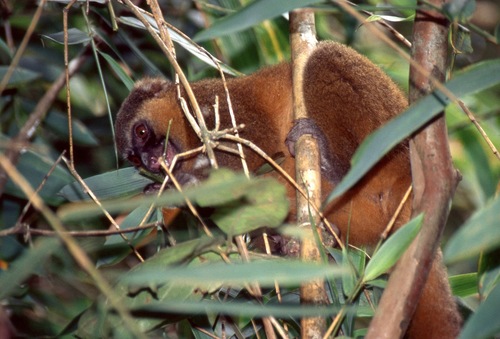
Closest Relatives at Ranomafana National Park




Before you go
What are the chances of seeing a Milne-Edwards' Sifaka in Ranomafana National Park?
Very likely
About 70% of wildlife watchers report a Milne-Edwards' Sifaka sighting in Ranomafana National Park on a given day, based on 179 verified sightings from GBIF citizen-science data from 2019 to 2026. It is the 2nd most-seen of the 14 mammals we can rate there. Over three days the chance rises to over 90%, if each day is a fresh chance.
When is the best time to see a Milne-Edwards' Sifaka in Ranomafana National Park?
May–June, August, October and December–January
In those months about 80% of wildlife watchers report a Milne-Edwards' Sifaka in Ranomafana National Park on a given day, against about 10% in February, the lowest month.
What time of day is best to see a Milne-Edwards' Sifaka?
Between 8 and 11 am
Across all the parks we cover, that three-hour window holds the most Milne-Edwards' Sifaka sightings with a recorded time, and about 9 in 10 of them come between 6 am and 6 pm: it is a daytime animal.
Where else can you see a Milne-Edwards' Sifaka?
Only Ranomafana National Park, in our data
Ranomafana National Park is the only park on Wallace's Line with enough records to rate Milne-Edwards' Sifaka sightings: about 70% of wildlife watchers there report one on a given day.
Where does the Milne-Edwards' Sifaka sighting chance come from?
GBIF citizen-science records
It is estimated from how often the Milne-Edwards' Sifaka is recorded against all the mammals logged in Ranomafana National Park (179 verified sightings from 2019 to 2026), calibrated against known sighting rates. Figures are rounded to the nearest 10% because citizen-science data supports honest approximations, not decimals, and months with records from fewer than five people show "—". How it works.
