


Completed


Red-fronted Brown Lemur
Eulemur rufifrons
Silhouette: Yan Wong · PhyloPic
- KingdomAnimalia (Animals)
- PhylumChordata (Chordates)
- ClassMammalia (Mammals)
- OrderPrimates
- FamilyLemuridae (Typical Lemurs)
- GenusEulemur (Brown Lemurs)
- SpeciesEulemur rufifrons (Red-fronted Brown Lemur)
In 3 days >90%
138 Verified sightings at Ranomafana National Park From 2019 to 2026
138 In 1 park
June Best month
☀️ Diurnal When it's spotted


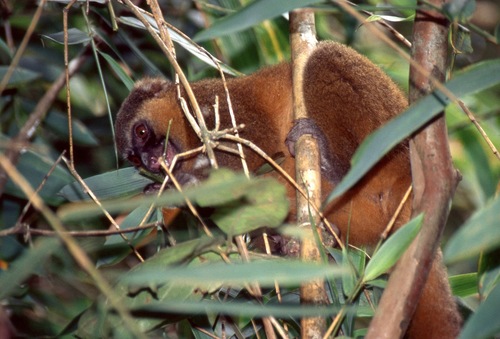
About the Red-fronted Brown Lemur
The red-fronted lemur (Eulemur rufifrons), also known as the red-fronted brown lemur or southern red-fronted brown lemur, is a species of lemur from Madagascar. Until 2001, it was considered a subspecies of the common brown lemur, E. fulvus. In 2001, E. fulvus was split into several separate species, including Eulemur rufus, in which this species was included. In 2008, E. rufus was split into two species, the red lemur (E. rufus) and the red-fronted lemur (E. rufifrons). E. rufus covers the population on the west coast north of the Tsiribihina River and E. rufifrons covers the population on the west coast south of the Tsiribihina River and the population in eastern Madagascar. The species split was based on genetic and morphological evidence. Mitochondrial DNA analysis indicates that E. rufifrons may be more closely related to the common brown lemur (E. fulvus), white-headed lemur (E. albifrons) and Sanford's brown lemur (E. sanfordi) than it is to E. rufus.
The red-fronted lemur lives on the western coast of Madagascar between the Tsiribihina River to the north and south of the Fiheranana River and in eastern Madagascar from the Mangoro River and Onive River to the Andringitra Massif. It lives in dry lowland forests. It has a head and body length of 35 to 48 centimetres (14 to 19 in) and with a 45 to 55 centimetres (18 to 22 in) tail. Its weight ranges between 2.2 and 2.3 kilograms (4.9 and 5.1 lb). It has a gray coat and black face, muzzle and forehead, plus a black line from the muzzle to the forehead, with white eyebrow patches. It displays sexual dimorphism with the males having white or cream colored cheeks and beards, while females having rufous or cream cheeks and beards that are less bushy than males.
There is considerable geographic variation in the natural history of this species. Western populations tend to have smaller home ranges and higher population densities than eastern populations, although group size tends to be fairly consistent (generally 4–18 animals, averaging 8–9). None of the studied populations show dominance hierarchies and aggression tends to be low.
Diet is diverse, encompassing leaves, seeds, fruit, nectar and flowers, but more so in eastern populations. Western populations tend to rely more on leaves for their diet. Western populations are primarily diurnal, but increase nocturnal activity during the dry season, while eastern populations show less such dichotomy.
Reproduction is seasonal. Wikipedia →
Recent sightings of Red-fronted Brown Lemur in Ranomafana National Park
LIVEiNaturalistGlobal Distribution
Parks Where Found
| # | Park | Country | Daily sighting probability |
|---|---|---|---|
| 1 | Ranomafana National Park | 🇲🇬 Madagascar |
More parks will be added in future updates.
Zoos & Centres Where Found
| # | Zoo / Centre | Country | |
|---|---|---|---|
| 1 | Calgary Zoo | 🇨🇦 Canada | |
| 2 | Zoologischer Garten Magdeburg | 🇩🇪 Germany | |
| 3 | Valencia Bioparc | 🇪🇸 Spain | |
| 4 | Lemurs Park | 🇲🇬 Madagascar | |
| 5 | Lemur Island | 🇲🇬 Madagascar | |
| 6 | Cougar Mountain Zoo | 🇺🇸 United States |
Closest Relatives at Ranomafana National Park




Before you go
What are the chances of seeing a Red-fronted Brown Lemur in Ranomafana National Park?
Very likely
About 70% of wildlife watchers report a Red-fronted Brown Lemur sighting in Ranomafana National Park on a given day, based on 138 verified sightings from GBIF citizen-science data from 2019 to 2026. It is the 3rd most-seen of the 14 mammals we can rate there. Over three days the chance rises to over 90%, if each day is a fresh chance.
When is the best time to see a Red-fronted Brown Lemur in Ranomafana National Park?
June, August and October
In those months about 80% of wildlife watchers report a Red-fronted Brown Lemur in Ranomafana National Park on a given day, against about 40% in July, the lowest month.
What time of day is best to see a Red-fronted Brown Lemur?
Between 8 and 11 am
Across all the parks we cover, that three-hour window holds the most Red-fronted Brown Lemur sightings with a recorded time, and about 8 in 10 of them come between 6 am and 6 pm: it is a daytime animal.
Where else can you see a Red-fronted Brown Lemur?
Only Ranomafana National Park, in our data
Ranomafana National Park is the only park on Wallace's Line with enough records to rate Red-fronted Brown Lemur sightings: about 70% of wildlife watchers there report one on a given day.
Where does the Red-fronted Brown Lemur sighting chance come from?
GBIF citizen-science records
It is estimated from how often the Red-fronted Brown Lemur is recorded against all the mammals logged in Ranomafana National Park (138 verified sightings from 2019 to 2026), calibrated against known sighting rates. Figures are rounded to the nearest 10% because citizen-science data supports honest approximations, not decimals, and months with records from fewer than five people show "—". How it works.
