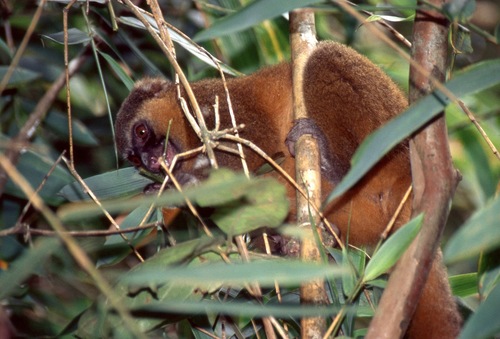
Malagasy Ring-tailed Mongoose

Malagasy Ring-tailed Mongoose

Galidia elegans

Silhouette: Margot Michaud · PhyloPic

LCLeast ConcernNTVUENCR Endemic
Daily sighting probability ~70% · Very likely
at Ranomafana National Park

In 3 days >90%

69 Verified sightings at Ranomafana National Park From 2019 to 2026
69 In 1 park
August Best month
☀️ Diurnal When it's spotted

About the Malagasy Ring-tailed Mongoose

The ring-tailed vontsira (Galidia elegans), locally still known as the ring-tailed mongoose, is a euplerid in the subfamily Galidiinae, a carnivoran native to Madagascar. It is the only species in the genus Galidia. There is much disagreement about the placement of Madagascar's carnivores, including the ring-tailed vontsira, within the phylogenetic tree. A 2003 study reported evidence that the Malagasy Carnivora evolved from a single herpestid ancestor.

A monotypic genus, Galidia literally means "little weasel", being a diminutive form of galē (γαλῆ, "weasel" in ancient Greek). Its local common name is vontsira mena, 'red vontsira' in Malagasy. The ring-tailed vontsira is relatively small but is the largest member of the subfamily Galidiinae. It is usually 32 to 38 cm (12.5 to 15 in) long and weighs only 700 to 900 g (25 to 32 oz). Its body is long and slender, and the rounded head has a pointed snout. The body is a dark red color and the feet are black. As the name implies, its bushy tail is covered with black and red rings and is similar to the red panda.

Ring-tailed vontsira are very agile, and good climbers. They are quite playful... Wikipedia →

Global Distribution

Parks Where Found

# Park Country Daily sighting probability
1 Ranomafana National Park 🇲🇬 Madagascar
~70%

More parks will be added in future updates.

Zoos & Centres Where Found

# Zoo / Centre Country
1 Bronx Zoo 🇺🇸 United States In captivity
2 Berlin Zoological Garden 🇩🇪 Germany In captivity
3 Allwetterzoo Münster 🇩🇪 Germany In captivity
4 Münster Zoo 🇩🇪 Germany In captivity
5 Łódź Zoo 🇵🇱 Poland In captivity
6 Dierenpark Zie-ZOO 🇳🇱 Netherlands In captivity
7 Aquarium Berlin 🇩🇪 Germany In captivity

Before you go

What are the chances of seeing a Malagasy Ring-tailed Mongoose in Ranomafana National Park?

Very likely

About 70% of wildlife watchers report a Malagasy Ring-tailed Mongoose sighting in Ranomafana National Park on a given day, based on 69 verified sightings from GBIF citizen-science data from 2019 to 2026. It is the 4th most-seen of the 14 mammals we can rate there. Over three days the chance rises to over 90%, if each day is a fresh chance.

When is the best time to see a Malagasy Ring-tailed Mongoose in Ranomafana National Park?

June to September

In those months about 80% of wildlife watchers report a Malagasy Ring-tailed Mongoose in Ranomafana National Park on a given day, against about 10% in February, April–May and December, the lowest months. Those are among Ranomafana National Park's driest months, with about 110 mm of rain a month against 450 mm in January.

What time of day is best to see a Malagasy Ring-tailed Mongoose?

Between 9 am and noon

Across all the parks we cover, that three-hour window holds the most Malagasy Ring-tailed Mongoose sightings with a recorded time, and about 9 in 10 of them come between 6 am and 6 pm: it is a daytime animal.

Where else can you see a Malagasy Ring-tailed Mongoose?

Only Ranomafana National Park, in our data

Ranomafana National Park is the only park on Wallace's Line with enough records to rate Malagasy Ring-tailed Mongoose sightings: about 70% of wildlife watchers there report one on a given day.

Where does the Malagasy Ring-tailed Mongoose sighting chance come from?

GBIF citizen-science records

It is estimated from how often the Malagasy Ring-tailed Mongoose is recorded against all the mammals logged in Ranomafana National Park (69 verified sightings from 2019 to 2026), calibrated against known sighting rates. Figures are rounded to the nearest 10% because citizen-science data supports honest approximations, not decimals, and months with records from fewer than five people show "—". How it works.

← Back to Ranomafana National Park