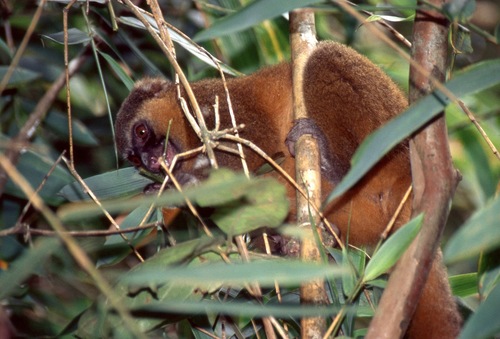
Small-toothed Sportive Lemur

Small-toothed Sportive Lemur

Lepilemur microdon

Silhouette: Zhengwei Xie · PhyloPic

LCNTVUENEndangeredCR Endemic
Daily sighting probability ~30% · Possible
at Ranomafana National Park

In 3 days ~70% in a week ~90%

16 Verified sightings at Ranomafana National Park From 2019 to 2026
16 In 1 park
July Best month
☀️ Diurnal When it's spotted

About the Small-toothed Sportive Lemur

The small-toothed sportive lemur (Lepilemur microdon), or small-toothed weasel lemur, is a primate species in the family Lepilemuridae that—like all extant lemurs—is endemic to Madagascar. The species lives in dense rainforest in southeastern Madagascar, and can be found in Ranomafana and Andringitra National Parks. Described in 1894, it was considered either a subspecies or taxonomic synonym of the weasel sportive lemur (Lepilemur mustelinus) throughout most of the 20th century. Phylogenetic studies not only support its species status, but also suggest that it is the only eastern Malagasy sportive lemur that is more closely related to western than to other eastern species.

According to the original description, some of its teeth are smaller than those in other sportive lemurs. It is relatively large for a sportive lemur, and is difficult to visually distinguish from the weasel sportive lemur. The species weighs between 0.9 and 1.2 kg (2.0 and 2.6 lb) and measures 55 to 64 cm (22 to 25 in) from head to tail. Its fur is mostly reddish-brown or chestnut color, with a dark stripe running from its head down its back. Its underside and neck are lighter in color. Like other sportive lemurs, it is nocturnal, sleeping in concealed tangles of vegetation as well as tree holes. The small-toothed sportive lemur is solitary and eats leaves, fruits, and flowers.

Due to recent taxonomic changes and a lack of clarity about its population size and range, it was listed as "data deficient" by the International Union for Conservation of Nature (IUCN) in 2008. This was changed to "endangered" in 2014, on the basis of a small, fragmented and shrinking range, as well as a declining population. It is also protected from international commercial trade under CITES Appendix I. Its primary threats are habitat loss to slash-and-burn agriculture and hunting. Wikipedia →

Global Distribution

Parks Where Found

# Park Country Daily sighting probability
1 Ranomafana National Park 🇲🇬 Madagascar
~30%

More parks will be added in future updates.

Before you go

What are the chances of seeing a Small-toothed Sportive Lemur in Ranomafana National Park?

Possible

About 30% of wildlife watchers report a Small-toothed Sportive Lemur sighting in Ranomafana National Park on a given day, based on 16 verified sightings from GBIF citizen-science data from 2019 to 2026. It is the 12th most-seen of the 14 mammals we can rate there. Over three days the chance rises to about 70%, and over a week to about 90%, if each day is a fresh chance.

When is the best time to see a Small-toothed Sportive Lemur in Ranomafana National Park?

July

In that month about 60% of wildlife watchers report a Small-toothed Sportive Lemur in Ranomafana National Park on a given day, against under 5% in April–June and December–January, the lowest months. That is one of Ranomafana National Park's driest months, with about 110 mm of rain against 450 mm in January.

What time of day is best to see a Small-toothed Sportive Lemur?

Between 8 and 11 am

Across all the parks we cover, that three-hour window holds the most Small-toothed Sportive Lemur sightings with a recorded time, and about 9 in 10 of them come between 6 am and 6 pm: it is a daytime animal.

Where else can you see a Small-toothed Sportive Lemur?

Only Ranomafana National Park, in our data

Ranomafana National Park is the only park on Wallace's Line with enough records to rate Small-toothed Sportive Lemur sightings: about 30% of wildlife watchers there report one on a given day.

Which relatives of the Small-toothed Sportive Lemur live in Ranomafana National Park?

Same order: Primates

The closest relatives of the Small-toothed Sportive Lemur that you can see in Ranomafana National Park (order Primates) are Golden Bamboo Lemur (about 80%), Milne-Edwards' Sifaka (about 70%) and Red-fronted Brown Lemur (about 70%), with each one's daily chance of a sighting.

Where does the Small-toothed Sportive Lemur sighting chance come from?

GBIF citizen-science records

It is estimated from how often the Small-toothed Sportive Lemur is recorded against all the mammals logged in Ranomafana National Park (16 verified sightings from 2019 to 2026), calibrated against known sighting rates. Figures are rounded to the nearest 10% because citizen-science data supports honest approximations, not decimals, and months with records from fewer than five people show "—". How it works.

← Back to Ranomafana National Park