


Completed



Eastern Lesser Bamboo Lemur
Hapalemur griseus
Silhouette: T. Michael Keesey · PhyloPic
- KingdomAnimalia (Animals)
- PhylumChordata (Chordates)
- ClassMammalia (Mammals)
- OrderPrimates
- FamilyLemuridae (Typical Lemurs)
- GenusHapalemur (Bamboo Lemurs)
- SpeciesHapalemur griseus (Eastern Lesser Bamboo Lemur)
In 3 days ~80% in a week >90%
38 Verified sightings at Ranomafana National Park From 2019 to 2026
208 In all 2 parks
June Best month
☀️ Diurnal When it's spotted


About the Eastern Lesser Bamboo Lemur
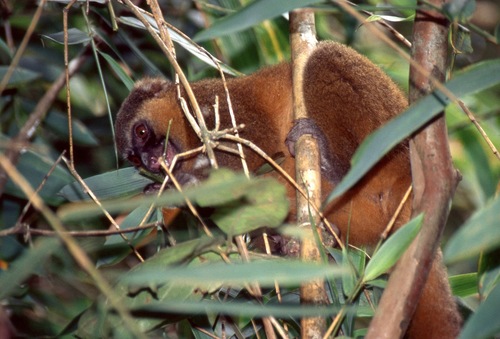
The eastern lesser bamboo lemur (Hapalemur griseus), also known as the gray bamboo lemur, the gray gentle lemur, and the Mahajanga lemur is a small lemur endemic to Madagascar, with three known subspecies. As its name suggests, the eastern lesser bamboo lemur feeds mainly on bamboo. The lemurs of the genus Hapalemur have more manual dexterity and hand–eye coordination than most lemurs. They are vertical climbers and jump from stalk to stalk in thick bamboo forests.
The eastern lesser bamboo lemur (Hapalemur griseus griseus), also known as the gray bamboo lemur, eastern gray bamboo lemur, or gray gentle lemur, was the original species described in 1795 by Johann Heinrich Friedrich Link. It is grey in colour, sometimes with a red patch on its head. It averages 284 mm (11 in) in length with a tail of 370 mm (14.6 in), and a mass of 0.8 kg. Based on data from more than one hundred transect surveys which took place between 2004 and 2009, the population is estimated to be declining. There is an estimated 818 individuals in Ranomafana National Park and the decline in numbers is due to hunting and habitat loss. It is listed by the Convention... Wikipedia →
Recent sightings of Eastern Lesser Bamboo Lemur in Ranomafana National Park
LIVEiNaturalistGlobal Distribution
Parks Where Found
| # | Park | Country | Daily sighting probability |
|---|---|---|---|
| 1 | Mantadia National Park | 🇲🇬 Madagascar | |
| 2 | Ranomafana National Park | 🇲🇬 Madagascar |
Zoos & Centres Where Found
| # | Zoo / Centre | Country | |
|---|---|---|---|
| 1 | Parken Zoo | 🇸🇪 Sweden | |
| 2 | Botanical and Zoological Garden of Tsimbazaza | 🇲🇬 Madagascar | |
| 3 | Lemurs Park | 🇲🇬 Madagascar | |
| 4 | Lemur Island | 🇲🇬 Madagascar |
Closest Relatives at Ranomafana National Park


Before you go
What are the chances of seeing an Eastern Lesser Bamboo Lemur in Ranomafana National Park?
Likely
About 50% of wildlife watchers report an Eastern Lesser Bamboo Lemur sighting in Ranomafana National Park on a given day, based on 38 verified sightings from GBIF citizen-science data from 2019 to 2026. It is the 9th most-seen of the 14 mammals we can rate there. Over three days the chance rises to about 80%, and over a week to over 90%, if each day is a fresh chance.
When is the best time to see an Eastern Lesser Bamboo Lemur in Ranomafana National Park?
June and September
In those months about 60% of wildlife watchers report an Eastern Lesser Bamboo Lemur in Ranomafana National Park on a given day, against about 10% in March, the lowest month. Those are among Ranomafana National Park's driest months, with about 120 mm of rain a month against 450 mm in January.
What time of day is best to see an Eastern Lesser Bamboo Lemur?
Between 8 and 11 am
Across all the parks we cover, that three-hour window holds the most Eastern Lesser Bamboo Lemur sightings with a recorded time, and about 8 in 10 of them come between 6 am and 6 pm: it is a daytime animal.
Is Ranomafana National Park the best place to see an Eastern Lesser Bamboo Lemur?
2nd of 2
Of the 2 parks where we can rate Eastern Lesser Bamboo Lemur sightings, Ranomafana National Park ranks 2nd at about 50%. The best odds are in Mantadia National Park (Madagascar, about 80%).
Where does the Eastern Lesser Bamboo Lemur sighting chance come from?
GBIF citizen-science records
It is estimated from how often the Eastern Lesser Bamboo Lemur is recorded against all the mammals logged in Ranomafana National Park (38 verified sightings from 2019 to 2026), calibrated against known sighting rates. Figures are rounded to the nearest 10% because citizen-science data supports honest approximations, not decimals, and months with records from fewer than five people show "—". How it works.
