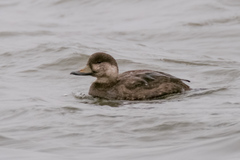
Black Scoter

Black Scoter

Melanitta americana

Silhouette: Sheatherius · PhyloPic

LCNTNear ThreatenedVUENCR
Daily sighting probability ~10% · With luck
at Redwood National Park

In 3 days ~10% in a week ~30%

106 Verified sightings at Redwood National Park From 2019 to 2026
3,884 In all 13 parks
March Best month
☀️ Diurnal When it's spotted

About the Black Scoter

The black scoter or American scoter (Melanitta americana) is a large sea duck, 43 to 49 cm (17 to 19 in) in length. The genus name is derived from Ancient Greek melas "black" and netta "duck". The species name is from the Latin for "American".

Together with the common scoter M. nigra, it forms the subgenus Oidemia; the two are sometimes considered conspecific, the black scoter then being referred to as M. nigra americana. Its French name, used in parts of its Canadian range, is macreuse noire (also meaning "black scoter"). The species is listed as Near Threatened by the IUCN.

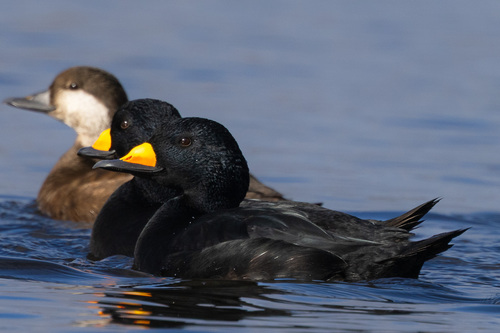
This large sea duck is characterised by its bulky shape and large bill. The adult male is all black with a very bulbous bill which is mostly yellow. The female is a brown bird with pale cheeks, very similar to female common scoter. The adult female averages about 980 g (2.16 lb) and 45 cm (18 in) in length, while the adult male is on average 1,100 g (2.4 lb) and 49 cm (19 in) in length.

This species can be distinguished from other scoters, apart from common scoter, by the lack of white anywhere on the drake, and the more extensive pale areas on the female. The black scoter... Wikipedia →
Sounds

Song1:09

Russian Federation · 2019

© Jens Kirkeby · XC486622 · CC BY-NC-SA 4.0

Call0:07

Canada · 2015

© Martin St-Michel · XC320517 · CC BY-NC-SA 4.0

Call0:16

United States · 2013

© Andrew Spencer · XC140734 · CC BY-NC-SA 3.0

Global Distribution

Parks Where Found

# Park Country Daily sighting probability
1 Acadia National Park 🇺🇸 United States
~20%
2 Cape Breton Highlands National Park 🇨🇦 Canada
~10%
3 Great Bear Rainforest 🇨🇦 Canada
~10%
4 Redwood National Park 🇺🇸 United States
~10%
5 Katmai National Park 🇺🇸 United States
<5%
6 Gros Morne National Park 🇨🇦 Canada
<5%
7 Merritt Island National Wildlife Refuge 🇺🇸 United States
<5%
8 Point Pelee National Park 🇨🇦 Canada
<5%
9 Pacific Rim National Park Reserve 🇨🇦 Canada
<5%
10 Olympic National Park 🇺🇸 United States
<5%
11 Denali National Park 🇺🇸 United States
<5%
12 Channel Islands National Park 🇺🇸 United States
<5%
13 Everglades National Park 🇺🇸 United States
<5%

Cities Where Found

# City Country Daily sighting probability
1 Miami 🇺🇸 United States
<5%
2 Seattle 🇺🇸 United States
<5%
3 Boston 🇺🇸 United States
<5%
4 Montreal 🇨🇦 Canada
<5%
5 New York City 🇺🇸 United States
<5%
6 Osaka 🇯🇵 Japan
<5%
7 San Francisco 🇺🇸 United States
<5%
8 Chicago 🇺🇸 United States
<5%
9 Vancouver 🇨🇦 Canada
<5%
10 Nagoya 🇯🇵 Japan
<5%

Zoos & Centres Where Found

# Zoo / Centre Country
1 Montreal Biodome 🇨🇦 Canada In captivity

Before you go

What are the chances of seeing a Black Scoter in Redwood National Park?

With luck

About 10% of wildlife watchers report a Black Scoter sighting in Redwood National Park on a given day, based on 106 verified sightings from GBIF citizen-science data from 2019 to 2026. It is the 113th most-seen of the 226 birds we can rate there. Over three days the chance rises to about 10%, and over a week to about 30%, if each day is a fresh chance.

When is the best time to see a Black Scoter in Redwood National Park?

March

In that month about 20% of wildlife watchers report a Black Scoter in Redwood National Park on a given day, against under 5% in April to September, the lowest months. That is one of Redwood National Park's wettest months, with about 270 mm of rain against almost none in July.

What time of day is best to see a Black Scoter?

Between noon and 3 pm

Across all the parks we cover, that three-hour window holds the most Black Scoter sightings with a recorded time, and about 8 in 10 of them come between 6 am and 6 pm: it is a daytime animal.

Which relatives of the Black Scoter live in Redwood National Park?

Same genus: Melanitta

The closest relatives of the Black Scoter that you can see in Redwood National Park (genus Melanitta, Scoters) are Surf Scoter (about 30%) and American White-winged Scoter (about 10%), with each one's daily chance of a sighting.

Where does the Black Scoter sighting chance come from?

GBIF citizen-science records

It is estimated from how often the Black Scoter is recorded against all the birds logged in Redwood National Park (106 verified sightings from 2019 to 2026), calibrated against known sighting rates. Figures are rounded to the nearest 10% because citizen-science data supports honest approximations, not decimals, and months with records from fewer than five people show "—". How it works.

← Back to Redwood National Park