Surf Scoter

Surf Scoter

Melanitta perspicillata

Silhouette: Sheatherius · PhyloPic

LCLeast ConcernNTVUENCR
Daily sighting probability ~30% · Possible
at Redwood National Park

In 3 days ~60% in a week ~90%

712 Verified sightings at Redwood National Park From 2019 to 2026
10,596 In all 21 parks
January Best month
☀️ Diurnal When it's spotted

About the Surf Scoter

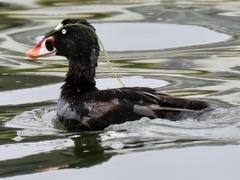
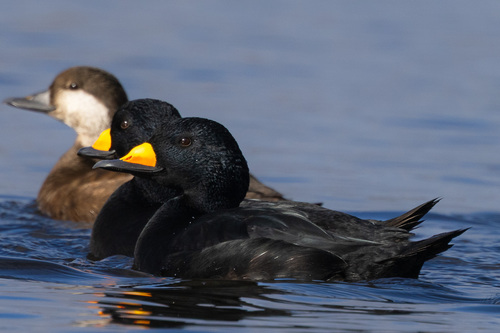
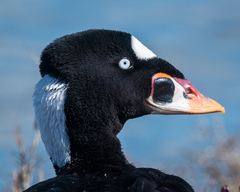
The surf scoter (Melanitta perspicillata) is a large sea duck native to North America. Adult males are almost entirely black with characteristic white patches on the forehead and the nape and adult females are slightly smaller and browner. Surf scoters breed in Northern Canada and Alaska and winter along the Pacific and Atlantic coasts of North America. They are diving ducks and mainly feed on benthic invertebrates, mussels representing an important part of their diet.

In 1750 the English naturalist George Edwards included an illustration and a description of the surf scoter in the third volume of his A Natural History of Uncommon Birds. He used the English name "The great black duck from Hudson's Bay". Edwards based his hand-coloured etching on a preserved specimen that had been brought to London from the Hudson Bay area of Canada by James Isham. When in 1758 the Swedish naturalist Carl Linnaeus updated his Systema Naturae for the tenth edition, he placed the surf scoter with the ducks and geese in the genus Anas. Linnaeus included a brief description, coined the binomial name Anas perspicillata and cited Edwards' work. The surf scoter is now one of six species placed... Wikipedia →

Sounds

Wing noise0:05

United States · 2019

© Bruce Lagerquist · XC452395 · CC BY-NC-SA 4.0

Wing noise and display0:24

United States · 2011

© Andrew Spencer · XC76453 · CC BY-NC-ND 2.5

Call0:30

Canada · 2015

© Martin St-Michel · XC295513 · CC BY-NC-SA 4.0

Global Distribution

Parks Where Found

# Park Country Daily sighting probability
1 Pacific Rim National Park Reserve 🇨🇦 Canada
~40%
2 Great Bear Rainforest 🇨🇦 Canada
~30%
3 Redwood National Park 🇺🇸 United States
~30%
4 Channel Islands National Park 🇺🇸 United States
~20%
5 Olympic National Park 🇺🇸 United States
~20%
6 El Vizcaíno Biosphere Reserve 🇲🇽 Mexico
~20%
7 Kenai Fjords National Park 🇺🇸 United States
~20%
8 Acadia National Park 🇺🇸 United States
~10%
9 Cape Breton Highlands National Park 🇨🇦 Canada
~10%
10 Katmai National Park 🇺🇸 United States
~10%
11 Kluane National Park 🇨🇦 Canada
~10%
12 Point Pelee National Park 🇨🇦 Canada
~10%
13 Wrangell-St. Elias National Park 🇺🇸 United States
~10%
14 Jasper National Park 🇨🇦 Canada
<5%
15 Bahía de Loreto National Park 🇲🇽 Mexico
<5%
16 Elk Island National Park 🇨🇦 Canada
<5%
17 Gros Morne National Park 🇨🇦 Canada
<5%
18 Denali National Park 🇺🇸 United States
<5%
19 Merritt Island National Wildlife Refuge 🇺🇸 United States
<5%
20 Banff National Park 🇨🇦 Canada
<5%
21 Grand Canyon National Park 🇺🇸 United States
<5%

Cities Where Found

# City Country Daily sighting probability
1 Seattle 🇺🇸 United States
~10%
2 San Diego 🇺🇸 United States
~10%
3 San Francisco 🇺🇸 United States
~10%
4 Tijuana 🇲🇽 México
~10%
5 Boston 🇺🇸 United States
~10%
6 Vancouver 🇨🇦 Canada
~10%
7 Los Angeles 🇺🇸 United States
~10%
8 Miami 🇺🇸 United States
<5%
9 Anchorage 🇺🇸 United States
<5%
10 New York City 🇺🇸 United States
<5%

Zoos & Centres Where Found

# Zoo / Centre Country
1 Montreal Biodome 🇨🇦 Canada In captivity

Before you go

What are the chances of seeing a Surf Scoter in Redwood National Park?

Possible

About 30% of wildlife watchers report a Surf Scoter sighting in Redwood National Park on a given day, based on 712 verified sightings from GBIF citizen-science data from 2019 to 2026. It is the 20th most-seen of the 226 birds we can rate there. Over three days the chance rises to about 60%, and over a week to about 90%, if each day is a fresh chance.

When is the best time to see a Surf Scoter in Redwood National Park?

November to January

In those months about 50% of wildlife watchers report a Surf Scoter in Redwood National Park on a given day, against about 10% in July, the lowest month. Those are among Redwood National Park's wettest months, with about 330 mm of rain a month against almost none in July.

What time of day is best to see a Surf Scoter?

Between 2 and 5 pm

Across all the parks we cover, that three-hour window holds the most Surf Scoter sightings with a recorded time, and about 9 in 10 of them come between 6 am and 6 pm: it is a daytime animal.

Which relatives of the Surf Scoter live in Redwood National Park?

Same genus: Melanitta

The closest relatives of the Surf Scoter that you can see in Redwood National Park (genus Melanitta, Scoters) are American White-winged Scoter (about 10%) and Black Scoter (about 10%), with each one's daily chance of a sighting.

Where does the Surf Scoter sighting chance come from?

GBIF citizen-science records

It is estimated from how often the Surf Scoter is recorded against all the birds logged in Redwood National Park (712 verified sightings from 2019 to 2026), calibrated against known sighting rates. Figures are rounded to the nearest 10% because citizen-science data supports honest approximations, not decimals, and months with records from fewer than five people show "—". How it works.

← Back to Redwood National Park