Arctic Blue

Arctic Blue

Agriades glandon

Daily sighting probability ~10% · With luck
at Riding Mountain National Park

In 3 days ~20% in a week ~40%

14 Verified sightings at Riding Mountain National Park From 2019 to 2026
348 In all 11 parks
June Best month
☀️ Diurnal When it's spotted

About the Arctic Blue

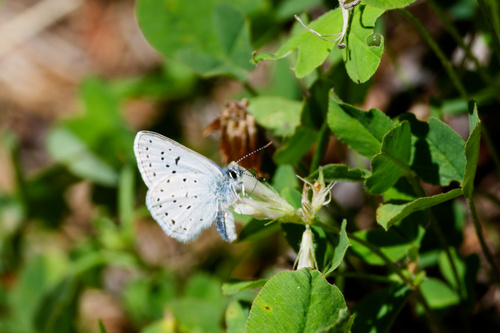
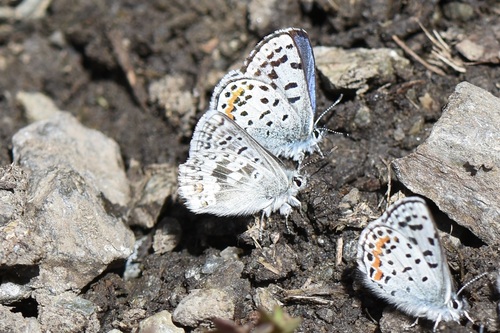
Agriades glandon, the Arctic blue or Glandon blue, is a species of butterfly in the family Lycaenidae. It in found in Eurasia and North America. In North America, this species is found from Alaska east to Newfoundland, south through the mountains to Washington, northern Arizona, and northern New Mexico. In Europe, it is found in mountainous areas like the Pyrenees and Alps, as well as the far north. It is also found in parts of Russia, including Siberia, and Kamchatka. Its habitats include arctic tundra, subarctic and subalpine forests, mountain meadows, and bogs.

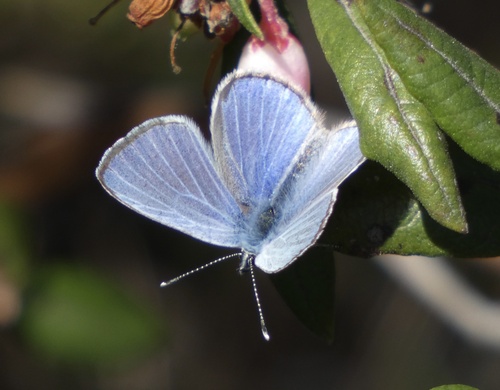
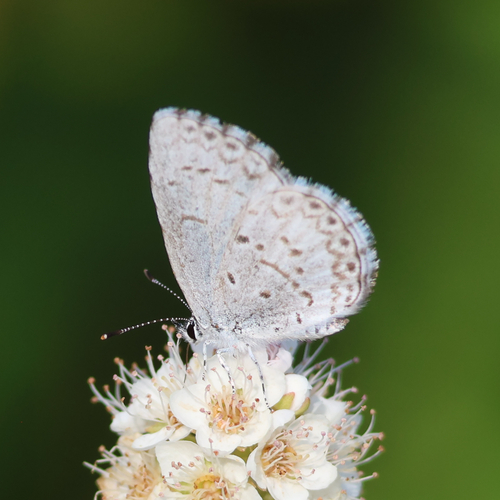
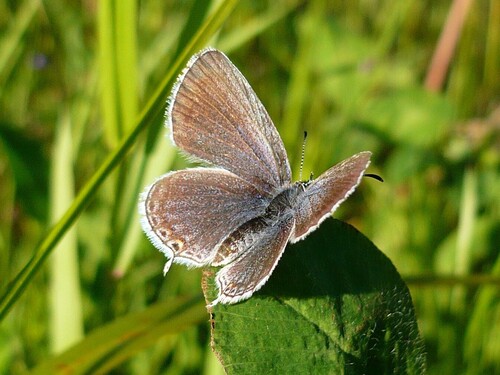
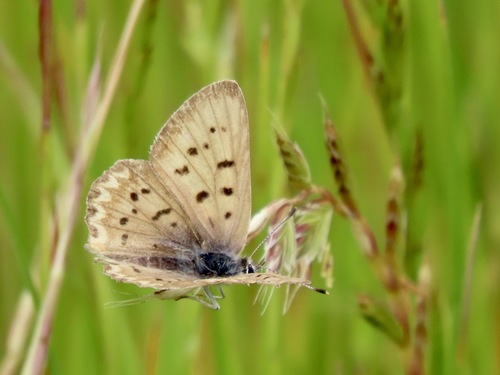
The wingspan is 17–26 mm. The male wing uppersides are silver-coloured, steely blue or pale shining blue and become increasingly brown towards the edges. The female wing uppersides are almost entirely brown but with a slightly bluish pollination in the basal region. The incidence of darkening increases with altitude. All wings usually have small, dark disk spots that are sometimes surrounded by white. Both sexes have white-rimmed black dots on the pale grey-brown ground of the forewing underside, while the underside of the hind wings reveals striking white spots and occasionally orange-colored... Wikipedia →
Global Distribution

Parks Where Found

# Park Country Daily sighting probability
1 Vanoise National Park 🇫🇷 France
~20%
2 Mercantour National Park 🇫🇷 France
~20%
3 Rocky Mountain National Park 🇺🇸 United States
~10%
4 Glacier National Park 🇺🇸 United States
~10%
5 Olympic National Park 🇺🇸 United States
~10%
6 Banff National Park 🇨🇦 Canada
~10%
7 Ecrins National Park 🇫🇷 France
~10%
8 Riding Mountain National Park 🇨🇦 Canada
~10%
9 Grand Canyon National Park 🇺🇸 United States
~10%
10 Yellowstone National Park 🇺🇸 United States
~10%
11 Pyrénées National Park 🇫🇷 France
<5%

Before you go

What are the chances of seeing an Arctic Blue in Riding Mountain National Park?

With luck

About 10% of wildlife watchers report an Arctic Blue sighting in Riding Mountain National Park on a given day, based on 14 verified sightings from GBIF citizen-science data from 2019 to 2026. It is the 66th most-seen of the 104 insects we can rate there. Over three days the chance rises to about 20%, and over a week to about 40%, if each day is a fresh chance.

When is the best time to see an Arctic Blue in Riding Mountain National Park?

June

In that month about 20% of wildlife watchers report an Arctic Blue in Riding Mountain National Park on a given day, against under 5% in July to April, the lowest months. That is one of Riding Mountain National Park's wettest months, with about 100 mm of rain against 20 mm in February.

What time of day is best to see an Arctic Blue?

Between 10 am and 1 pm

Across all the parks we cover, that three-hour window holds the most Arctic Blue sightings with a recorded time, and about 9 in 10 of them come between 6 am and 6 pm: it is a daytime animal.

Which relatives of the Arctic Blue live in Riding Mountain National Park?

Same family: Lycaenidae

The closest relatives of the Arctic Blue that you can see in Riding Mountain National Park (family Lycaenidae, Gossamer-winged Butterflies) are Silvery Blue (about 20%), Northern Azure (about 10%) and Elkalyce amyntula (about 10%), with each one's daily chance of a sighting.

Where does the Arctic Blue sighting chance come from?

GBIF citizen-science records

It is estimated from how often the Arctic Blue is recorded against all the insects logged in Riding Mountain National Park (14 verified sightings from 2019 to 2026), calibrated against known sighting rates. Figures are rounded to the nearest 10% because citizen-science data supports honest approximations, not decimals, and months with records from fewer than five people show "—". How it works.

← Back to Riding Mountain National Park