About the White-Marked Tussock Moth
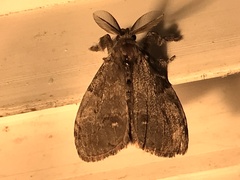
Orgyia leucostigma, the white-marked tussock moth, is a moth in the family Erebidae. The species was first described by James Edward Smith in 1797. The caterpillar is very common especially in late summer in eastern North America, extending as far west as Texas, California, and Alberta.
The genus name Orgyia is from the ancient Greek word ὄργυια, órgyia - 'outstretched arms'. So named because, when at rest, the moth stretches forward its forelegs like arms. Two or more generations occur per year in eastern North America. They overwinter in the egg stage.
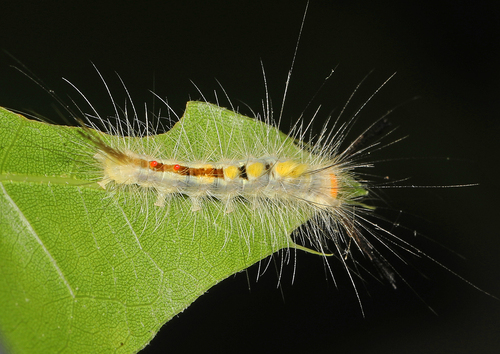
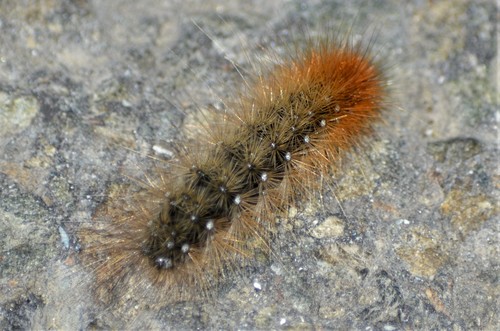
Eggs are laid in a single mass over the cocoon of the female, and covered in a froth. Up to 300 eggs are laid at a time. The larvae are brightly colored, with tufts of hair-like setae. The head is bright red and the body has yellow or white stripes, with a black stripe along the middle of the back. Bright red defensive glands are seen on the hind end of the back. Four white toothbrush-like tufts stand out from the back, and a gray-brown hair pencil is at the hind end. The four white tufts on the larva's back may mimic the cocoons of parasitic wasps. Touching the hairs sets off... Wikipedia →