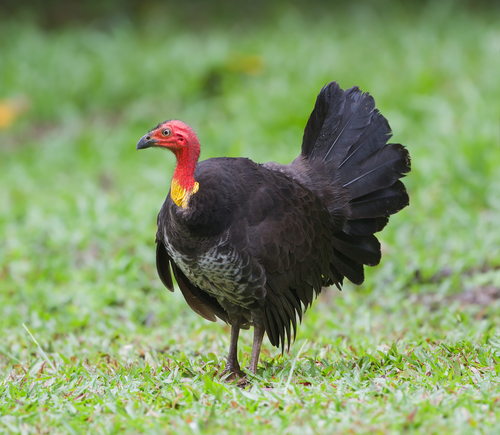
Australian Brush-turkey

Australian Brush-turkey

Alectura lathami

Silhouette: Jorgo Ristevski · PhyloPic

LCLeast ConcernNTVUENCR Endemic
Daily sighting probability <5% · Rare
at Royal National Park

In 3 days <5% in a week ~10%

61 Verified sightings at Royal National Park From 2019 to 2026
5,412 In all 6 parks
March Best month
☀️ Diurnal When it's spotted

About the Australian Brush-turkey

The Australian brushturkey, Australian brush-turkey, or gweela (Alectura lathami), also commonly called the bush turkey, scrub turkey, or just brushturkey, is a large mound-building bird of the family Megapodiidae. It is found in eastern Australia, ranging from Far North Queensland to the south coast of New South Wales, and has also been introduced to Kangaroo Island in South Australia. It is the largest living member of the Megapodiidae and one of three species native to Australia.

Despite its name and superficial resemblance to other birds, the Australian brushturkey is not closely related to the American turkey or the Australian bustard (which is also known locally as the bush turkey in central Australia). Its closest relatives are the wattled brushturkey, Waigeo brushturkey, and malleefowl.

The range of the Australian brushturkey extends from the top of Cape York to approximately the area around Wollongong. The Australian brushturkey inhabits rainforests and wet sclerophyll forests, as well as drier scrubs and open areas. It lives in both mountainous and lowland areas. In the northern part of its range, the Australian brushturkey is most common at... Wikipedia →
Sounds

Recording0:34

Australia · 2022

© Mike FitzGerald · XC734158 · CC BY-NC-SA 4.0

Call0:36

Australia · 2022

© Marc Anderson · XC733319 · CC BY-NC-ND 4.0

Call0:25

Australia · 2021

© nick talbot · XC694790 · CC BY-NC-SA 4.0

Global Distribution

Parks Where Found

# Park Country Daily sighting probability
1 Lamington National Park 🇦🇺 Australia
~80%
2 Noosa National Park 🇦🇺 Australia
~60%
3 Springbrook National Park 🇦🇺 Australia
~40%
4 Daintree National Park 🇦🇺 Australia
~20%
5 Royal National Park 🇦🇺 Australia
<5%
6 Blue Mountains National Park 🇦🇺 Australia
<5%

Cities Where Found

# City Country Daily sighting probability
1 Brisbane 🇦🇺 Australia
~40%
2 Sydney 🇦🇺 Australia
~20%

Zoos & Centres Where Found

# Zoo / Centre Country
1 Basel Zoo 🇨🇭 Switzerland In captivity
2 Australia Zoo 🇦🇺 Australia In captivity
3 Healesville Sanctuary 🇦🇺 Australia In captivity
4 Fort Worth Zoo 🇺🇸 United States In captivity
5 Taronga Zoo 🇦🇺 Australia In captivity
6 Currumbin Wildlife Sanctuary 🇦🇺 Australia In captivity
7 Ueno Zoo 🇯🇵 Japan In captivity
8 Billabong Sanctuary 🇦🇺 Australia In captivity
9 Ipswich Nature Centre 🇦🇺 Australia In captivity
10 Wild Life Sydney 🇦🇺 Australia In captivity

Before you go

What are the chances of seeing an Australian Brush-turkey in Royal National Park?

Rare

Under 5% of wildlife watchers report an Australian Brush-turkey sighting in Royal National Park on a given day, based on 61 verified sightings from GBIF citizen-science data from 2019 to 2026. It is the 130th most-seen of the 178 birds we can rate there. Over three days the chance rises to under 5%, and over a week to about 10%, if each day is a fresh chance.

When is the best time to see an Australian Brush-turkey in Royal National Park?

Any time of year

In every month with enough records, under 5% of wildlife watchers report an Australian Brush-turkey in Royal National Park on a given day, so our monthly data shows no clear season.

What time of day is best to see an Australian Brush-turkey?

Between 10 am and 1 pm

Across all the parks we cover, that three-hour window holds the most Australian Brush-turkey sightings with a recorded time, and nearly all of them come between 6 am and 6 pm: it is a daytime animal.

Where does the Australian Brush-turkey sighting chance come from?

GBIF citizen-science records

It is estimated from how often the Australian Brush-turkey is recorded against all the birds logged in Royal National Park (61 verified sightings from 2019 to 2026), calibrated against known sighting rates. Figures are rounded to the nearest 10% because citizen-science data supports honest approximations, not decimals, and months with records from fewer than five people show "—". How it works.

← Back to Royal National Park