Delicate Skink

Delicate Skink

Lampropholis delicata

Silhouette: Michael Scroggie · PhyloPic

LCLeast ConcernNTVUENCR
Daily sighting probability ~20% · Possible
at Royal National Park

In 3 days ~40% in a week ~80%

26 Verified sightings at Royal National Park From 2019 to 2026
82 In all 4 parks
March Best month
☀️ Diurnal When it's spotted

About the Delicate Skink

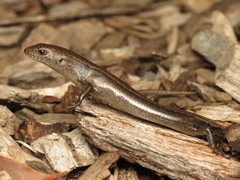
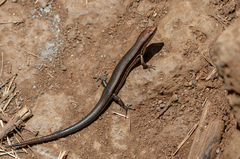
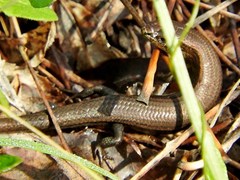
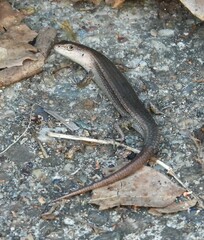
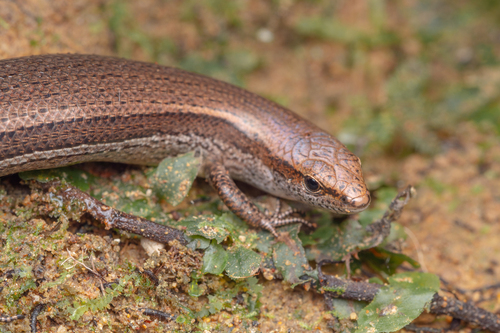
Lampropholis delicata, the delicate skink, dark-flecked garden sun skink, garden skink, delicate garden skink, rainbow skink or plague skink, or the metallic skink is native to Australia and invasive in New Zealand and Hawaii where it is commonly found in gardens. The species is known for their color dimorphism between males and females; striped morphs and non-striped morphs exist in this species, however the stripe is less pronounced in males. This species' diet consists of a wide range of prey, such as spiders, bees, larvae, and termites. Mating occurs in the late summer and generally one clutch of 2 to 4 eggs are laid per year by each female.

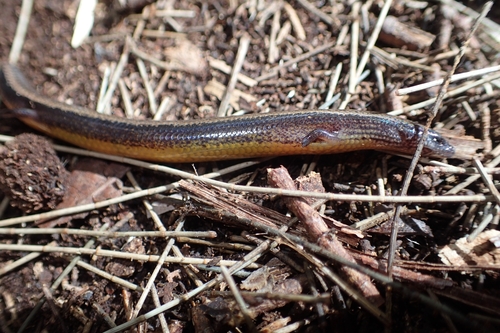
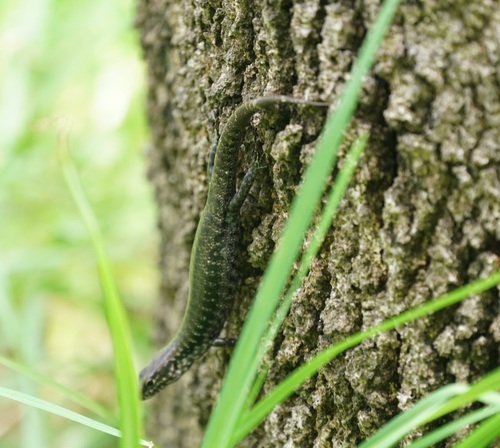
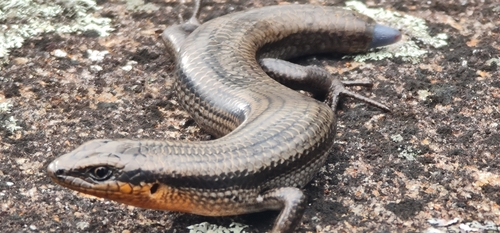
The delicate skink is more common in suburban gardens than in adjacent native bushland. It has a moderate body with a medium length, slender tail. Its scales are smooth. The back and sides are greyish-brown to rich brown, often with darker and paler flecks. A narrow yellowish-brown stripe is usually present on the outer edge of the back. The species can also have two distinct forms: a prominent white stripe and a less prominent white stripe. This dimorphism is not strictly distinguished by gender.

Lampropholis... Wikipedia →
Global Distribution

Parks Where Found

# Park Country Daily sighting probability
1 Royal National Park 🇦🇺 Australia
~20%
2 Blue Mountains National Park 🇦🇺 Australia
~10%
3 Lamington National Park 🇦🇺 Australia
~10%
4 Springbrook National Park 🇦🇺 Australia
~10%

Cities Where Found

# City Country Daily sighting probability
1 Auckland 🇳🇿 New Zealand
~50%
2 Sydney 🇦🇺 Australia
~20%
3 Brisbane 🇦🇺 Australia
~20%
4 Perth 🇦🇺 Australia
~10%
5 Melbourne 🇦🇺 Australia
~10%

Closest Relatives at Royal National Park

Before you go

What are the chances of seeing a Delicate Skink in Royal National Park?

Possible

About 20% of wildlife watchers report a Delicate Skink sighting in Royal National Park on a given day, based on 26 verified sightings from GBIF citizen-science data from 2019 to 2026. It is the 18th most-seen of the 37 reptiles we can rate there. Over three days the chance rises to about 40%, and over a week to about 80%, if each day is a fresh chance.

When is the best time to see a Delicate Skink in Royal National Park?

March and August

In those months about 30% of wildlife watchers report a Delicate Skink in Royal National Park on a given day, against under 5% in June and July, the lowest months.

What time of day is best to see a Delicate Skink?

Between 11 am and 2 pm

Across all the parks we cover, that three-hour window holds the most Delicate Skink sightings with a recorded time, and about 9 in 10 of them come between 6 am and 6 pm: it is a daytime animal.

Is Royal National Park the best place to see a Delicate Skink?

Yes

Of the 4 parks where we can rate Delicate Skink sightings, Royal National Park has the highest daily chance: about 20%. Next come Blue Mountains National Park (Australia, about 10%) and Lamington National Park (Australia, about 10%).

Where does the Delicate Skink sighting chance come from?

GBIF citizen-science records

It is estimated from how often the Delicate Skink is recorded against all the reptiles logged in Royal National Park (26 verified sightings from 2019 to 2026), calibrated against known sighting rates. Figures are rounded to the nearest 10% because citizen-science data supports honest approximations, not decimals, and months with records from fewer than five people show "—". How it works.

← Back to Royal National Park