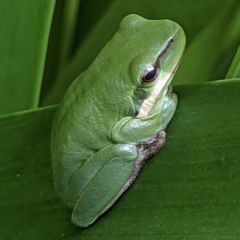
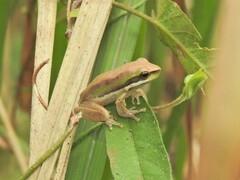
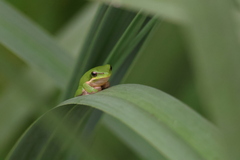
Eastern Dwarf Treefrog

Eastern Dwarf Treefrog

Litoria fallax

Silhouette: Robbi Bishop-Taylor · PhyloPic

LCLeast ConcernNTVUENCR
Daily sighting probability ~20% · Possible
at Royal National Park

In 3 days ~50% in a week ~80%

34 Verified sightings at Royal National Park From 2019 to 2026
82 In all 4 parks
January Best month
🌅 Crepuscular When it's spotted

About the Eastern Dwarf Treefrog

The eastern dwarf tree frog (Drymomantis fallax), also known as the eastern sedge frog, is a species of tree frog native to Australia. It is a small and very common frog found on the eastern coast of Australia, from approximately Cairns, Queensland to Ulladulla, New South Wales. Individual frogs of this species are often found elsewhere, having been accidentally relocated by transported fruit or horticultural products. Two naturalised populations are known outside of its native range: a population successfully established on Guam around 1968, and breeding populations have established in multiple suburbs of Melbourne, Victoria.

The eastern dwarf tree frog is a small species of frog; females can reach a maximum size of 25–30 mm, while males may only reach 20 mm when fully grown. The dorsum is usually green in colour, but can range from brown to bright green, and occasionally has black flecks. The ventral surface is white with a granular texture. A distinct white line runs from under the eye to above the arm. A brown line begins from the nostril, continues across the eye, and can extend between the dorsal and ventral colours. This species' toe discs are only slightly... Wikipedia →

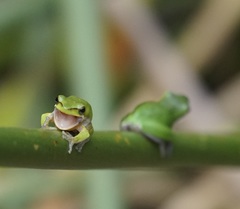
Sounds

Advertisement call0:14

Australia · 2020

© Marc Anderson · XC883160 · CC BY-NC-ND 4.0

Uncertain1:00

Australia · 2023

© nick talbot · XC899744 · CC BY-NC-SA 4.0

Advertisement call0:11

Australia · 2014

© Chris Harrison · XC892869 · CC BY-NC-SA 4.0

Global Distribution

Parks Where Found

# Park Country Daily sighting probability
1 Royal National Park 🇦🇺 Australia
~20%
2 Lamington National Park 🇦🇺 Australia
~20%
3 Springbrook National Park 🇦🇺 Australia
~10%
4 Blue Mountains National Park 🇦🇺 Australia
~10%

Cities Where Found

# City Country Daily sighting probability
1 Sydney 🇦🇺 Australia
~20%
2 Brisbane 🇦🇺 Australia
~20%
3 Melbourne 🇦🇺 Australia
<5%

Before you go

What are the chances of seeing an Eastern Dwarf Treefrog in Royal National Park?

Possible

About 20% of wildlife watchers report an Eastern Dwarf Treefrog sighting in Royal National Park on a given day, based on 34 verified sightings from GBIF citizen-science data from 2019 to 2026. It is the 5th most-seen of the 9 amphibians we can rate there. Over three days the chance rises to about 50%, and over a week to about 80%, if each day is a fresh chance.

When is the best time to see an Eastern Dwarf Treefrog in Royal National Park?

January

In that month about 40% of wildlife watchers report an Eastern Dwarf Treefrog in Royal National Park on a given day, against under 5% in May to August, the lowest months.

What time of day is best to see an Eastern Dwarf Treefrog?

Between 4 and 7 pm

Across all the parks we cover, that three-hour window holds the most Eastern Dwarf Treefrog sightings with a recorded time, and about 7 in 10 of them come between 6 am and 6 pm: it is most active around dawn and dusk.

Is Royal National Park the best place to see an Eastern Dwarf Treefrog?

Yes

Of the 4 parks where we can rate Eastern Dwarf Treefrog sightings, Royal National Park has the highest daily chance: about 20%. Next come Lamington National Park (Australia, about 20%) and Springbrook National Park (Australia, about 10%).

Which relatives of the Eastern Dwarf Treefrog live in Royal National Park?

Same genus: Litoria

The closest relatives of the Eastern Dwarf Treefrog that you can see in Royal National Park (genus Litoria) are Peron's Tree Frog (about 30%) and Wallum Rocket Frog (about 10%), with each one's daily chance of a sighting.

Where does the Eastern Dwarf Treefrog sighting chance come from?

GBIF citizen-science records

It is estimated from how often the Eastern Dwarf Treefrog is recorded against all the amphibians logged in Royal National Park (34 verified sightings from 2019 to 2026), calibrated against known sighting rates. Figures are rounded to the nearest 10% because citizen-science data supports honest approximations, not decimals, and months with records from fewer than five people show "—". How it works.

← Back to Royal National Park