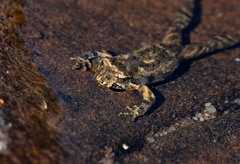
Common Eastern Froglet

Common Eastern Froglet

Crinia signifera

Silhouette: Jose Carlos Arenas-Monroy · PhyloPic

LCLeast ConcernNTVUENCR Endemic
Daily sighting probability ~30% · Possible
at Royal National Park

In 3 days ~70% in a week ~90%

126 Verified sightings at Royal National Park From 2019 to 2026
393 In all 8 parks
September Best month
☀️ Diurnal When it's spotted

About the Common Eastern Froglet

The common eastern froglet (Crinia signifera) is a very common, Australian ground-dwelling frog, of the family Myobatrachidae. They are also referred to as 'gunggung' by the Dharug people of the Sydney basin. The common eastern froglet ranges from southeastern Australia, from Adelaide to Melbourne, up the eastern coast to Brisbane. It also inhabits a majority of Tasmania. It is one of the most commonly encountered frog species within its range, due to its ability to occupy several habitat types.

The common eastern froglet is a small frog (approx. 3 centimetres), of brown or grey colour of various shades. The frog is of extremely variable markings, with great variety usually found within confined populations. A dark, triangular mark is found on the upper lip, with darker bands on the legs. A small white spot is on the base of each arm. The dorsal and ventral surfaces are very variable. The dorsal surface may be smooth, warty or have longitudinal skin folds. The colour varies from dark brown, fawn, light and dark grey. The colour of the ventral surface is similar to the dorsal surface, but mottled with white spots.

The common... Wikipedia →

Sounds

Uncertain0:55

Australia · 2024

© nick talbot · XC899045 · CC BY-NC-SA 4.0

Advertisement call1:05

Australia · 2015

© Marc Anderson · XC883186 · CC BY-NC-ND 4.0

Recording0:06

Australia · 2024

© Harvey L · XC935753 · CC BY-NC-SA 4.0

Global Distribution

Parks Where Found

# Park Country Daily sighting probability
1 Royal National Park 🇦🇺 Australia
~30%
2 Flinders Chase 🇦🇺 Australia
~30%
3 Grampians National Park 🇦🇺 Australia
~30%
4 Blue Mountains National Park 🇦🇺 Australia
~30%
5 Kosciuszko National Park 🇦🇺 Australia
~30%
6 Wilsons Promontory National Park 🇦🇺 Australia
~20%
7 Booderee National Park 🇦🇺 Australia
~20%
8 Great Otway National Park 🇦🇺 Australia
~10%

Cities Where Found

# City Country Daily sighting probability
1 Melbourne 🇦🇺 Australia
~20%
2 Sydney 🇦🇺 Australia
~20%
3 Brisbane 🇦🇺 Australia
<5%

Before you go

What are the chances of seeing a Common Eastern Froglet in Royal National Park?

Possible

About 30% of wildlife watchers report a Common Eastern Froglet sighting in Royal National Park on a given day, based on 126 verified sightings from GBIF citizen-science data from 2019 to 2026. It is the most-seen of the 9 amphibians we can rate there. Over three days the chance rises to about 70%, and over a week to about 90%, if each day is a fresh chance.

When is the best time to see a Common Eastern Froglet in Royal National Park?

February–April and August–September

In those months about 40% of wildlife watchers report a Common Eastern Froglet in Royal National Park on a given day, against about 20% in July, the lowest month.

What time of day is best to see a Common Eastern Froglet?

Between 1 and 4 pm

Across all the parks we cover, that three-hour window holds the most Common Eastern Froglet sightings with a recorded time, and about 7 in 10 of them come between 6 am and 6 pm: it is a daytime animal.

Is Royal National Park the best place to see a Common Eastern Froglet?

Yes

Of the 8 parks where we can rate Common Eastern Froglet sightings, Royal National Park has the highest daily chance: about 30%. Next come Flinders Chase (Australia, about 30%) and Grampians National Park (Australia, about 30%).

Where does the Common Eastern Froglet sighting chance come from?

GBIF citizen-science records

It is estimated from how often the Common Eastern Froglet is recorded against all the amphibians logged in Royal National Park (126 verified sightings from 2019 to 2026), calibrated against known sighting rates. Figures are rounded to the nearest 10% because citizen-science data supports honest approximations, not decimals, and months with records from fewer than five people show "—". How it works.

← Back to Royal National Park