About the Figeater Beetle
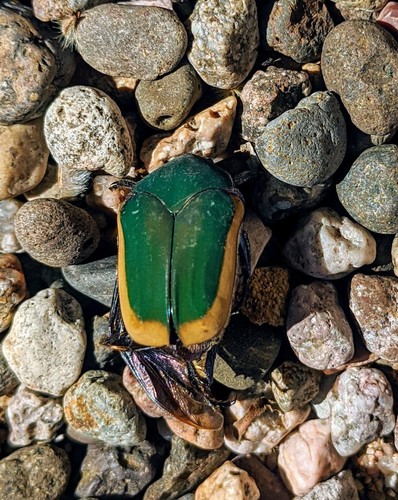
The figeater beetle (also green fruit beetle or fig beetle, Cotinis mutabilis) is a member of the scarab beetle family in the subfamily Cetoniinae, comprising a group of beetles commonly called flower chafers, since many of them feed on pollen, nectar, or petals. Its habitat covers primarily the southwestern United States (including California) and Mexico, extending south to northern South America. Within the figeater beetle's cuticle, twisted fibers are arranged in stacked layers. When light hits those layers, it bends and creates a distinct iridescent color. Figeater beetles are often mistaken for green June beetles (Cotinis nitida) and occasionally Japanese beetles (Popillia japonica), which occur in the Eastern US. C. mutabilis are also named by the synonym C. texana.
After mating, eggs are laid in decaying matter or compost piles, which provide sustenance for the emerging larvae. Oviposition takes place over an extended period of about three months, beginning in early August and continuing until the end of October. Eggs measure approximately 1.8 mm wide and 2.3 mm long and have a whitish color. In laboratory conditions with optimal temperatures, eggs hatch within... Wikipedia →