



Completed
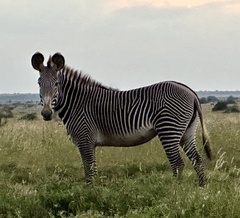
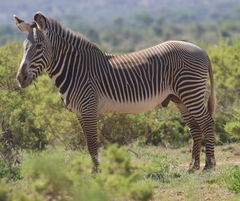
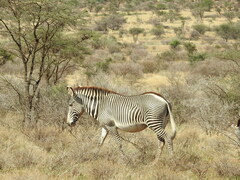


Grévy's Zebra
Equus grevyi
Silhouette: Kai Caspar · PhyloPic
- KingdomAnimalia (Animals)
- PhylumChordata (Chordates)
- ClassMammalia (Mammals)
- OrderPerissodactyla (Odd-toed Ungulates)
- FamilyEquidae (Equines)
- GenusEquus (Equines)
- SpeciesEquus grevyi (Grévy's Zebra)
In 3 days ~90% in a week >90%
175 Verified sightings at Samburu National Reserve From 2019 to 2026
180 In all 2 parks
March Best month
☀️ Diurnal When it's spotted



About the Grévy's Zebra
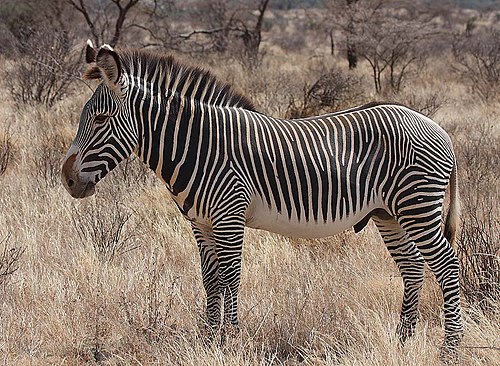
Grévy's zebra (Equus grevyi), also known commonly as the imperial zebra, is the largest living species of wild equid and the most threatened of the three species of zebras, the other two being the plains zebra and the mountain zebra. Named after French president Jules Grévy, it is found in parts of Kenya and Ethiopia. Superficially, Grévy's zebra's physical features can help to identify it from the other zebra species; its overall appearance is slightly closer to that of a mule and donkey, compared to the more "equine" (horse) appearance of the plains and mountain zebras. Compared to other zebra species, Grévy's zebra is the tallest; it has mule-like, larger ears, and has the narrowest stripes of all zebras. It has a distinctively erect mane, and a more slender snout.
Grévy's zebra lives in semi-arid savanna, where it feeds on grasses, legumes, and browse, such as acacia; it can survive up to five days without water. It differs from the other zebra species in that it does not live in a harem, and it maintains few long-lasting social bonds. Stallion territoriality and mother–foal relationships form the basis of the social system of the Grévy's zebra. Despite a handful of zoos and animal parks around the world having had successful captive-breeding programs, in its native home this zebra is listed by the IUCN as endangered. Its population has declined from 15,000 to 2,000 since the 1970s. In 2016, the population was reported to be "stable"; however, as of 2020, the wild numbers are still estimated at only around 2,250 animals, in part due to anthrax outbreaks in eastern Africa. Wikipedia →
Recent sightings of Grévy's Zebra in Samburu National Reserve
LIVEiNaturalistGlobal Distribution
Parks Where Found
| # | Park | Country | Daily sighting probability |
|---|---|---|---|
| 1 | Samburu National Reserve | 🇰🇪 Kenya | |
| 2 | Meru National Park | 🇰🇪 Kenya |
Zoos & Centres Where Found
| # | Zoo / Centre | Country | |
|---|---|---|---|
| 1 | Disney's Animal Kingdom | 🇺🇸 United States | |
| 2 | San Diego Zoo | 🇺🇸 United States | |
| 3 | National Zoological Park | 🇺🇸 United States | |
| 4 | Shedd Aquarium | 🇺🇸 United States | |
| 5 | ZooParc de Beauval | 🇫🇷 France | |
| 6 | Denver Zoo | 🇺🇸 United States | |
| 7 | Lisbon Oceanarium | 🇵🇹 Portugal | |
| 8 | Planckendael Zoo | 🇧🇪 Belgium | |
| 9 | Le Pal | 🇫🇷 France | |
| 10 | Cabarceno Natural Park | 🇪🇸 Spain | |
| 11 | Ostrava Zoo | 🇨🇿 Czechia | |
| 12 | Kolmården Wildlife Park | 🇸🇪 Sweden | |
| 13 | Paris Zoological Park | 🇫🇷 France | |
| 14 | Réserve africaine de Sigean | 🇫🇷 France | |
| 15 | Zoo de Doué | 🇫🇷 France | |
| 16 | The Wilds | 🇺🇸 United States | |
| 17 | Zoo Miami | 🇺🇸 United States | |
| 18 | San Diego Zoo Safari Park | 🇺🇸 United States | |
| 19 | Safaripark Beekse Bergen | 🇳🇱 Netherlands | |
| 20 | Toronto Zoo | 🇨🇦 Canada | |
| 21 | Taipei Zoo | 🇹🇼 Taiwan | |
| 22 | Living Desert Zoo and Gardens | 🇺🇸 United States | |
| 23 | Knowsley Safari Park | 🇬🇧 United Kingdom | |
| 24 | Bronx Zoo | 🇺🇸 United States | |
| 25 | Brookfield Zoo | 🇺🇸 United States | |
| 26 | West Midland Safari Park | 🇬🇧 United Kingdom | |
| 27 | West Midlands Safari Park | 🇬🇧 United Kingdom | |
| 28 | Parc zoologique de Montpellier | 🇫🇷 France | |
| 29 | Sedgwick County Zoo | 🇺🇸 United States | |
| 30 | Yorkshire Wildlife Park | 🇬🇧 United Kingdom | |
| 31 | Los Angeles Zoo | 🇺🇸 United States | |
| 32 | Phoenix Zoo | 🇺🇸 United States | |
| 33 | Detroit Zoo | 🇺🇸 United States | |
| 34 | Jacksonville Zoo and Gardens | 🇺🇸 United States | |
| 35 | São Paulo Zoo | 🇧🇷 Brazil | |
| 36 | Marwell Zoo | 🇬🇧 United Kingdom | |
| 37 | Zoológico de San Juan de Aragón | 🇲🇽 Mexico | |
| 38 | Oklahoma City Zoo and Botanical Garden | 🇺🇸 United States | |
| 39 | Saint Louis Zoo | 🇺🇸 United States | |
| 40 | Caldwell Zoo | 🇺🇸 United States | |
| 41 | Edinburgh Zoo | 🇬🇧 United Kingdom | |
| 42 | Brevard Zoo | 🇺🇸 United States | |
| 43 | Nyíregyháza Zoo | 🇭🇺 Hungary | |
| 44 | Tanganyika Wildlife Park | 🇺🇸 United States | |
| 45 | Chiba Zoological Park | 🇯🇵 Japan | |
| 46 | Gatorland | 🇺🇸 United States | |
| 47 | Lisbon Zoo | 🇵🇹 Portugal | |
| 48 | Wilhelma | 🇩🇪 Germany | |
| 49 | DierenPark Amersfoort | 🇳🇱 Netherlands | |
| 50 | Parc Zoologique et Botanique de Mulhouse | 🇫🇷 France |
Closest Relatives at Samburu National Reserve







Before you go
What are the chances of seeing a Grévy's Zebra in Samburu National Reserve?
Likely
About 50% of wildlife watchers report a Grévy's Zebra sighting in Samburu National Reserve on a given day, based on 175 verified sightings from GBIF citizen-science data from 2019 to 2026. It is the 14th most-seen of the 25 mammals we can rate there. Over three days the chance rises to about 90%, and over a week to over 90%, if each day is a fresh chance.
When is the best time to see a Grévy's Zebra in Samburu National Reserve?
March
In that month about 70% of wildlife watchers report a Grévy's Zebra in Samburu National Reserve on a given day, against about 40% in May, July, October and December–January, the lowest months.
What time of day is best to see a Grévy's Zebra?
Between 2 and 5 pm
Across all the parks we cover, that three-hour window holds the most Grévy's Zebra sightings with a recorded time, and about 8 in 10 of them come between 6 am and 6 pm: it is a daytime animal.
Is Samburu National Reserve the best place to see a Grévy's Zebra?
Yes
Of the 2 parks where we can rate Grévy's Zebra sightings, Samburu National Reserve has the highest daily chance: about 50%. Next come Meru National Park (Kenya, about 30%).
Where does the Grévy's Zebra sighting chance come from?
GBIF citizen-science records
It is estimated from how often the Grévy's Zebra is recorded against all the mammals logged in Samburu National Reserve (175 verified sightings from 2019 to 2026), calibrated against known sighting rates. Figures are rounded to the nearest 10% because citizen-science data supports honest approximations, not decimals, and months with records from fewer than five people show "—". How it works.
