Calliope Hummingbird

Calliope Hummingbird

Selasphorus calliope

Silhouette: Ferran Sayol · PhyloPic

LCLeast ConcernNTVUENCR
Daily sighting probability <5% · Rare
at Sequoia and Kings Canyon National Parks

In 3 days <5% in a week ~10%

26 Verified sightings at Sequoia and Kings Canyon National Parks From 2019 to 2026
916 In all 10 parks
August Best month
☀️ Diurnal When it's spotted

About the Calliope Hummingbird

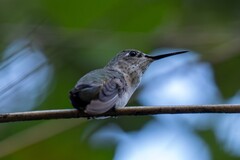
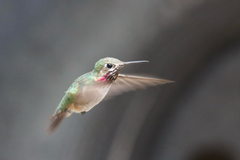
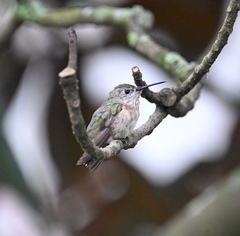
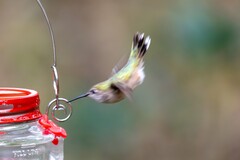
The calliope hummingbird ( kə-LY-ə-pee; Selasphorus calliope) is the smallest bird native to the United States and Canada. It has a western breeding range mainly from California to British Columbia, and migrates to the Southwestern United States, Mexico, and Central America for its wintering grounds. The calliope hummingbird is the smallest known long-distance bird migrant, completing migrations twice per year of some 9,000 km (5,600 mi).

It was previously considered the only member of the genus Stellula (meaning little star), but research evidence suggests its existing placement in the genus Selasphorus. The bird was named after the Greek muse Calliope. The calliope is the smallest breeding bird found in Canada and the United States. An adult calliope hummingbird can measure 7–10 cm (2.8–3.9 in) in length, span 11 cm (4.3 in) across the wings and weigh 2 to 3 g (0.071 to 0.106 oz).

Calliope hummingbirds have glossy green on the back and crown with white underparts. The adult male has wine-red streaks on the gorget, green flanks, and a dark tail. When an adult male is competing for territory or females, the dark red feathers of its gorget distend outwards to create... Wikipedia →

Sounds

Display dive0:33

United States · 2019

© Bruce Lagerquist · XC483902 · CC BY-NC-SA 4.0

Call0:26

United States · 2014

© Andrew Spencer · XC188264 · CC BY-NC-SA 4.0

Dive display sound0:20

United States · 2026

© Ed Pandolfino · XC1152009 · CC BY-NC-SA 4.0

Global Distribution

Parks Where Found

# Park Country Daily sighting probability
1 Glacier National Park 🇺🇸 United States
~10%
2 Grand Teton National Park 🇺🇸 United States
~10%
3 Shenandoah National Park 🇺🇸 United States
~10%
4 Yosemite National Park 🇺🇸 United States
<5%
5 Jasper National Park 🇨🇦 Canada
<5%
6 Yellowstone National Park 🇺🇸 United States
<5%
7 Sequoia and Kings Canyon National Parks 🇺🇸 United States
<5%
8 Rocky Mountain National Park 🇺🇸 United States
<5%
9 Banff National Park 🇨🇦 Canada
<5%
10 Guadalupe Mountains National Park 🇺🇸 United States
<5%

Cities Where Found

# City Country Daily sighting probability
1 Monterrey 🇲🇽 México
~10%
2 Denver 🇺🇸 United States
<5%
3 Salt Lake City 🇺🇸 United States
<5%
4 Calgary 🇨🇦 Canada
<5%
5 San Francisco 🇺🇸 United States
<5%
6 Portland 🇺🇸 United States
<5%
7 Mexico City 🇲🇽 México
<5%
8 Houston 🇺🇸 United States
<5%
9 San Diego 🇺🇸 United States
<5%
10 Sacramento 🇺🇸 United States
<5%

Before you go

What are the chances of seeing a Calliope Hummingbird in Sequoia and Kings Canyon National Parks?

Rare

Under 5% of wildlife watchers report a Calliope Hummingbird sighting in Sequoia and Kings Canyon National Parks on a given day, based on 26 verified sightings from GBIF citizen-science data from 2019 to 2026. It is the 123rd most-seen of the 152 birds we can rate there. Over three days the chance rises to under 5%, and over a week to about 10%, if each day is a fresh chance.

When is the best time to see a Calliope Hummingbird in Sequoia and Kings Canyon National Parks?

Any time of year

In every month with enough records, under 5% of wildlife watchers report a Calliope Hummingbird in Sequoia and Kings Canyon National Parks on a given day, so our monthly data shows no clear season.

What time of day is best to see a Calliope Hummingbird?

Between 9 am and noon

Across all the parks we cover, that three-hour window holds the most Calliope Hummingbird sightings with a recorded time, and about 8 in 10 of them come between 6 am and 6 pm: it is a daytime animal.

Is Sequoia and Kings Canyon National Parks the best place to see a Calliope Hummingbird?

7th of 10

Of the 10 parks where we can rate Calliope Hummingbird sightings, Sequoia and Kings Canyon National Parks ranks 7th at under 5%. The best odds are in Glacier National Park (United States, about 10%), Grand Teton National Park (United States, about 10%) and Shenandoah National Park (United States, about 10%).

Where does the Calliope Hummingbird sighting chance come from?

GBIF citizen-science records

It is estimated from how often the Calliope Hummingbird is recorded against all the birds logged in Sequoia and Kings Canyon National Parks (26 verified sightings from 2019 to 2026), calibrated against known sighting rates. Figures are rounded to the nearest 10% because citizen-science data supports honest approximations, not decimals, and months with records from fewer than five people show "—". How it works.

← Back to Sequoia and Kings Canyon National Parks