White-throated Swift

White-throated Swift

Aeronautes saxatalis

Silhouette: Aviceda (vectorized by T. Michael Keesey) · PhyloPic

LCLeast ConcernNTVUENCR
Daily sighting probability ~10% · With luck
at Sequoia and Kings Canyon National Parks

In 3 days ~30% in a week ~60%

251 Verified sightings at Sequoia and Kings Canyon National Parks From 2019 to 2026
7,326 In all 17 parks
April Best month
☀️ Diurnal When it's spotted

About the White-throated Swift

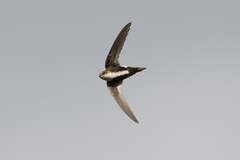
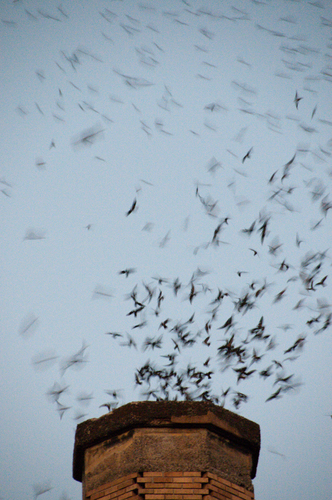
The white-throated swift (Aeronautes saxatalis) is a swift of the family Apodidae native to western North America, south to cordilleran western Honduras. Its coastal range extends as far north as Northern California, while inland it has migratory populations found throughout the Great Basin and Rocky Mountain regions, ranging as far north as southern British Columbia. White-throated swifts are found in open areas near cliffs, rock faces, or man-made structures, where they roost. Swifts are social birds, and groups are often seen roosting and foraging for flying insects together.

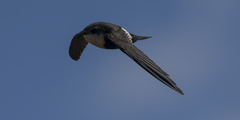
The white-throated swift is medium-sized bird that is primarily black and white. Its back and wings are blackish-brown or black, and its breast, belly, chin, and throat are white. In newly molted adults, the dark feathers may have a slight greenish sheen, though this is rarely observable in the field. Sexes cannot be distinguished by plumage. Juvenile (first basic) plumage is similar to adult (definitive basic) plumage, but with the feathers on juveniles' heads and necks appearing duller and paler.

Adults are generally 15–18 centimeters in length, and have a tail with a relatively shallow 10... Wikipedia →

Sounds

Call0:09

United States · 2013

© Tero Linjama · XC942738 · CC BY-NC-SA 4.0

Flight call0:19

United States · 2020

© Paul Marvin · XC552939 · CC BY-NC-SA 4.0

Song0:56

United States · 2019

© Thomas G. Graves · XC470554 · CC BY-NC-SA 4.0

Global Distribution

Parks Where Found

# Park Country Daily sighting probability
1 Grand Canyon National Park 🇺🇸 United States
~40%
2 Zion National Park 🇺🇸 United States
~30%
3 Big Bend National Park 🇺🇸 United States
~30%
4 Yosemite National Park 🇺🇸 United States
~20%
5 Guadalupe Mountains National Park 🇺🇸 United States
~20%
6 Joshua Tree National Park 🇺🇸 United States
~20%
7 Badlands National Park 🇺🇸 United States
~10%
8 Cumbres de Monterrey National Park 🇲🇽 Mexico
~10%
9 Sequoia and Kings Canyon National Parks 🇺🇸 United States
~10%
10 Death Valley National Park 🇺🇸 United States
~10%
11 Yellowstone National Park 🇺🇸 United States
<5%
12 Saguaro National Park 🇺🇸 United States
<5%
13 Channel Islands National Park 🇺🇸 United States
<5%
14 Bahía de Loreto National Park 🇲🇽 Mexico
<5%
15 Rocky Mountain National Park 🇺🇸 United States
<5%
16 El Vizcaíno Biosphere Reserve 🇲🇽 Mexico
<5%
17 Grand Teton National Park 🇺🇸 United States
<5%

Cities Where Found

# City Country Daily sighting probability
1 Sacramento 🇺🇸 United States
~10%
2 Los Angeles 🇺🇸 United States
~10%
3 San Diego 🇺🇸 United States
~10%
4 Phoenix 🇺🇸 United States
~10%
5 San Francisco 🇺🇸 United States
<5%
6 Guadalajara 🇲🇽 México
<5%
7 Mesa 🇺🇸 United States
<5%
8 Las Vegas 🇺🇸 United States
<5%
9 Mexico City 🇲🇽 México
<5%
10 Guatemala City 🇬🇹 Guatemala
<5%

Zoos & Centres Where Found

# Zoo / Centre Country
1 California Wildlife Center, Malibu 🇺🇸 United States In captivity

Before you go

What are the chances of seeing a White-throated Swift in Sequoia and Kings Canyon National Parks?

With luck

About 10% of wildlife watchers report a White-throated Swift sighting in Sequoia and Kings Canyon National Parks on a given day, based on 251 verified sightings from GBIF citizen-science data from 2019 to 2026. It is the 56th most-seen of the 152 birds we can rate there. Over three days the chance rises to about 30%, and over a week to about 60%, if each day is a fresh chance.

When is the best time to see a White-throated Swift in Sequoia and Kings Canyon National Parks?

April

In that month about 30% of wildlife watchers report a White-throated Swift in Sequoia and Kings Canyon National Parks on a given day, against under 5% in October to February, the lowest months.

What time of day is best to see a White-throated Swift?

Between 8 and 11 am

Across all the parks we cover, that three-hour window holds the most White-throated Swift sightings with a recorded time, and about 9 in 10 of them come between 6 am and 6 pm: it is a daytime animal.

Is Sequoia and Kings Canyon National Parks the best place to see a White-throated Swift?

9th of 17

Of the 17 parks where we can rate White-throated Swift sightings, Sequoia and Kings Canyon National Parks ranks 9th at about 10%. The best odds are in Grand Canyon National Park (United States, about 40%), Zion National Park (United States, about 30%) and Big Bend National Park (United States, about 30%). All parks ranked.

Where does the White-throated Swift sighting chance come from?

GBIF citizen-science records

It is estimated from how often the White-throated Swift is recorded against all the birds logged in Sequoia and Kings Canyon National Parks (251 verified sightings from 2019 to 2026), calibrated against known sighting rates. Figures are rounded to the nearest 10% because citizen-science data supports honest approximations, not decimals, and months with records from fewer than five people show "—". How it works.

← Back to Sequoia and Kings Canyon National Parks