Speke's Weaver

Speke's Weaver

Ploceus spekei

Silhouette: Sheatherius · PhyloPic

LCLeast ConcernNTVUENCR
Daily sighting probability ~10% · With luck
at Serengeti National Park

In 3 days ~20% in a week ~50%

260 Verified sightings at Serengeti National Park From 2019 to 2026
2,114 In all 11 parks
May Best month
☀️ Diurnal When it's spotted

About the Speke's Weaver

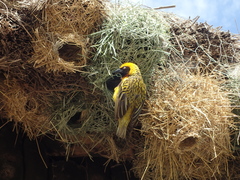
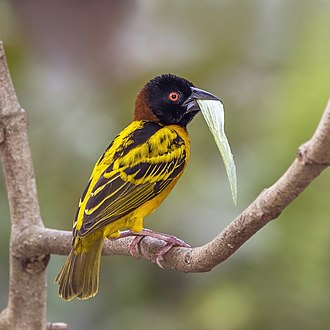
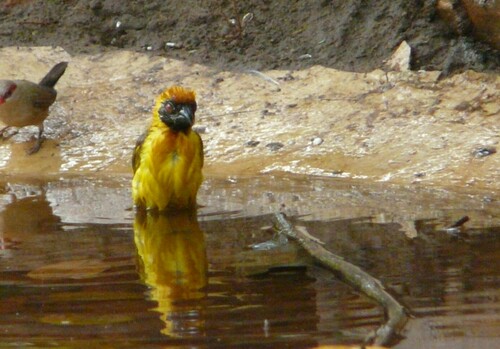
Speke's weaver (Ploceus spekei) is a familiar East African songbird. The eyes are pale and the bill is on the large side for a weaver. Unlike many weavers, it has the same plumage all year. The adult male is yellow with black throat (edged rusty), face, and bill, and variable black mottling on the back. The adult female's upperparts are dull olive-gray with dusky brown streaks; the underparts are pale yellow, whiter on the belly and grayer on the flanks. The juvenile is similar but duller.

The song is variable; one version is transcribed as "pew…pew…tew, chinkichi-chewchew-skerinkitsitew". Calls include harsh chatter at the nest and a sharp "tseep!" This species nests in colonies or occasionally singly. The nest, often woven in an acacia, is spherical with a short entrance tube opening sideways or downward. Many grass stems project sloppily, sometimes obscuring the shape. It nests in both the short rainy season and the middle of the long rainy season. Typical clutches comprise four eggs, which are unmarked deep blue, somewhat pointed at both ends, 24 to 26 mm long and 15 to 17 mm wide.

Speke's weaver is found in northern and eastern Somalia, Ethiopia, Kenya (mostly the central highlands), and north-eastern Tanzania. It inhabits savanna, bush, agricultural land, and towns. In parts of its range it is common, notably the densely populated area of Nairobi and environs, where it visits bird feeders.

This bird was named in honor of John Speke. Wikipedia →

Sounds

Song0:33

Kenya · 2024

© Peter Boesman · XC948397 · CC BY-NC-ND 4.0

Call0:33

Kenya · 2022

© Magnus Wadstein · XC772975 · CC BY-NC-SA 4.0

Song0:42

Kenya · 2020

© isaac kilusu · XC607578 · CC BY-NC-SA 4.0

Global Distribution

Parks Where Found

# Park Country Daily sighting probability
1 Lake Nakuru National Park 🇰🇪 Kenya
~30%
2 Nairobi National Park 🇰🇪 Kenya
~30%
3 Ngorongoro Conservation Area 🇹🇿 Tanzania
~20%
4 Arusha National Park 🇹🇿 Tanzania
~10%
5 Serengeti National Park 🇹🇿 Tanzania
~10%
6 Amboseli National Park 🇰🇪 Kenya
~10%
7 Masai Mara National Reserve 🇰🇪 Kenya
<5%
8 Tarangire National Park 🇹🇿 Tanzania
<5%
9 Aberdare National Park 🇰🇪 Kenya
<5%
10 Lake Manyara National Park 🇹🇿 Tanzania
<5%
11 Samburu National Reserve 🇰🇪 Kenya
<5%

Cities Where Found

# City Country Daily sighting probability
1 Nairobi 🇰🇪 Kenya
~10%

Zoos & Centres Where Found

# Zoo / Centre Country
1 Berlin Zoological Garden 🇩🇪 Germany In captivity
2 Aquarium Berlin 🇩🇪 Germany In captivity

Before you go

What are the chances of seeing a Speke's Weaver in Serengeti National Park?

With luck

About 10% of wildlife watchers report a Speke's Weaver sighting in Serengeti National Park on a given day, based on 260 verified sightings from GBIF citizen-science data from 2019 to 2026. It is the 165th most-seen of the 469 birds we can rate there. Over three days the chance rises to about 20%, and over a week to about 50%, if each day is a fresh chance.

When is the best time to see a Speke's Weaver in Serengeti National Park?

May

In that month about 20% of wildlife watchers report a Speke's Weaver in Serengeti National Park on a given day, against under 5% in June to October, the lowest months.

What time of day is best to see a Speke's Weaver?

Between noon and 3 pm

Across all the parks we cover, that three-hour window holds the most Speke's Weaver sightings with a recorded time, and about 9 in 10 of them come between 6 am and 6 pm: it is a daytime animal.

Which relatives of the Speke's Weaver live in Serengeti National Park?

Same genus: Ploceus

The closest relatives of the Speke's Weaver that you can see in Serengeti National Park (genus Ploceus, Typical Weavers) are Lesser Masked-Weaver (about 20%), Vitelline Masked-Weaver (about 20%) and Village Weaver (about 10%), with each one's daily chance of a sighting.

Where does the Speke's Weaver sighting chance come from?

GBIF citizen-science records

It is estimated from how often the Speke's Weaver is recorded against all the birds logged in Serengeti National Park (260 verified sightings from 2019 to 2026), calibrated against known sighting rates. Figures are rounded to the nearest 10% because citizen-science data supports honest approximations, not decimals, and months with records from fewer than five people show "—". How it works.

← Back to Serengeti National Park