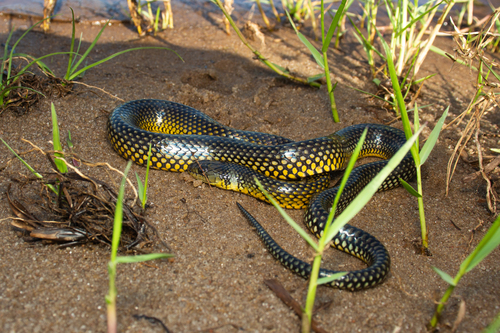
Painted Coral Snake

Painted Coral Snake

Micrurus corallinus

Silhouette: Edwin Price · PhyloPic

LCLeast ConcernNTVUENCR
Daily sighting probability ~20% · Possible
at Serra dos Órgãos National Park

In 3 days ~40% in a week ~70%

5 Verified sightings at Serra dos Órgãos National Park From 2019 to 2026
37 In all 4 parks
November Best month
☀️ Diurnal When it's spotted

About the Painted Coral Snake

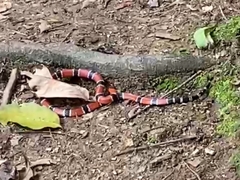
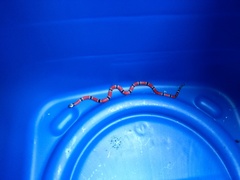
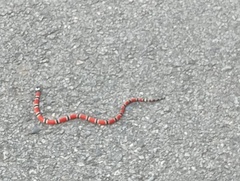
Micrurus corallinus, also known commonly as the painted coral snake, is a species of highly venomous snake in the family Elapidae. The species is native to eastern South America (Argentina, Brazil, and Paraguay). There are no recognized subspecies.

Local common names for Micrurus corallinus include cobra coral pintada, mboi-chumbe, vibora de coral, boicora, bocora, coral-verdadeira, ibiboboca, and mboi-yvyvovo. The painted coral snake is a medium-sized tri-colored snake which can grow to a total length (tail included) of 98 cm (39 in), but most are closer to 65–85 cm (26–33 in).

It is a snake with nocturnal habits found on the coastlines, in leaf litter, and under logs and stones. Its diet is based on caecilians, amphisbaenids, lizards (including gymnophthalmids), other snakes (including colubrids).

The head color is black with a white or yellow band on the posterior portion of the parietals. This band narrows strongly mid-dorsally. The body has wide red rings that are separated by a series of 15–27 (usually 17–21) narrower black rings with white borders. The tail has 3–8 alternating black and yellow rings. It has a slim body, with a... Wikipedia →

Global Distribution

Parks Where Found

# Park Country Daily sighting probability
1 Serra dos Órgãos National Park 🇧🇷 Brazil
~20%
2 Iguazú National Park 🇦🇷 Argentina
~10%
3 Tijuca National Park 🇧🇷 Brazil
~10%
4 Iguaçu National Park 🇧🇷 Brazil
~10%

Cities Where Found

# City Country Daily sighting probability
1 Rio de Janeiro 🇧🇷 Brazil
~10%

Closest Relatives at Serra dos Órgãos National Park

No species of the same family or order lives in Serra dos Órgãos National Park, so these are its closest relatives here: other reptiles.

Before you go

What are the chances of seeing a Painted Coral Snake in Serra dos Órgãos National Park?

Possible

About 20% of wildlife watchers report a Painted Coral Snake sighting in Serra dos Órgãos National Park on a given day, based on 5 verified sightings from GBIF citizen-science data from 2019 to 2026. It is the 9th most-seen of the 14 reptiles we can rate there. Over three days the chance rises to about 40%, and over a week to about 70%, if each day is a fresh chance.

When is the best time to see a Painted Coral Snake in Serra dos Órgãos National Park?

November

In that month about 40% of wildlife watchers report a Painted Coral Snake in Serra dos Órgãos National Park on a given day, against under 5% in January–March, May–July and September–October, the lowest months. That is one of Serra dos Órgãos National Park's wettest months, with about 310 mm of rain against 50 mm in July.

What time of day is best to see a Painted Coral Snake?

Between 3 and 6 pm

Across all the parks we cover, that three-hour window holds the most Painted Coral Snake sightings with a recorded time, and about 7 in 10 of them come between 6 am and 6 pm: it is a daytime animal.

Is Serra dos Órgãos National Park the best place to see a Painted Coral Snake?

Yes

Of the 4 parks where we can rate Painted Coral Snake sightings, Serra dos Órgãos National Park has the highest daily chance: about 20%. Next come Iguazú National Park (Argentina, about 10%) and Tijuca National Park (Brazil, about 10%).

Where does the Painted Coral Snake sighting chance come from?

GBIF citizen-science records

It is estimated from how often the Painted Coral Snake is recorded against all the reptiles logged in Serra dos Órgãos National Park (5 verified sightings from 2019 to 2026), calibrated against known sighting rates. Figures are rounded to the nearest 10% because citizen-science data supports honest approximations, not decimals, and months with records from fewer than five people show "—". How it works.

← Back to Serra dos Órgãos National Park