Eastern Tent Caterpillar Moth

Eastern Tent Caterpillar Moth

Malacosoma americana

Daily sighting probability ~20% · Possible
at Shenandoah National Park

In 3 days ~50% in a week ~80%

88 Verified sightings at Shenandoah National Park From 2019 to 2026
218 In all 3 parks
May Best month
☀️ Diurnal When it's spotted

About the Eastern Tent Caterpillar Moth

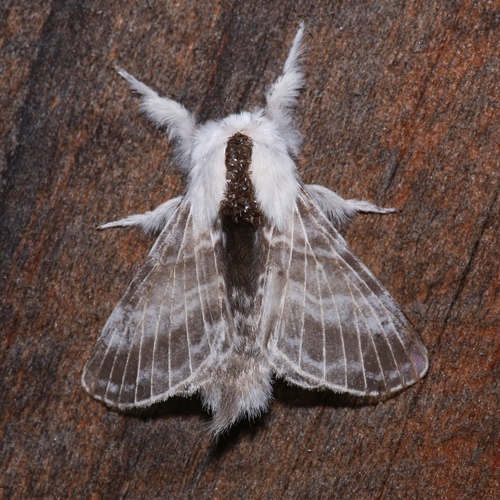
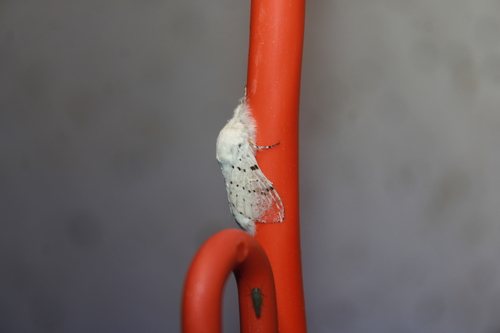
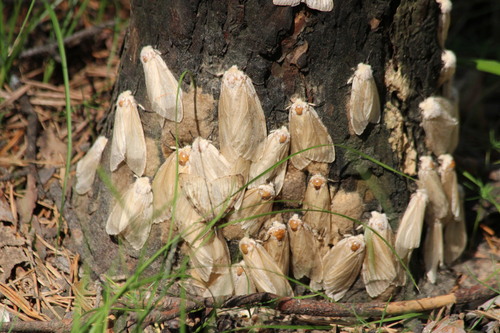
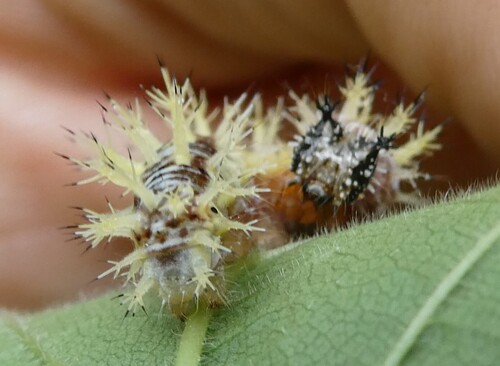
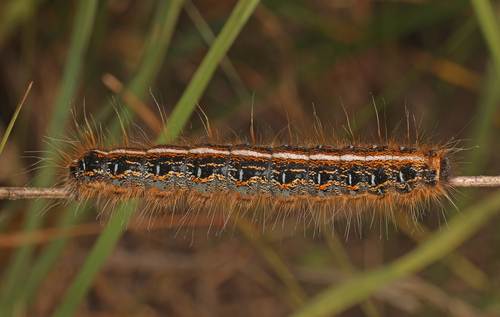
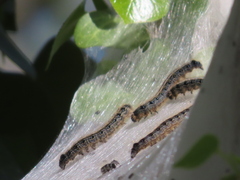
The eastern tent caterpillar (Malacosoma americanum) is a species of moth in the family Lasiocampidae, the tent caterpillars or lappet moths. It is univoltine, producing one generation per year. It is a tent caterpillar, a social species that forms communal nests in the branches of trees. It is sometimes confused with the spongy moth (whose larvae look similar) and the fall webworm (which also builds tents), and may be erroneously referred to as a bagworm, which is the common name applied to unrelated caterpillars in the family Psychidae. The moths oviposit almost exclusively on trees in the plant family Rosaceae, particularly cherry (Prunus) and apple (Malus). The caterpillars are hairy with areas of blue, white, black and orange. The blue and white colors are structural colors created by the selective filtering of light by microtubules that arise on the ball cuticle.

Tent caterpillars are among the most social of larvae. The adult moth lays her eggs in a single batch in late spring or early summer. An egg mass contains about 200 to 300 eggs. Embryogenesis proceeds rapidly, and within three weeks, fully formed caterpillars can be found within the eggs. The... Wikipedia →
Global Distribution

Parks Where Found

# Park Country Daily sighting probability
1 Shenandoah National Park 🇺🇸 United States
~20%
2 Acadia National Park 🇺🇸 United States
~10%
3 Great Smoky Mountains National Park 🇺🇸 United States
~10%

Cities Where Found

# City Country Daily sighting probability
1 Boston 🇺🇸 United States
~20%
2 Washington 🇺🇸 United States
~10%
3 Baltimore 🇺🇸 United States
~10%
4 Philadelphia 🇺🇸 United States
~10%
5 New York City 🇺🇸 United States
~10%
6 Toronto 🇨🇦 Canada
~10%
7 Montreal 🇨🇦 Canada
<5%
8 Orlando 🇺🇸 United States
<5%
9 Austin 🇺🇸 United States
<5%

Before you go

What are the chances of seeing an Eastern Tent Caterpillar Moth in Shenandoah National Park?

Possible

About 20% of wildlife watchers report an Eastern Tent Caterpillar Moth sighting in Shenandoah National Park on a given day, based on 88 verified sightings from GBIF citizen-science data from 2019 to 2026. It is the 28th most-seen of the 723 insects we can rate there. Over three days the chance rises to about 50%, and over a week to about 80%, if each day is a fresh chance.

When is the best time to see an Eastern Tent Caterpillar Moth in Shenandoah National Park?

April and May

In those months about 40% of wildlife watchers report an Eastern Tent Caterpillar Moth in Shenandoah National Park on a given day, against under 5% in July and September–March, the lowest months.

What time of day is best to see an Eastern Tent Caterpillar Moth?

Between 2 and 5 pm

Across all the parks we cover, that three-hour window holds the most Eastern Tent Caterpillar Moth sightings with a recorded time, and about 8 in 10 of them come between 6 am and 6 pm: it is a daytime animal.

Is Shenandoah National Park the best place to see an Eastern Tent Caterpillar Moth?

Yes

Of the 3 parks where we can rate Eastern Tent Caterpillar Moth sightings, Shenandoah National Park has the highest daily chance: about 20%. Next come Acadia National Park (United States, about 10%) and Great Smoky Mountains National Park (United States, about 10%).

Where does the Eastern Tent Caterpillar Moth sighting chance come from?

GBIF citizen-science records

It is estimated from how often the Eastern Tent Caterpillar Moth is recorded against all the insects logged in Shenandoah National Park (88 verified sightings from 2019 to 2026), calibrated against known sighting rates. Figures are rounded to the nearest 10% because citizen-science data supports honest approximations, not decimals, and months with records from fewer than five people show "—". How it works.

← Back to Shenandoah National Park