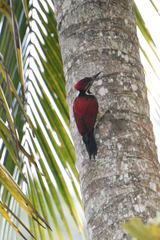
Lesser Sri Lanka Flameback

Lesser Sri Lanka Flameback

Dinopium psarodes

Silhouette: Pepe Reigada · PhyloPic

LCLeast ConcernNTVUENCR Endemic
Daily sighting probability ~40% · Likely
at Sinharaja Forest Reserve

In 3 days ~80% in a week >90%

678 Verified sightings at Sinharaja Forest Reserve From 2019 to 2026
1,217 In all 6 parks
May Best month
🌅 Crepuscular When it's spotted

About the Lesser Sri Lanka Flameback

The Red-backed flameback, Lesser Sri Lanka flameback, Sri Lanka red-backed woodpecker or Ceylon red-backed woodpecker (Dinopium psarodes) is a species of bird in the family Picidae. It is endemic to Sri Lanka, only absent in the far-north. It is sometimes considered a subspecies of the Black-rumped flameback.

It has been considered an endemic species since the time of Legge. It was first placed in the genus Brachypternus as Brachypternus ceylonus. It was later lumped as subspecies of the Black-rumped flameback (Dinopium benghalense), as Dinopium benghalense psarodes. It was elevated to full species status in a study by Sampath S. Seneviratne, Darren E. Irwin, and Saminda P. Fernando.

In this study, it was found to hybridize with the Black-rumped flameback. The hybridization is concentrated north of a border from Trincomalee to the base of Puttalam lagoon and south of a border from Mullaitivu to Mannar. Hybridization is less out of this border, where the Black-rumped flameback dominates north of the border while the Red-backed flameback dominates south of the border. It is a case of Hybrid inferiority, in which the pure species are more successful than the hybrids... Wikipedia →

Sounds

Call0:04

Sri Lanka · 2026

© Uku Paal · XC1097301 · CC BY-NC-SA 4.0

Call0:10

Sri Lanka · 2014

© Andrew Spencer · XC190963 · CC BY-NC-SA 4.0

Global Distribution

Parks Where Found

# Park Country Daily sighting probability
1 Sinharaja Forest Reserve 🇱🇰 Sri Lanka
~40%
2 Minneriya National Park 🇱🇰 Sri Lanka
~20%
3 Yala National Park 🇱🇰 Sri Lanka
~20%
4 Udawalawe National Park 🇱🇰 Sri Lanka
~20%
5 Wilpattu National Park 🇱🇰 Sri Lanka
~20%
6 Horton Plains National Park 🇱🇰 Sri Lanka
<5%

Cities Where Found

# City Country Daily sighting probability
1 Colombo [Sri Jayawardenepura Kotte] 🇱🇰 Sri Lanka
~30%

Before you go

What are the chances of seeing a Lesser Sri Lanka Flameback in Sinharaja Forest Reserve?

Likely

About 40% of wildlife watchers report a Lesser Sri Lanka Flameback sighting in Sinharaja Forest Reserve on a given day, based on 678 verified sightings from GBIF citizen-science data from 2019 to 2026. It is the 32nd most-seen of the 156 birds we can rate there. Over three days the chance rises to about 80%, and over a week to over 90%, if each day is a fresh chance.

When is the best time to see a Lesser Sri Lanka Flameback in Sinharaja Forest Reserve?

April–June and September

In those months about 50% of wildlife watchers report a Lesser Sri Lanka Flameback in Sinharaja Forest Reserve on a given day, against about 30% in January to March, the lowest months.

What time of day is best to see a Lesser Sri Lanka Flameback?

Between 3 and 6 am

Across all the parks we cover, that three-hour window holds the most Lesser Sri Lanka Flameback sightings with a recorded time, and about 6 in 10 of them come between 6 am and 6 pm: it is most active around dawn and dusk.

Is Sinharaja Forest Reserve the best place to see a Lesser Sri Lanka Flameback?

Yes

Of the 6 parks where we can rate Lesser Sri Lanka Flameback sightings, Sinharaja Forest Reserve has the highest daily chance: about 40%. Next come Minneriya National Park (Sri Lanka, about 20%) and Yala National Park (Sri Lanka, about 20%).

Where does the Lesser Sri Lanka Flameback sighting chance come from?

GBIF citizen-science records

It is estimated from how often the Lesser Sri Lanka Flameback is recorded against all the birds logged in Sinharaja Forest Reserve (678 verified sightings from 2019 to 2026), calibrated against known sighting rates. Figures are rounded to the nearest 10% because citizen-science data supports honest approximations, not decimals, and months with records from fewer than five people show "—". How it works.

← Back to Sinharaja Forest Reserve