Green Leafhopper

Green Leafhopper

Cicadella viridis

Daily sighting probability ~10% · With luck
at Snowdonia National Park

In 3 days ~20% in a week ~50%

9 Verified sightings at Snowdonia National Park From 2019 to 2026
97 In all 7 parks
July Best month
☀️ Diurnal When it's spotted

About the Green Leafhopper

Cicadella viridis, sometimes called the "green leafhopper" (but not to be confused with Nephotettix a genus that includes rice pests), is a species of European leafhoppers belonging to the subfamily Cicadellinae. This species is present in most of Europe, in eastern Palearctic realm, in the Near East, in the Nearctic realm, and in the Indomalayan realm.

These leafhoppers inhabit rough grassy areas, peat bogs and mires, wet meadows, near marshes or in swampy habitats, but sometimes live also in drier areas. The adult males of Cicadella viridis can reach a length of 5.7–7 millimetres (0.22–0.28 in), but the females are quite larger than the males, reaching 7.5–9 millimetres (0.30–0.35 in).

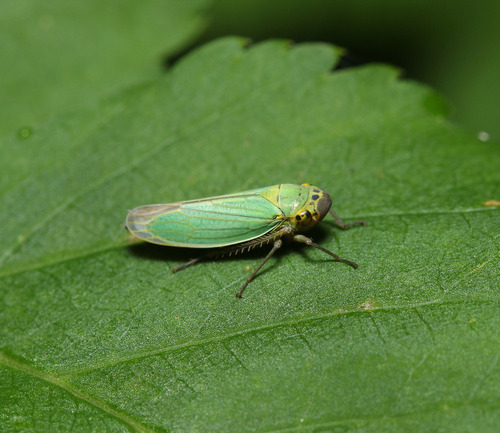
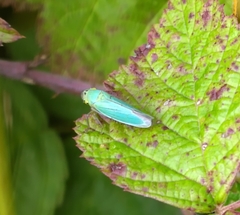
Their pronotum and scutellum are green and yellow. The front head is pale yellow, with two black spots near the compound eyes. The forewings are turquoise green in the females, blue or dark bluish in males (sexual dimorphism). The abdomen is bluish-black.

The larvae are yellowish and have two brownish stripes running from head to the end of the abdomen. Adult leafhoppers can mostly be encountered from July through October. These leafhoppers... Wikipedia →
Global Distribution

Parks Where Found

# Park Country Daily sighting probability
1 Cévennes National Park 🇫🇷 France
~10%
2 Snowdonia National Park 🇬🇧 United Kingdom
~10%
3 Fertő-Hanság National Park 🇭🇺 Hungary
~10%
4 Bavarian Forest National Park 🇩🇪 Germany
~10%
5 Cairngorms National Park 🇬🇧 United Kingdom
~10%
6 Pyrénées National Park 🇫🇷 France
~10%
7 Wadden Sea National Park 🇩🇪 Germany
<5%

Cities Where Found

# City Country Daily sighting probability
1 Manchester 🇬🇧 United Kingdom
~10%
2 Porto 🇵🇹 Portugal
~10%
3 Turin 🇮🇹 Italy
~10%
4 Birmingham 🇬🇧 United Kingdom
~10%
5 Helsinki 🇫🇮 Finland
~10%
6 Rotterdam [The Hague] 🇳🇱 Netherlands
~10%
7 Amsterdam 🇳🇱 Netherlands
~10%
8 Brussels 🇧🇪 Belgium
~10%
9 Milan 🇮🇹 Italy
~10%
10 Hamburg 🇩🇪 Germany
~10%

Before you go

What are the chances of seeing a Green Leafhopper in Snowdonia National Park?

With luck

About 10% of wildlife watchers report a Green Leafhopper sighting in Snowdonia National Park on a given day, based on 9 verified sightings from GBIF citizen-science data from 2019 to 2026. It is the 227th most-seen of the 387 insects we can rate there. Over three days the chance rises to about 20%, and over a week to about 50%, if each day is a fresh chance.

When is the best time to see a Green Leafhopper in Snowdonia National Park?

July

In that month about 20% of wildlife watchers report a Green Leafhopper in Snowdonia National Park on a given day, against under 5% in August and October–June, the lowest months.

What time of day is best to see a Green Leafhopper?

Between 2 and 5 pm

Across all the parks we cover, that three-hour window holds the most Green Leafhopper sightings with a recorded time, and about 8 in 10 of them come between 6 am and 6 pm: it is a daytime animal.

Is Snowdonia National Park the best place to see a Green Leafhopper?

Among the best

Of the 7 parks where we can rate Green Leafhopper sightings, Snowdonia National Park ranks 2nd at about 10%, level with the leaders once rounded. The best odds are in Cévennes National Park (France, about 10%).

Which relatives of the Green Leafhopper live in Snowdonia National Park?

Same order: Hemiptera

The closest relatives of the Green Leafhopper that you can see in Snowdonia National Park (order Hemiptera, True Bugs, Hoppers, Aphids, and allies) are Forest Bug (about 20%), Green Shield Bug (about 20%) and Dock Bug (about 10%), with each one's daily chance of a sighting.

Where does the Green Leafhopper sighting chance come from?

GBIF citizen-science records

It is estimated from how often the Green Leafhopper is recorded against all the insects logged in Snowdonia National Park (9 verified sightings from 2019 to 2026), calibrated against known sighting rates. Figures are rounded to the nearest 10% because citizen-science data supports honest approximations, not decimals, and months with records from fewer than five people show "—". How it works.

← Back to Snowdonia National Park