Dock Bug

Dock Bug

Coreus marginatus

Daily sighting probability ~10% · With luck
at Snowdonia National Park

In 3 days ~40% in a week ~70%

23 Verified sightings at Snowdonia National Park From 2019 to 2026
517 In all 17 parks
August Best month
☀️ Diurnal When it's spotted

About the Dock Bug

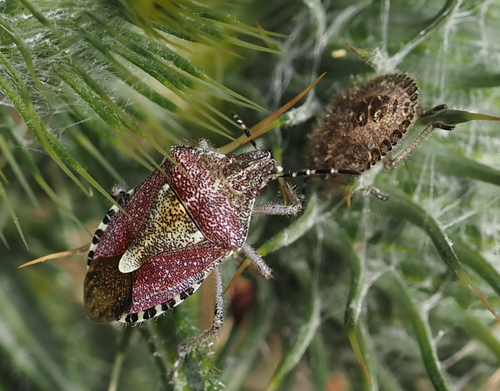
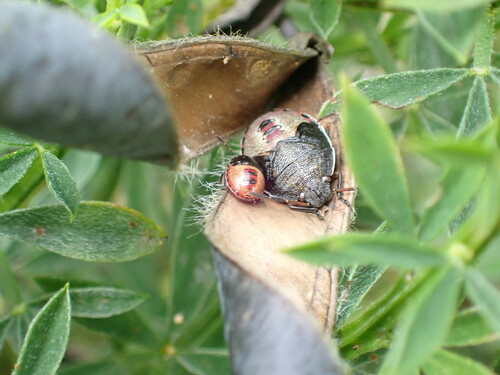
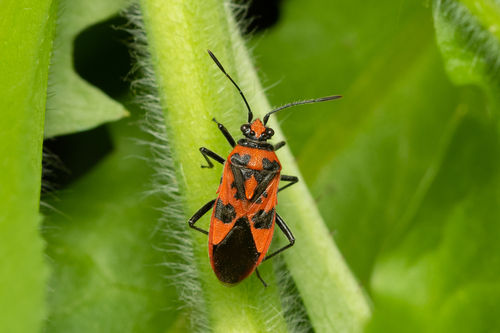
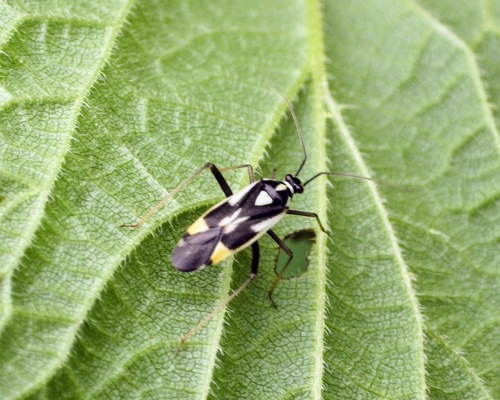
Coreus marginatus is a herbivorous species of true bug in the family Coreidae. It is commonly known as the dock bug as it feeds on the leaves and seeds of docks and sorrels. It is a medium-sized speckled brown insect, between 13 and 15 mm long as an adult, with a broad abdomen. It occurs throughout Europe, Asia and northern Africa. It is often found in dense vegetation, such as hedgerows and wasteland.

This species was among the first Hemiptera formally described in the scientific literature by the Swedish biologist Carl Linnaeus in 1758, under the name Cimex marginatus. It was transferred to the genus Coreus by the Danish zoologist Johan Fabricius in 1794. It has numerous synonyms and was historically placed in the genus Syromastus.

The specific epithet marginatus refers to the prominent margins of the abdomen. The head, pronotum and abdomen of an adult dock bug are speckled reddish brown. The antennae are composed of four segments, red-orange in colour except for the final fourth segment which is black. Between the antennae are two small projections, known as antenniferous tubercles, which can be used to distinguish this species from other superficially... Wikipedia →

Global Distribution

Parks Where Found

# Park Country Daily sighting probability
1 Cévennes National Park 🇫🇷 France
~20%
2 Biebrza National Park 🇵🇱 Poland
~20%
3 Bavarian Forest National Park 🇩🇪 Germany
~20%
4 Picos de Europa National Park 🇪🇸 Spain
~20%
5 Ecrins National Park 🇫🇷 France
~20%
6 Aigüestortes National Park 🇪🇸 Spain
~20%
7 Białowieża National Park 🇵🇱 Poland
~10%
8 Pyrénées National Park 🇫🇷 France
~10%
9 Snowdonia National Park 🇬🇧 United Kingdom
~10%
10 Tatra National Park 🇸🇰 Slovakia
~10%
11 Sierra Nevada National Park 🇪🇸 Spain
~10%
12 Triglav National Park 🇸🇮 Slovenia
~10%
13 Vanoise National Park 🇫🇷 France
~10%
14 Fertő-Hanság National Park 🇭🇺 Hungary
~10%
15 Mercantour National Park 🇫🇷 France
~10%
16 Sierra de Guadarrama National Park 🇪🇸 Spain
~10%
17 Wadden Sea National Park 🇩🇪 Germany
~10%

Cities Where Found

# City Country Daily sighting probability
1 Kharkiv 🇺🇦 Ukraine
~30%
2 Liverpool 🇬🇧 United Kingdom
~30%
3 Birmingham 🇬🇧 United Kingdom
~30%
4 London 🇬🇧 United Kingdom
~20%
5 Brussels 🇧🇪 Belgium
~20%
6 Kyiv 🇺🇦 Ukraine
~20%
7 Paris 🇫🇷 France
~20%
8 Sofia 🇧🇬 Bulgaria
~20%
9 Lyon 🇫🇷 France
~20%
10 Berlin 🇩🇪 Germany
~20%

Before you go

What are the chances of seeing a Dock Bug in Snowdonia National Park?

With luck

About 10% of wildlife watchers report a Dock Bug sighting in Snowdonia National Park on a given day, based on 23 verified sightings from GBIF citizen-science data from 2019 to 2026. It is the 92nd most-seen of the 387 insects we can rate there. Over three days the chance rises to about 40%, and over a week to about 70%, if each day is a fresh chance.

When is the best time to see a Dock Bug in Snowdonia National Park?

August

In that month about 30% of wildlife watchers report a Dock Bug in Snowdonia National Park on a given day, against under 5% in April and October–February, the lowest months.

What time of day is best to see a Dock Bug?

Between 10 am and 1 pm

Across all the parks we cover, that three-hour window holds the most Dock Bug sightings with a recorded time, and about 9 in 10 of them come between 6 am and 6 pm: it is a daytime animal.

Which relatives of the Dock Bug live in Snowdonia National Park?

Same order: Hemiptera

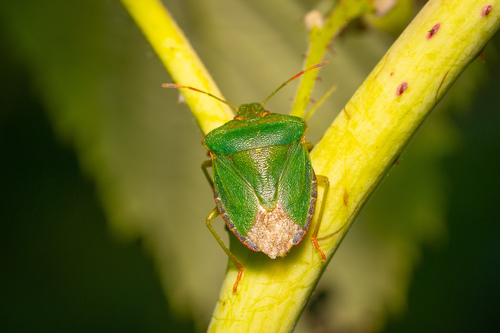
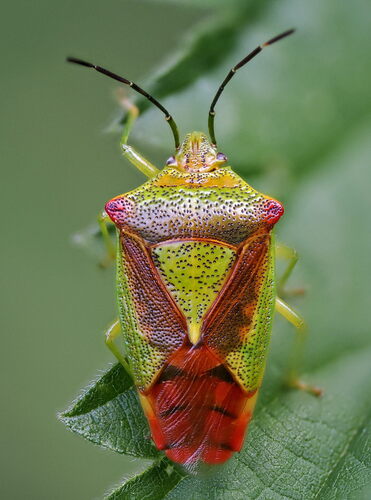
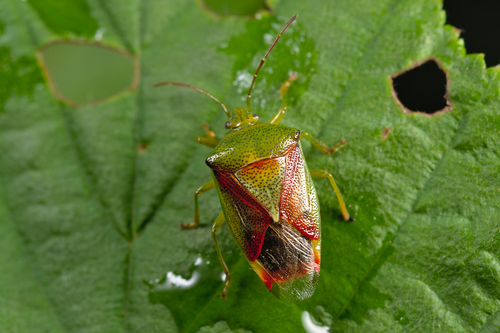
The closest relatives of the Dock Bug that you can see in Snowdonia National Park (order Hemiptera, True Bugs, Hoppers, Aphids, and allies) are Forest Bug (about 20%), Green Shield Bug (about 20%) and Hawthorn Shield Bug (about 10%), with each one's daily chance of a sighting.

Where does the Dock Bug sighting chance come from?

GBIF citizen-science records

It is estimated from how often the Dock Bug is recorded against all the insects logged in Snowdonia National Park (23 verified sightings from 2019 to 2026), calibrated against known sighting rates. Figures are rounded to the nearest 10% because citizen-science data supports honest approximations, not decimals, and months with records from fewer than five people show "—". How it works.

← Back to Snowdonia National Park