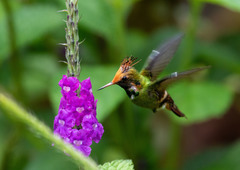
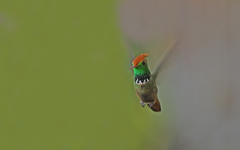

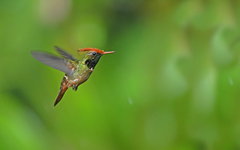

Rufous-crested Coquette

Rufous-crested Coquette

Lophornis delattrei

Silhouette: Ferran Sayol · PhyloPic

LCLeast ConcernNTVUENCR
Daily sighting probability <5% · Rare
at Soberanía National Park

In 3 days <5%

45 Verified sightings at Soberanía National Park From 2019 to 2026
1,103 In all 4 parks
March Best month
☀️ Diurnal When it's spotted

About the Rufous-crested Coquette

The rufous-crested coquette (Lophornis delattrei) is a species of hummingbird native to the tropical slopes of pacific South America. Due to its small size and population, it is a rare sight even within its native region. Males of the species can be easily distinguished by their striking rufous coloured spiked crests, and females, while less obvious, can be identified by their small size and rufous coloured foreheads.

The rufous-crested coquette is a bird in the family Trochilidae, which includes all extant species of hummingbirds. It is a member of the genus Lophornis, which was identified first by the French naturalist and surgeon René Lesson in 1829, and includes a number of extremely small hummingbirds distributed across central and south America. The rufous-crested coquette was identified by Lesson in 1839, and is thought to be closely related to the tufted coquette.

An extremely similar species of coquette is endemic to a small region of Guerrero Mexico. This bird's taxonomic classification is debated, and some ornithologists list it as the independent coquette species Lophornis brachylophus, but has also been classified as a subspecies of the rufous... Wikipedia →

Sounds

Call0:10

Peru · 2016

© Dries Van de Loock · XC682240 · CC BY-NC-SA 4.0

Call1:07

Peru · 2014

© Dan Lane · XC277061 · CC BY-NC-SA 4.0

Call0:22

Panama · 2012

© William Adsett · XC94747 · CC BY-NC-ND 2.5

Global Distribution

Parks Where Found

# Park Country Daily sighting probability
1 Manu National Park 🇵🇪 Peru
~20%
2 Chagres National Park 🇵🇦 Panama
~10%
3 Darién National Park 🇵🇦 Panama
<5%
4 Soberanía National Park 🇵🇦 Panama
<5%

Before you go

What are the chances of seeing a Rufous-crested Coquette in Soberanía National Park?

Rare

Under 5% of wildlife watchers report a Rufous-crested Coquette sighting in Soberanía National Park on a given day, based on 45 verified sightings from GBIF citizen-science data from 2019 to 2026. It is the 353rd most-seen of the 449 birds we can rate there. Over three days the chance rises to under 5%, if each day is a fresh chance.

When is the best time to see a Rufous-crested Coquette in Soberanía National Park?

Any time of year

In every month with enough records, under 5% of wildlife watchers report a Rufous-crested Coquette in Soberanía National Park on a given day, so our monthly data shows no clear season.

What time of day is best to see a Rufous-crested Coquette?

Between 8 and 11 am

Across all the parks we cover, that three-hour window holds the most Rufous-crested Coquette sightings with a recorded time, and about 9 in 10 of them come between 6 am and 6 pm: it is a daytime animal.

Is Soberanía National Park the best place to see a Rufous-crested Coquette?

4th of 4

Of the 4 parks where we can rate Rufous-crested Coquette sightings, Soberanía National Park ranks 4th at under 5%. The best odds are in Manu National Park (Peru, about 20%), Chagres National Park (Panama, about 10%) and Darién National Park (Panama, under 5%).

Which relatives of the Rufous-crested Coquette live in Soberanía National Park?

Same family: Trochilidae

The closest relatives of the Rufous-crested Coquette that you can see in Soberanía National Park (family Trochilidae, Hummingbirds) are White-necked Jacobin (about 40%), Violet-bellied Hummingbird (about 40%) and Long-billed Hermit (about 40%), with each one's daily chance of a sighting.

Where does the Rufous-crested Coquette sighting chance come from?

GBIF citizen-science records

It is estimated from how often the Rufous-crested Coquette is recorded against all the birds logged in Soberanía National Park (45 verified sightings from 2019 to 2026), calibrated against known sighting rates. Figures are rounded to the nearest 10% because citizen-science data supports honest approximations, not decimals, and months with records from fewer than five people show "—". How it works.

← Back to Soberanía National Park