African Wood-Owl

African Wood-Owl

Strix woodfordii

Silhouette: Matías Muñoz · PhyloPic

LCLeast ConcernNTVUENCR
Daily sighting probability ~10% · With luck
at South Luangwa National Park

In 3 days ~20% in a week ~30%

43 Verified sightings at South Luangwa National Park From 2019 to 2026
962 In all 22 parks
May Best month
🌅 Crepuscular When it's spotted

About the African Wood-Owl

The African wood owl (Strix woodfordii) or Woodford's owl, is a typical owl from the genus Strix in the family Strigidae and is arguably the most common forest owl in Africa. It inhabits wooded areas and possesses a distinctive call. During the day it roosts singly or in pairs in dense cover, high in trees, whilst at night it forages for food.

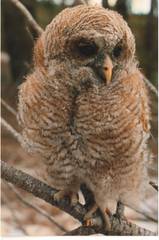
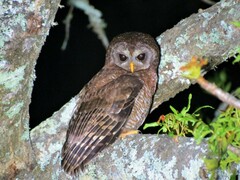
The African wood owl is a medium-sized owl which has the typical rounded head of the genus Strix, similar to the Palearctic tawny owl or Holarctic great grey owl, with large dark eyes outlined by white eyebrows. The rest of the head is generally dark brown with white spots and a prominent yellow beak. It has a white belly with brown barring and has and overall rich brown plumage with paler underparts, but this varies considerably across its range. Juveniles are a paler rufous colour. It is 30.5 to 35 cm (12.0 to 13.8 in) long and weighs from 240 to 350 grams (8.5 to 12.3 oz).

The typical song, like that of the tawny owl, is a duet between the male and the female, the male makes a series of rapid, clear hoots, and the female answers with higher pitched, more leisurely hoots. Each series of hoots (for each sex) comprise... Wikipedia →

Sounds

Song1:29

Kenya · 2026

© Ding Li Yong · XC1177558 · CC BY-NC-ND 4.0

Call1:05

South Africa · 2023

© Marc Anderson · XC875568 · CC BY-NC-ND 4.0

Duet0:23

Mozambique · 1965

© Nature sounds by Simply Birding · XC651902 · CC BY-NC-ND 4.0

Global Distribution

Parks Where Found

# Park Country Daily sighting probability
1 Mana Pools National Park 🇿🇼 Zimbabwe
~10%
2 Gonarezhou National Park 🇿🇼 Zimbabwe
~10%
3 Lower Zambezi National Park 🇿🇲 Zambia
~10%
4 Kafue National Park 🇿🇲 Zambia
~10%
5 Bwindi Impenetrable National Park 🇺🇬 Uganda
~10%
6 Gorongosa National Park 🇲🇿 Mozambique
~10%
7 Semuliki National Park 🇺🇬 Uganda
~10%
8 South Luangwa National Park 🇿🇲 Zambia
~10%
9 Bale Mountains National Park 🇪🇹 Ethiopia
<5%
10 Kibale National Park 🇺🇬 Uganda
<5%
11 uMkhuze Game Reserve 🇿🇦 South Africa
<5%
12 iSimangaliso Wetland Park 🇿🇦 South Africa
<5%
13 Arusha National Park 🇹🇿 Tanzania
<5%
14 Mikumi National Park 🇹🇿 Tanzania
<5%
15 Liwonde National Park 🇲🇼 Malawi
<5%
16 Kruger National Park 🇿🇦 South Africa
<5%
17 Garden Route National Park 🇿🇦 South Africa
<5%
18 Nyungwe National Park 🇷🇼 Rwanda
<5%
19 Queen Elizabeth National Park 🇺🇬 Uganda
<5%
20 Chobe National Park 🇧🇼 Botswana
<5%
21 Table Mountain National Park 🇿🇦 South Africa
<5%
22 Serengeti National Park 🇹🇿 Tanzania
<5%

Cities Where Found

# City Country Daily sighting probability
1 Kampala 🇺🇬 Uganda
~10%
2 Nairobi 🇰🇪 Kenya
<5%
3 Addis Ababa 🇪🇹 Ethiopia
<5%

Zoos & Centres Where Found

# Zoo / Centre Country
1 Dullstroom Bird Of Prey & Rehabilitation Centre 🇿🇦 South Africa In captivity
2 Small Breeds Farm Park 🇬🇧 United Kingdom In captivity
3 World of Birds Wildlife Sanctuary and Monkey Park 🇿🇦 South Africa In captivity
4 Lory Park Zoo 🇿🇦 South Africa In captivity
5 African Bird of Prey Sanctuary 🇿🇦 South Africa In captivity
6 Falconry of Kenya 🇰🇪 Kenya In captivity

Before you go

What are the chances of seeing an African Wood-Owl in South Luangwa National Park?

With luck

About 10% of wildlife watchers report an African Wood-Owl sighting in South Luangwa National Park on a given day, based on 43 verified sightings from GBIF citizen-science data from 2019 to 2026. It is the 157th most-seen of the 257 birds we can rate there. Over three days the chance rises to about 20%, and over a week to about 30%, if each day is a fresh chance.

When is the best time to see an African Wood-Owl in South Luangwa National Park?

May

In that month about 20% of wildlife watchers report an African Wood-Owl in South Luangwa National Park on a given day, against under 5% in March, July and September–January, the lowest months. That is one of South Luangwa National Park's driest months, with about 5 mm of rain against 310 mm in January.

What time of day is best to see an African Wood-Owl?

Between 7 and 10 pm

Across all the parks we cover, that three-hour window holds the most African Wood-Owl sightings with a recorded time, and about half of them come between 6 pm and 6 am: it is most active around dawn and dusk.

Is South Luangwa National Park the best place to see an African Wood-Owl?

Among the best

Of the 22 parks where we can rate African Wood-Owl sightings, South Luangwa National Park ranks 8th at about 10%, level with the leaders once rounded. The best odds are in Mana Pools National Park (Zimbabwe, about 10%), Gonarezhou National Park (Zimbabwe, about 10%) and Lower Zambezi National Park (Zambia, about 10%).

Which relatives of the African Wood-Owl live in South Luangwa National Park?

Same family: Strigidae

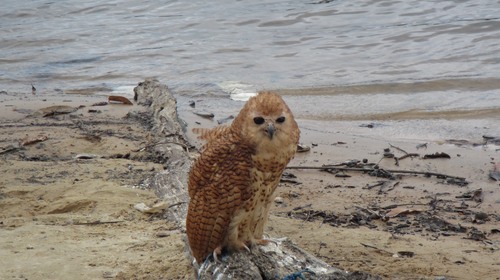
The closest relatives of the African Wood-Owl that you can see in South Luangwa National Park (family Strigidae, Typical Owls) are Verreaux's Eagle-Owl (about 10%) and Pel's Fishing-Owl (about 10%), with each one's daily chance of a sighting.

Where does the African Wood-Owl sighting chance come from?

GBIF citizen-science records

It is estimated from how often the African Wood-Owl is recorded against all the birds logged in South Luangwa National Park (43 verified sightings from 2019 to 2026), calibrated against known sighting rates. Figures are rounded to the nearest 10% because citizen-science data supports honest approximations, not decimals, and months with records from fewer than five people show "—". How it works.

← Back to South Luangwa National Park