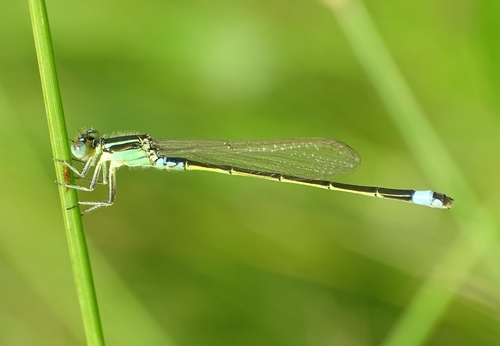
Common Bluetail

Common Bluetail

Ischnura senegalensis

Daily sighting probability ~20% · Possible
at South Luangwa National Park

In 3 days ~50% in a week ~80%

6 Verified sightings at South Luangwa National Park From 2019 to 2026
864 In all 10 parks
September Best month
☀️ Diurnal When it's spotted

About the Common Bluetail

Ischnura senegalensis, also known variously as common bluetail, marsh bluetail, ubiquitous bluetail, African bluetail, and Senegal golden dartlet, is a widespread damselfly of the family Coenagrionidae. It is native from Africa, through the Middle East, to southern and eastern Asia.

It is a small damselfly with black capped bluish green eyes. Its thorax is black on dorsum and greenish blue on the sides. Its abdomen is black on dorsum up to segment 7. Segments 1 and 2 are greenish blue and 3 to 7 are khaki yellow on the sides. Segments 8 and 9 are azure blue, with 9 black on dorsum. Segment 10 is black on dorsum and khaki yellow on the sides. The green on thorax and abdomen may turn to blue in both male and female when aged.

The females of this species exhibit sexual mimicry. One group mimics the males' colour (androchromes). Other group will have their own female colouration (gynochromes). Androchrom female looks exactly like the male except in sexual characteristics. In gynochrome, the eyes are olive green with orange above. Sides of the thorax is mud colored, will pale when matured. All the abdominal segments are marked with black on dorsum. The lateral... Wikipedia →
Global Distribution

Parks Where Found

# Park Country Daily sighting probability
1 Keoladeo National Park 🇮🇳 India
~30%
2 Garden Route National Park 🇿🇦 South Africa
~30%
3 De Hoop Nature Reserve 🇿🇦 South Africa
~30%
4 South Luangwa National Park 🇿🇲 Zambia
~20%
5 iSimangaliso Wetland Park 🇿🇦 South Africa
~20%
6 Addo Elephant National Park 🇿🇦 South Africa
~20%
7 Table Mountain National Park 🇿🇦 South Africa
~10%
8 Kruger National Park 🇿🇦 South Africa
~10%
9 Kaeng Krachan National Park 🇹🇭 Thailand
~10%
10 Pilanesberg National Park 🇿🇦 South Africa
~10%

Cities Where Found

# City Country Daily sighting probability
1 Antananarivo 🇲🇬 Madagascar
~50%
2 Kota 🇮🇳 India
~40%
3 Berhampore 🇮🇳 India
~30%
4 Taichung 🇹🇼 Taiwan
~30%
5 Kochi 🇮🇳 India
~30%
6 Vasai-Virar 🇮🇳 India
~30%
7 Mysuru 🇮🇳 India
~30%
8 Kolkata 🇮🇳 India
~20%
9 Chennai 🇮🇳 India
~20%
10 Yogyakarta 🇮🇩 Indonesia
~20%

Before you go

What are the chances of seeing a Common Bluetail in South Luangwa National Park?

Possible

About 20% of wildlife watchers report a Common Bluetail sighting in South Luangwa National Park on a given day, based on 6 verified sightings from GBIF citizen-science data from 2019 to 2026. It is the 6th most-seen of the 9 insects we can rate there. Over three days the chance rises to about 50%, and over a week to about 80%, if each day is a fresh chance.

When is the best time to see a Common Bluetail in South Luangwa National Park?

September

In that month about 60% of wildlife watchers report a Common Bluetail in South Luangwa National Park on a given day, against under 5% in April–July and October–November, the lowest months. That is one of South Luangwa National Park's driest months, with almost no rain against 310 mm in January.

What time of day is best to see a Common Bluetail?

Between 10 am and 1 pm

Across all the parks we cover, that three-hour window holds the most Common Bluetail sightings with a recorded time, and about 9 in 10 of them come between 6 am and 6 pm: it is a daytime animal.

Is South Luangwa National Park the best place to see a Common Bluetail?

4th of 10

Of the 10 parks where we can rate Common Bluetail sightings, South Luangwa National Park ranks 4th at about 20%. The best odds are in Keoladeo National Park (India, about 30%), Garden Route National Park (South Africa, about 30%) and De Hoop Nature Reserve (South Africa, about 30%).

Which relatives of the Common Bluetail live in South Luangwa National Park?

Same order: Odonata

The closest relatives of the Common Bluetail that you can see in South Luangwa National Park (order Odonata, Dragonflies and Damselflies) are Southern Banded Groundling (about 40%), Lucia Widow (about 30%) and Red Basker (about 20%), with each one's daily chance of a sighting.

Where does the Common Bluetail sighting chance come from?

GBIF citizen-science records

It is estimated from how often the Common Bluetail is recorded against all the insects logged in South Luangwa National Park (6 verified sightings from 2019 to 2026), calibrated against known sighting rates. Figures are rounded to the nearest 10% because citizen-science data supports honest approximations, not decimals, and months with records from fewer than five people show "—". How it works.

← Back to South Luangwa National Park