Beluga

Beluga

Delphinapterus leucas

LCLeast ConcernNTVUENCR
Daily sighting probability ~40% · Likely
at Svalbard

In 3 days ~80% in a week >90%

113 Verified sightings at Svalbard From 2019 to 2026
113 In 1 park
February Best month
☀️ Diurnal When it's spotted

About the Beluga

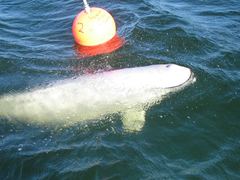
The beluga whale or the white whale (Delphinapterus leucas) is an Arctic and sub-Arctic cetacean. It is one of two living members of the family Monodontidae, along with the narwhal, and the only member of the genus Delphinapterus. It is also known as the sea canary, due to its high-pitched calls; and the melonhead, though that more commonly refers to the melon-headed whale, which is an oceanic dolphin.

The beluga is adapted to life in the Arctic, with anatomical and physiological characteristics that differentiate it from other cetaceans. Amongst these are its all-white colour that gives the whale its name; and the absence of a dorsal fin, which allows it to swim under ice with ease. It possesses a distinctive protuberance at the front of its head which houses an echolocation organ called the melon, which in this species is large and deformable. The beluga's body size is between that of a dolphin and a True's beaked whale, with males growing up to 5.5 m (18 ft) long and weighing up to 1,600 kg (3,530 lb). This whale has a stocky body. Like many cetaceans, a large percentage of its weight is blubber (subcutaneous fat). Its sense of hearing is highly developed and its echolocation allows it to move about and find breathing holes under sheet ice.

Belugas are gregarious and form groups of 10 animals on average, although during the summer, they can gather in the hundreds or even thousands in estuaries and shallow coastal areas. They are slow swimmers, but can dive to 700 m (2,300 ft) below the surface. They are opportunistic feeders and their diets vary according to their locations and the season. The majority of belugas live in the Arctic Ocean and the seas and coasts around North America, Russia, and Greenland; their worldwide population is thought to number around 200,000. Belugas are migratory and the majority of groups spend the winter around the Arctic ice cap; when the sea ice melts in summer, they move to warmer river estuaries and coastal areas. Some populations are sedentary and do not migrate over great distances during the year.

The native peoples of North America and Russia have hunted belugas for many centuries. They were also hunted by non-natives, primarily Europeans, during the 19th century and part of the 20th century. Hunting of belugas is not controlled by the International Whaling Commission, and each country has developed its own regulations in different years. Wikipedia →

Global Distribution

Parks Where Found

# Park Country Daily sighting probability
1 Svalbard 🇳🇴 Norway
~40%

More parks will be added in future updates.

Cities Where Found

# City Country Daily sighting probability
1 Anchorage 🇺🇸 United States
~10%

Zoos & Centres Where Found

# Zoo / Centre Country
1 Zhuhai Chimelong Ocean Kingdom 🇨🇳 China In captivity
2 Shanghai Haichang Ocean Park 🇨🇳 China In captivity
3 SeaWorld Orlando 🇺🇸 United States In captivity
4 Chimelong Spaceship 🇨🇳 China In captivity
5 SeaWorld San Diego 🇺🇸 United States In captivity
6 Shedd Aquarium 🇺🇸 United States In captivity
7 Bronx Zoo 🇺🇸 United States In captivity
8 SeaWorld San Antonio 🇺🇸 United States In captivity
9 Beijing Zoo 🇨🇳 China In captivity
10 Safari World 🇹🇭 Thailand In captivity
11 Leofoo Village Theme Park 🇹🇼 Taiwan In captivity
12 Ukumarí Biopark 🇨🇴 Colombia In captivity
13 San Antonio Zoo 🇺🇸 United States In captivity
14 Discovery Cove 🇺🇸 United States In captivity
15 Yokohama Hakkeijima Sea Paradise 🇯🇵 Japan In captivity
16 L'Oceanogràfic 🇪🇸 Spain In captivity
17 Mystic Aquarium & Institute for Exploration 🇺🇸 United States In captivity
18 New York Aquarium 🇺🇸 United States In captivity
19 Port of Nagoya Public Aquarium 🇯🇵 Japan In captivity
20 Georgia Aquarium 🇺🇸 United States In captivity
21 Vancouver Aquarium 🇨🇦 Canada In captivity
22 Moskvarium 🇷🇺 Russia In captivity
23 Ripley's Aquarium of Canada 🇨🇦 Canada In captivity
24 海兽馆 🇨🇳 China In captivity
25 Dolphinarium in Lazorevskoe 🇷🇺 Russia In captivity
26 Hanhwa Aqua Planet Yeosu 🇰🇷 South Korea In captivity
27 National Museum of Marine Biology and Aquarium 🇹🇼 Taiwan In captivity
28 Okeanarium in Lazorevskoe 🇷🇺 Russia In captivity
29 Sæheimar Aquarium 🇮🇸 Iceland In captivity

Before you go

What are the chances of seeing a Beluga in Svalbard?

Likely

About 40% of wildlife watchers report a Beluga sighting in Svalbard on a given day, based on 113 verified sightings from GBIF citizen-science data from 2019 to 2026. It is the 7th most-seen of the 14 mammals we can rate there. Over three days the chance rises to about 80%, and over a week to over 90%, if each day is a fresh chance.

When is the best time to see a Beluga in Svalbard?

February and September

In those months about 60% of wildlife watchers report a Beluga in Svalbard on a given day, against about 10% in March, the lowest month. December has too few records to rate.

What time of day is best to see a Beluga?

Between 9 am and noon

Across all the parks we cover, that three-hour window holds the most Beluga sightings with a recorded time, and about 8 in 10 of them come between 6 am and 6 pm: it is a daytime animal.

Where else can you see a Beluga?

Only Svalbard, in our data

Svalbard is the only park on Wallace's Line with enough records to rate Beluga sightings: about 40% of wildlife watchers there report one on a given day.

Which relatives of the Beluga live in Svalbard?

Same order: Cetacea

The closest relatives of the Beluga that you can see in Svalbard (order Cetacea) are Minke Whale (about 40%), Humpback Whale (about 30%) and Fin Whale (about 20%), with each one's daily chance of a sighting.

Where does the Beluga sighting chance come from?

GBIF citizen-science records

It is estimated from how often the Beluga is recorded against all the mammals logged in Svalbard (113 verified sightings from 2019 to 2026), calibrated against known sighting rates. Figures are rounded to the nearest 10% because citizen-science data supports honest approximations, not decimals, and months with records from fewer than five people show "—". How it works.

← Back to Svalbard
