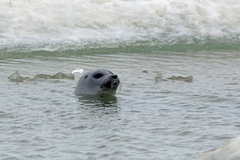
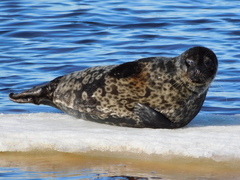
Ringed Seal

Ringed Seal

Pusa hispida

Silhouette: Tracy A. Heath · PhyloPic

LCLeast ConcernNTVUENCR
Daily sighting probability ~20% · Possible
at Svalbard

In 3 days ~60% in a week ~80%

31 Verified sightings at Svalbard From 2019 to 2026
31 In 1 park
June Best month
☀️🌙 Day & Night When it's spotted

About the Ringed Seal

The ringed seal (Pusa hispida) is a small earless seal species found in Arctic and sub-Arctic regions. Its common name is derived from a distinctive patterning of dark spots surrounded by light gray rings. The ringed seal is the most abundant and wide-ranging ice seal in the Northern Hemisphere; they can be found throughout the Arctic Ocean, into the Bering Sea and Okhotsk Sea as far south as the northern coast of Japan in the Pacific, and throughout the North Atlantic coasts of Greenland, Baltic Sea, Scandinavia as far south as Newfoundland. Two freshwater subspecies live in northern Europe. They are the smallest members of the seal family found in these regions, averaging 1.5 metres (5 ft) in length.

The average lifespan of a ringed seal is 40 years. They have a solitary lifestyle, and their diet consists mostly of Arctic cod and planktonic crustaceans. They are a primary prey of polar bears – which are their primary predator – and killer whales, and have long been a component of the diet of indigenous people of the Arctic.

Recently, the biggest threat to ringed seals has been the changing temperature in the Arctic and the detrimental changes to sea ice that follow. Declines in snowpack and sea ice due to increasing ocean temperatures and atmospheric temperatures poses a threat to their survival. However, some projections indicate that the extinction of their predators due to warming may ultimately allow ringed seal numbers to thrive. Wikipedia →

Global Distribution

Parks Where Found

# Park Country Daily sighting probability
1 Svalbard 🇳🇴 Norway
~20%

More parks will be added in future updates.

Zoos & Centres Where Found

# Zoo / Centre Country
1 Karlsruhe Zoo 🇩🇪 Germany In captivity
2 Ecomare 🇳🇱 Netherlands In captivity
3 Osaka Aquarium Kaiyukan 🇯🇵 Japan In captivity
4 Polaria 🇳🇴 Norway In captivity

Before you go

What are the chances of seeing a Ringed Seal in Svalbard?

Possible

About 20% of wildlife watchers report a Ringed Seal sighting in Svalbard on a given day, based on 31 verified sightings from GBIF citizen-science data from 2019 to 2026. It is the 11th most-seen of the 14 mammals we can rate there. Over three days the chance rises to about 60%, and over a week to about 80%, if each day is a fresh chance.

When is the best time to see a Ringed Seal in Svalbard?

June

In that month about 30% of wildlife watchers report a Ringed Seal in Svalbard on a given day, against under 5% in March and April, the lowest months. December has too few records to rate.

What time of day is best to see a Ringed Seal?

Between 3 and 6 pm

Across all the parks we cover, that three-hour window holds the most Ringed Seal sightings with a recorded time, and about 6 in 10 of them come between 6 am and 6 pm: it is seen both by day and at night.

Where else can you see a Ringed Seal?

Only Svalbard, in our data

Svalbard is the only park on Wallace's Line with enough records to rate Ringed Seal sightings: about 20% of wildlife watchers there report one on a given day.

Which relatives of the Ringed Seal live in Svalbard?

Same family: Phocidae

The closest relatives of the Ringed Seal that you can see in Svalbard (family Phocidae, Earless Seals) are Harbor Seal (about 50%), Bearded Seal (about 50%) and Harp Seal (about 10%), with each one's daily chance of a sighting.

Where does the Ringed Seal sighting chance come from?

GBIF citizen-science records

It is estimated from how often the Ringed Seal is recorded against all the mammals logged in Svalbard (31 verified sightings from 2019 to 2026), calibrated against known sighting rates. Figures are rounded to the nearest 10% because citizen-science data supports honest approximations, not decimals, and months with records from fewer than five people show "—". How it works.

← Back to Svalbard