Walrus

Walrus

Odobenus rosmarus

Silhouette: Steven Traver · PhyloPic

LCNTVUVulnerableENCR
Daily sighting probability ~80% · Very likely
at Svalbard

In 3 days >90%

626 Verified sightings at Svalbard From 2019 to 2026
626 In 1 park
March Best month
☀️ Diurnal When it's spotted

About the Walrus

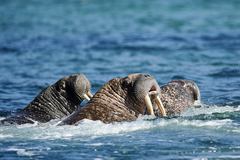
The walrus (Odobenus rosmarus; plural walrus or walruses) is a large pinniped marine mammal with discontinuous distribution about the North Pole in the Arctic Ocean and subarctic seas of the Northern Hemisphere. It is the only extant species in the family Odobenidae and genus Odobenus.

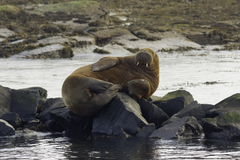
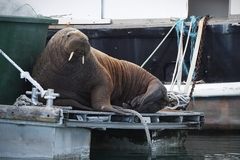
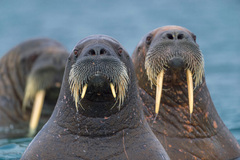
Adult walrus are characterised by prominent tusks and whiskers, and considerable bulk; adult males in the Pacific can weigh more than 2,000 kilograms (4,400 pounds) and, among pinnipeds, are exceeded in size only by the two species of elephant seals. Walrus live mostly in shallow waters above the continental shelves, spending significant amounts of their lives on the sea ice looking for benthic bivalve molluscs. Walruses are relatively long-lived, social and intelligent animals, and are considered a keystone species of the Arctic marine region.

The walrus has played a prominent role in the cultures of many indigenous Arctic peoples, who have hunted it for meat, fat, skin, tusks, and bone. During the 19th century and the early 20th century, walrus were widely hunted for their blubber, walrus ivory, leather, and meat; in this period, the walrus population dropped rapidly all around the Arctic region. It has rebounded somewhat since, though the populations of Atlantic and Laptev walruses remain fragmented and at low levels compared with the time before human interference. Wikipedia →

Global Distribution

Parks Where Found

# Park Country Daily sighting probability
1 Svalbard 🇳🇴 Norway
~80%

More parks will be added in future updates.

Zoos & Centres Where Found

# Zoo / Centre Country
1 SeaWorld San Diego 🇺🇸 United States In captivity
2 Pairi Daiza 🇧🇪 Belgium In captivity
3 Denver Zoo 🇺🇸 United States In captivity
4 Copenhagen Zoo 🇩🇰 Denmark In captivity
5 Izhevsk Zoo 🇷🇺 Russia In captivity
6 Safari World 🇹🇭 Thailand In captivity
7 Wildpark Schwarze Berge 🇩🇪 Germany In captivity
8 Indianapolis Zoo 🇺🇸 United States In captivity
9 Emirates Park Zoo 🇦🇪 United Arab Emirates In captivity
10 Pittsburgh Zoo & Aquarium 🇺🇸 United States In captivity
11 Point Defiance Zoo & Aquarium 🇺🇸 United States In captivity
12 Aquarium du Québec 🇨🇦 Canada In captivity
13 L'Oceanogràfic 🇪🇸 Spain In captivity
14 Hong Kong Zoological and Botanical Gardens 🇨🇳 China In captivity
15 Kinosaki Marine World 🇯🇵 Japan In captivity
16 Minami Chita Beach Land 🇯🇵 Japan In captivity
17 Zero Distance Aquarium Ise Sea Paradise 🇯🇵 Japan In captivity
18 Alaska SeaLife Center 🇺🇸 United States In captivity
19 SEA LIFE Orlando Aquarium 🇺🇸 United States In captivity
20 Edward Youde Aviary 🇭🇰 Hong Kong SAR China In captivity
21 Shanghai Ocean Aquarium 🇨🇳 China In captivity
22 Aviary 🇭🇰 Hong Kong SAR China In captivity
23 Izu Mito Sea Paradise 🇯🇵 Japan In captivity
24 Polaria 🇳🇴 Norway In captivity
25 Grandview Mall Aquarium 🇨🇳 China In captivity
26 Kung Fu Corals 🇺🇸 United States In captivity
27 Ocean Park Hong Kong 🇨🇳 China In captivity
28 Sea Life Arizona 🇺🇸 United States In captivity

Before you go

What are the chances of seeing a Walrus in Svalbard?

Very likely

About 80% of wildlife watchers report a Walrus sighting in Svalbard on a given day, based on 626 verified sightings from GBIF citizen-science data from 2019 to 2026. It is the 2nd most-seen of the 14 mammals we can rate there. Over three days the chance rises to over 90%, if each day is a fresh chance.

When is the best time to see a Walrus in Svalbard?

March and May–September

In those months about 80% of wildlife watchers report a Walrus in Svalbard on a given day, against about 30% in January–February and October–November, the lowest months. December has too few records to rate.

What time of day is best to see a Walrus?

Between 9 am and noon

Across all the parks we cover, that three-hour window holds the most Walrus sightings with a recorded time, and about 8 in 10 of them come between 6 am and 6 pm: it is a daytime animal.

Where else can you see a Walrus?

Only Svalbard, in our data

Svalbard is the only park on Wallace's Line with enough records to rate Walrus sightings: about 80% of wildlife watchers there report one on a given day.

Which relatives of the Walrus live in Svalbard?

Same order: Carnivora

The closest relatives of the Walrus that you can see in Svalbard (order Carnivora, Carnivorans) are Arctic Fox (about 80%), Polar Bear (about 80%) and Harbor Seal (about 50%), with each one's daily chance of a sighting.

Where does the Walrus sighting chance come from?

GBIF citizen-science records

It is estimated from how often the Walrus is recorded against all the mammals logged in Svalbard (626 verified sightings from 2019 to 2026), calibrated against known sighting rates. Figures are rounded to the nearest 10% because citizen-science data supports honest approximations, not decimals, and months with records from fewer than five people show "—". How it works.

← Back to Svalbard