Polar Bear

Polar Bear

Ursus maritimus

LCNTVUVulnerableENCR
Daily sighting probability ~80% · Very likely
at Svalbard

In 3 days >90%

387 Verified sightings at Svalbard From 2019 to 2026
387 In 1 park
August Best month
☀️ Diurnal When it's spotted

About the Polar Bear

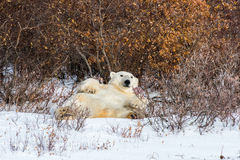
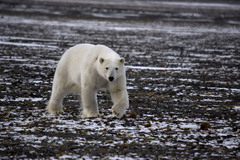
The polar bear (Ursus maritimus) is a large bear native to the Arctic and nearby areas. It is closely related to the brown bear, and the two species can interbreed. The polar bear is the largest extant species of bear and land carnivore by body mass, with adult males weighing 300–800 kg (660–1,760 lb). The species is sexually dimorphic, as adult females are much smaller. The polar bear is white or yellowish-furred with black skin and a thick layer of fat. It is more slender than the brown bear, with a narrower skull, longer neck and lower shoulder hump. Its teeth are sharper and more adapted to cutting meat. The paws are large and allow the bear to walk on ice and paddle in the water.

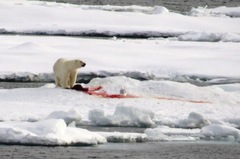
Polar bears are both terrestrial and pagophilic (ice-living) and are considered marine mammals because of their dependence on marine ecosystems. They prefer the annual sea ice but live on land when the ice melts in the summer. They are mostly carnivorous and specialized for preying on seals, particularly ringed seals. Such prey is typically taken by ambush; the bear may stalk its prey on the ice or in the water, but also will stay at a breathing hole or ice edge to wait for prey to swim by. The bear primarily feeds on the seal's energy-rich blubber. Other prey include walruses, beluga whales and some terrestrial animals. Polar bears are usually solitary but can be found in groups when on land. During the breeding season, male bears guard females and defend them from rivals. Mothers give birth to cubs in maternity dens during the winter. Young stay with their mother for up to two and a half years.

The polar bear is considered a vulnerable species by the International Union for Conservation of Nature (IUCN) with an estimated total population of 22,000 to 31,000 individuals. Its biggest threats are climate change, pollution and energy development. Climate change has caused a decline in sea ice, giving the polar bear less access to its favoured prey and increasing the risk of malnutrition, starvation, and eventually death. Less sea ice also means that the bears must spend more time on land, increasing conflicts with humans. Polar bears have been hunted, both by native and non-native peoples, for their coats, meat and other items. They have been kept in captivity in zoos and circuses and are prevalent in art, folklore, religion and modern culture. Wikipedia →

Global Distribution

Parks Where Found

# Park Country Daily sighting probability
1 Svalbard 🇳🇴 Norway
~80%

More parks will be added in future updates.

Zoos & Centres Where Found

# Zoo / Centre Country
1 Zhuhai Chimelong Ocean Kingdom 🇨🇳 China In captivity
2 Shanghai Haichang Ocean Park 🇨🇳 China In captivity
3 Chimelong Spaceship 🇨🇳 China In captivity
4 SeaWorld San Diego 🇺🇸 United States In captivity
5 San Diego Zoo 🇺🇸 United States In captivity
6 Moscow Zoo 🇷🇺 Russia In captivity
7 Pairi Daiza 🇧🇪 Belgium In captivity
8 Prague Zoo 🇨🇿 Czechia In captivity
9 Shedd Aquarium 🇺🇸 United States In captivity
10 Denver Zoo 🇺🇸 United States In captivity
11 Copenhagen Zoo 🇩🇰 Denmark In captivity
12 Tierpark Berlin 🇩🇪 Germany In captivity
13 North Carolina Zoo 🇺🇸 United States In captivity
14 Yekaterinburg Zoo 🇷🇺 Russia In captivity
15 Rostov Zoo 🇷🇺 Russia In captivity
16 Kaliningrad Zoo 🇷🇺 Russia In captivity
17 Ranua Wildlife Park 🇫🇮 Finland In captivity
18 Zoo Sauvage de St-Félicien 🇨🇦 Canada In captivity
19 Zoo sauvage Saint-Félicien 🇨🇦 Canada In captivity
20 San Diego Zoo Safari Park 🇺🇸 United States In captivity
21 Toronto Zoo 🇨🇦 Canada In captivity
22 Columbus Zoo and Aquarium 🇺🇸 United States In captivity
23 Bronx Zoo 🇺🇸 United States In captivity
24 Tallinn Zoo 🇪🇪 Estonia In captivity
25 Brookfield Zoo 🇺🇸 United States In captivity
26 Beijing Zoo 🇨🇳 China In captivity
27 Highland Wildlife Park 🇬🇧 United Kingdom In captivity
28 Parc zoologique de Lisieux 🇫🇷 France In captivity
29 Yorkshire Wildlife Park 🇬🇧 United Kingdom In captivity
30 Johannesburg Zoo 🇿🇦 South Africa In captivity
31 Nuremberg Zoo 🇩🇪 Germany In captivity
32 Tiergarten Am Tiergarten 28 in Nürnberg 🇩🇪 Germany In captivity
33 The Maryland Zoo 🇺🇸 United States In captivity
34 Toledo Zoo 🇺🇸 United States In captivity
35 Detroit Zoo 🇺🇸 United States In captivity
36 São Paulo Zoo 🇧🇷 Brazil In captivity
37 Skandinavisk Dyrepark 🇩🇰 Denmark In captivity
38 Rostock Zoo 🇩🇪 Germany In captivity
39 Louisville Zoo 🇺🇸 United States In captivity
40 Warsaw Zoo 🇵🇱 Poland In captivity
41 Guadalajara Zoo 🇲🇽 Mexico In captivity
42 Novosibirsk Zoo 🇷🇺 Russia In captivity
43 Hellabrunn Zoo 🇩🇪 Germany In captivity
44 Kyiv Zoo 🇺🇦 Ukraine In captivity
45 Saint Louis Zoo 🇺🇸 United States In captivity
46 ABQ BioPark: Zoo, Aquarium, Botanic Garden 🇺🇸 United States In captivity
47 Edinburgh Zoo 🇬🇧 United Kingdom In captivity
48 Calgary Zoo 🇨🇦 Canada In captivity
49 Jimmy’s Farm & Wildlife Park 🇬🇧 United Kingdom In captivity
50 San Francisco Zoo 🇺🇸 United States In captivity

Before you go

What are the chances of seeing a Polar Bear in Svalbard?

Very likely

About 80% of wildlife watchers report a Polar Bear sighting in Svalbard on a given day, based on 387 verified sightings from GBIF citizen-science data from 2019 to 2026. It is the 4th most-seen of the 14 mammals we can rate there. Over three days the chance rises to over 90%, if each day is a fresh chance.

When is the best time to see a Polar Bear in Svalbard?

July to September

In those months about 80% of wildlife watchers report a Polar Bear in Svalbard on a given day, against about 30% in January–February and October–November, the lowest months. December has too few records to rate.

What time of day is best to see a Polar Bear?

Between 9 am and noon

Across all the parks we cover, that three-hour window holds the most Polar Bear sightings with a recorded time, and about 8 in 10 of them come between 6 am and 6 pm: it is a daytime animal.

Where else can you see a Polar Bear?

Only Svalbard, in our data

Svalbard is the only park on Wallace's Line with enough records to rate Polar Bear sightings: about 80% of wildlife watchers there report one on a given day.

Which relatives of the Polar Bear live in Svalbard?

Same order: Carnivora

The closest relatives of the Polar Bear that you can see in Svalbard (order Carnivora, Carnivorans) are Walrus (about 80%), Arctic Fox (about 80%) and Harbor Seal (about 50%), with each one's daily chance of a sighting.

Where does the Polar Bear sighting chance come from?

GBIF citizen-science records

It is estimated from how often the Polar Bear is recorded against all the mammals logged in Svalbard (387 verified sightings from 2019 to 2026), calibrated against known sighting rates. Figures are rounded to the nearest 10% because citizen-science data supports honest approximations, not decimals, and months with records from fewer than five people show "—". How it works.

← Back to Svalbard