Yellow-spotted Barbet

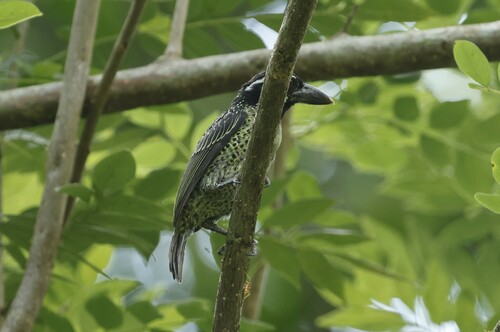
Yellow-spotted Barbet

Buccanodon duchaillui

Silhouette: PhyloPic

LCLeast ConcernNTVUENCR
Daily sighting probability ~10% · With luck
at Taï National Park

In 3 days ~30% in a week ~50%

5 Verified sightings at Taï National Park From 2019 to 2026
767 In all 4 parks
September Best month
☀️ Diurnal When it's spotted

About the Yellow-spotted Barbet

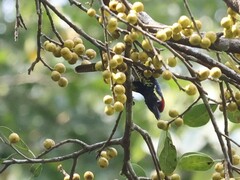
The yellow-spotted barbet (Buccanodon duchaillui) is a bird species in the monotypic genus Buccanodon. It belongs to the African barbet family (Lybiidae) which was formerly included in the Capitonidae and sometimes in the Ramphastidae.

Two subspecies are known: The western subspecies was described in 2019 as a distinct species based on its unique song. The western yellow-spotted barbet has a song described by Nigel James Collar and Peter Boesman as "a series of 7–10 accelerating notes similar to a song of hairy-breasted barbet (Tricholaema hirsuta)" (phoneticized as "oop"), while the eastern yellow-spotted barbet has a song described by Collar and Boesman as a "characteristic purring (lasting 1–2 seconds), unique among [African] barbets" (phoneticized as "rrurrrrrr…"). These song differences led to the description of B. dowsetti as a distinct species. In 2023, the International Ornithological Congress recognized dowsetti as a distinct taxon, but tentatively kept it as a subspecies of duchailllui due to other studies finding significant divergences elsewhere within the species' range, indicating that B. duchaillui as a whole may represent a species complex.

It is found in Angola, Cameroon, Central African Republic, Republic of the Congo, Democratic Republic of the Congo, Ivory Coast, Equatorial Guinea, Gabon, Ghana, Guinea, Kenya, Liberia, Nigeria, Sierra Leone, Tanzania, and Uganda. Wikipedia →

Sounds

Song0:24

Ghana · 2022

© Peter Boesman · XC718905 · CC BY-NC-ND 4.0

Call1:30

Ghana · 2018

© Barry Edmonston · XC419616 · CC BY-NC-SA 4.0

Song0:57

Ghana · 2021

© Brendan Sloan · XC701957 · CC BY-NC-ND 4.0

Global Distribution

Parks Where Found

# Park Country Daily sighting probability
1 Kibale National Park 🇺🇬 Uganda
~20%
2 Bwindi Impenetrable National Park 🇺🇬 Uganda
~20%
3 Taï National Park 🇨🇮 Ivory Coast
~10%
4 Semuliki National Park 🇺🇬 Uganda
~10%

Cities Where Found

# City Country Daily sighting probability
1 Yaoundé 🇨🇲 Cameroon
~10%

Before you go

What are the chances of seeing a Yellow-spotted Barbet in Taï National Park?

With luck

About 10% of wildlife watchers report a Yellow-spotted Barbet sighting in Taï National Park on a given day, based on 5 verified sightings from GBIF citizen-science data from 2019 to 2026. It is the 56th most-seen of the 74 birds we can rate there. Over three days the chance rises to about 30%, and over a week to about 50%, if each day is a fresh chance.

What time of day is best to see a Yellow-spotted Barbet?

Between 8 and 11 am

Across all the parks we cover, that three-hour window holds the most Yellow-spotted Barbet sightings with a recorded time, and about 9 in 10 of them come between 6 am and 6 pm: it is a daytime animal.

Is Taï National Park the best place to see a Yellow-spotted Barbet?

3rd of 4

Of the 4 parks where we can rate Yellow-spotted Barbet sightings, Taï National Park ranks 3rd at about 10%. The best odds are in Kibale National Park (Uganda, about 20%) and Bwindi Impenetrable National Park (Uganda, about 20%).

Which relatives of the Yellow-spotted Barbet live in Taï National Park?

Same family: Lybiidae

The closest relatives of the Yellow-spotted Barbet that you can see in Taï National Park (family Lybiidae, African Barbets) are Hairy-breasted Barbet (about 20%), Red-rumped Tinkerbird (about 10%) and Yellow-rumped Tinkerbird (about 10%), with each one's daily chance of a sighting.

Where does the Yellow-spotted Barbet sighting chance come from?

GBIF citizen-science records

It is estimated from how often the Yellow-spotted Barbet is recorded against all the birds logged in Taï National Park (5 verified sightings from 2019 to 2026), calibrated against known sighting rates. Figures are rounded to the nearest 10% because citizen-science data supports honest approximations, not decimals, and months with records from fewer than five people show "—". How it works.

← Back to Taï National Park