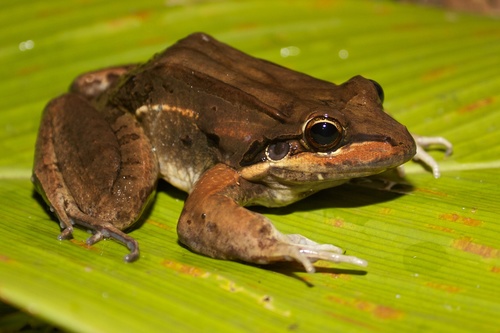
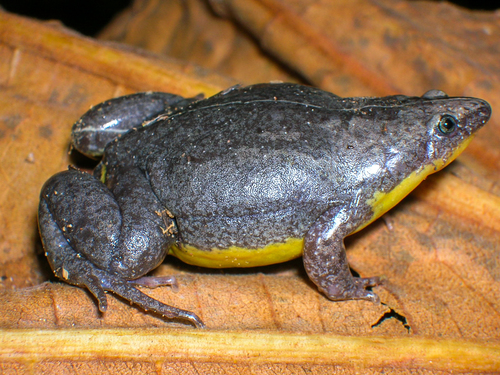
Cocha Chirping Frog

Cocha Chirping Frog

Adenomera andreae

Silhouette: PhyloPic

LCLeast ConcernNTVUENCR
Daily sighting probability ~10% · With luck
at Tambopata National Reserve

In 3 days ~20% in a week ~50%

6 Verified sightings at Tambopata National Reserve From 2019 to 2026
23 In all 3 parks
July Best month
☀️🌙 Day & Night When it's spotted

About the Cocha Chirping Frog

Adenomera andreae (common name: lowland tropical bullfrog, Göldi's thin-toed frog, rana dedilarga de Göldi) is a species of frog in the family Leptodactylidae. It is found in the lowlands of northern South America east of the Andes (Bolivia, Brazil, Colombia, Ecuador, French Guiana, Guyana, Peru, Suriname, and Venezuela). As currently defined, it probably represents a cryptic species complex, comprising perhaps four species.

Adenomera andreae are small frogs, usually less than 30 mm (1.2 in) in adult body length. Dorsum is grayish brown to beige, occasionally with dark brown spots, and rarely with a vertebral dark brown stripe and/or dorsolateral orangish yellow stripe. The ventral surfaces are white. Iris is chestnut.

Eggs are laid in foam nests on the ground. Tadpoles are terrestrial: they are endotrophic and develop in the nest. Recruitment of juveniles is synchronized with rainfall. Its predators include large tarantulas. This terrestrial frog lives in lowland primary forest with well-drained soil. Scientists saw the frog between 0 and 400 m (0 and 1,312 ft) above sea level. Many subpopulations live in protected areas. The IUCN classifies... Wikipedia →

Sounds

Uncertain0:18

Ecuador · 2025

© Marc Anderson · XC1076841 · CC BY-NC-ND 4.0

Territorial call0:48

Ecuador · 2025

© Manuel Sánchez-Nivicela · XC1016880 · CC BY-NC-ND 4.0

Recording0:17

French Guiana · 2023

© Augustin Bussac · XC928975 · CC BY-NC-SA 4.0

Global Distribution

Parks Where Found

# Park Country Daily sighting probability
1 Manu National Park 🇵🇪 Peru
~10%
2 Tambopata National Reserve 🇵🇪 Peru
~10%
3 Yasuní National Park 🇪🇨 Ecuador
~10%

Before you go

What are the chances of seeing a Cocha Chirping Frog in Tambopata National Reserve?

With luck

About 10% of wildlife watchers report a Cocha Chirping Frog sighting in Tambopata National Reserve on a given day, based on 6 verified sightings from GBIF citizen-science data from 2019 to 2026. It is the 41st most-seen of the 44 amphibians we can rate there. Over three days the chance rises to about 20%, and over a week to about 50%, if each day is a fresh chance.

When is the best time to see a Cocha Chirping Frog in Tambopata National Reserve?

July

In that month about 20% of wildlife watchers report a Cocha Chirping Frog in Tambopata National Reserve on a given day, against under 5% in August and October–May, the lowest months. That is one of Tambopata National Reserve's driest months, with about 45 mm of rain against 420 mm in February.

What time of day is best to see a Cocha Chirping Frog?

Between 7 and 10 pm

Across all the parks we cover, that three-hour window holds the most Cocha Chirping Frog sightings with a recorded time, and about 7 in 10 of them come between 6 pm and 6 am: it is seen both by day and at night.

Is Tambopata National Reserve the best place to see a Cocha Chirping Frog?

Among the best

Of the 3 parks where we can rate Cocha Chirping Frog sightings, Tambopata National Reserve ranks 2nd at about 10%, level with the leaders once rounded. The best odds are in Manu National Park (Peru, about 10%).

Where does the Cocha Chirping Frog sighting chance come from?

GBIF citizen-science records

It is estimated from how often the Cocha Chirping Frog is recorded against all the amphibians logged in Tambopata National Reserve (6 verified sightings from 2019 to 2026), calibrated against known sighting rates. Figures are rounded to the nearest 10% because citizen-science data supports honest approximations, not decimals, and months with records from fewer than five people show "—". How it works.

← Back to Tambopata National Reserve