Painted Antnest Frog

Painted Antnest Frog

Lithodytes lineatus

Silhouette: PhyloPic

LCLeast ConcernNTVUENCR
Daily sighting probability ~20% · Possible
at Tambopata National Reserve

In 3 days ~50% in a week ~80%

22 Verified sightings at Tambopata National Reserve From 2019 to 2026
104 In all 4 parks
July Best month
🌙 Nocturnal When it's spotted

About the Painted Antnest Frog

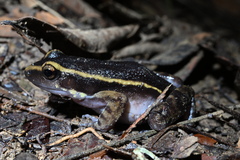
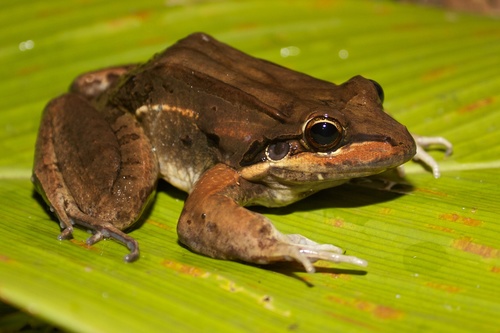
Lithodytes is a genus of frogs in the family of Leptodactylidae. It is monotypic, being represented by the single species, Lithodytes lineatus, also commonly known as the gold-striped frog or painted antnest frog. It is found in tropical South America where it lives in humid forests among the leaf litter. These frogs build foam nests at the edge of temporary pools, and the tadpoles develop within these. The frogs also associate with certain leafcutter ants (Atta cephalotes) and breed inside their nests without being attacked by the ants.

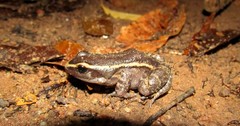
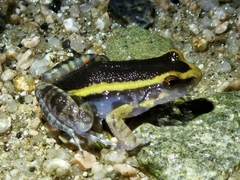
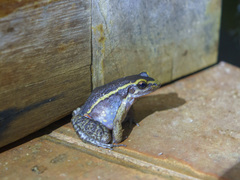
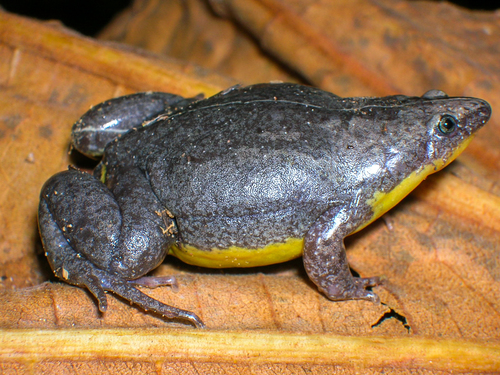
The female Lithodytes lineatus grows to a length ranging from 38 and 52 mm (1.5 and 2.0 in), and the male is slightly smaller. It has a slender body and blunt snout. The overall color is black apart from a pair of yellow lateral stripes running from the snout to the groin, where there is a red or orange patch. The limbs are brown banded with black.

This frog is similar in appearance to the brilliant-thighed poison frog (Allobates femoralis), Ameerega hahneli, and the Amazonian poison-dart frog Ameerega picta. By mimicking the appearance of the toxic species, Lithodytes lineatus avoids detection by predators.

Tadpoles... Wikipedia →

Sounds

Advertisement call0:58

Ecuador · 2025

© Marc Anderson · XC1002278 · CC BY-NC-ND 4.0

Recording0:30

Peru · 2018

© Fabricio Gorleri · iNaturalist · CC BY-NC 4.0

Recording0:10

Ecuador · 2026

© Alex Bentley · iNaturalist · CC BY-NC 4.0

Global Distribution

Parks Where Found

# Park Country Daily sighting probability
1 Cuyabeno Wildlife Reserve 🇪🇨 Ecuador
~40%
2 Yasuní National Park 🇪🇨 Ecuador
~20%
3 Tambopata National Reserve 🇵🇪 Peru
~20%
4 Manu National Park 🇵🇪 Peru
~20%

Before you go

What are the chances of seeing a Painted Antnest Frog in Tambopata National Reserve?

Possible

About 20% of wildlife watchers report a Painted Antnest Frog sighting in Tambopata National Reserve on a given day, based on 22 verified sightings from GBIF citizen-science data from 2019 to 2026. It is the 16th most-seen of the 44 amphibians we can rate there. Over three days the chance rises to about 50%, and over a week to about 80%, if each day is a fresh chance.

When is the best time to see a Painted Antnest Frog in Tambopata National Reserve?

July and August

In those months about 30% of wildlife watchers report a Painted Antnest Frog in Tambopata National Reserve on a given day, against under 5% in January, March–May and November, the lowest months. Those are among Tambopata National Reserve's driest months, with about 60 mm of rain a month against 420 mm in February.

What time of day is best to see a Painted Antnest Frog?

Between 7 and 10 pm

Across all the parks we cover, that three-hour window holds the most Painted Antnest Frog sightings with a recorded time, and about 7 in 10 of them come between 6 pm and 6 am: it is mostly seen at night.

Is Tambopata National Reserve the best place to see a Painted Antnest Frog?

3rd of 4

Of the 4 parks where we can rate Painted Antnest Frog sightings, Tambopata National Reserve ranks 3rd at about 20%. The best odds are in Cuyabeno Wildlife Reserve (Ecuador, about 40%) and Yasuní National Park (Ecuador, about 20%).

Where does the Painted Antnest Frog sighting chance come from?

GBIF citizen-science records

It is estimated from how often the Painted Antnest Frog is recorded against all the amphibians logged in Tambopata National Reserve (22 verified sightings from 2019 to 2026), calibrated against known sighting rates. Figures are rounded to the nearest 10% because citizen-science data supports honest approximations, not decimals, and months with records from fewer than five people show "—". How it works.

← Back to Tambopata National Reserve