Black-naped Tern

Black-naped Tern

Sterna sumatrana

Silhouette: Sharon Wegner-Larsen · PhyloPic

LCLeast ConcernNTVUENCR
Daily sighting probability ~10% · With luck
at Tangkoko Nature Reserve

In 3 days ~20% in a week ~30%

46 Verified sightings at Tangkoko Nature Reserve From 2019 to 2026
365 In all 4 parks
September Best month
☀️ Diurnal When it's spotted

About the Black-naped Tern

The black-naped tern (Sterna sumatrana) is an oceanic tern mostly found in tropical and subtropical areas of the Indian Ocean and western Pacific Ocean. They are rarely found inland. It was described from the islands around Sumatra. It is most closely related to roseate tern S. dougallii and white-fronted tern S. striata.

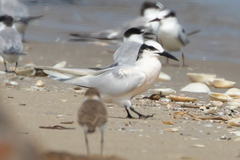
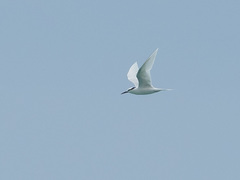
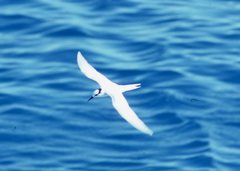
The black-naped tern is named from the black band beginning at the eyes connecting behind the head and descending the back of the neck. The rest of their plumage is white, with pale silvery-grey wings and mantle, apart from the outermost primary feather which has a narrow black outer web. The tail is white, and deeply forked, extending (like the related roseate and white-fronted terns) beyond the wingtips on perched birds. The beaks and legs are black. They have a body length of 30–35 cm and a wingspan of 66 cm. Adults weigh between 97 and 120 g. Hatchlings are mottled brown.

There are two listed subspecies: Sterna sumatrana sumatrana (Raffles, 1822) – islands of the eastern Indian Ocean through to the western Pacific, north to Taiwan and south to Queensland in Australia Sterna sumatrana mathewsi (Stresemann, 1914) – islands of the... Wikipedia →

Sounds

Call0:47

Malaysia · 2025

© Lim Ying Hien 林勇贤 · XC1080804 · CC BY-NC-ND 4.0

Flight call0:04

Malaysia · 2024

© Lim Ying Hien · XC897369 · CC BY-NC-ND 4.0

Call0:30

Indonesia · 2024

© Ding Li Yong/Audrey Ngo · XC920899 · CC BY-NC-ND 4.0

Global Distribution

Parks Where Found

# Park Country Daily sighting probability
1 Komodo National Park 🇮🇩 Indonesia
~30%
2 Bali Barat National Park 🇮🇩 Indonesia
~10%
3 Raja Ampat 🇮🇩 Indonesia
~10%
4 Tangkoko Nature Reserve 🇮🇩 Indonesia
~10%

Cities Where Found

# City Country Daily sighting probability
1 Denpasar 🇮🇩 Indonesia
<5%
2 Kaohsiung 🇹🇼 Taiwan
<5%
3 Singapore 🇸🇬 Singapore
<5%
4 Hong Kong 🇨🇳 China
<5%

Before you go

What are the chances of seeing a Black-naped Tern in Tangkoko Nature Reserve?

With luck

About 10% of wildlife watchers report a Black-naped Tern sighting in Tangkoko Nature Reserve on a given day, based on 46 verified sightings from GBIF citizen-science data from 2019 to 2026. It is the 86th most-seen of the 138 birds we can rate there. Over three days the chance rises to about 20%, and over a week to about 30%, if each day is a fresh chance.

When is the best time to see a Black-naped Tern in Tangkoko Nature Reserve?

February and June–September

In those months about 10% of wildlife watchers report a Black-naped Tern in Tangkoko Nature Reserve on a given day, against under 5% in March–May and October–January, the lowest months.

What time of day is best to see a Black-naped Tern?

Between 9 am and noon

Across all the parks we cover, that three-hour window holds the most Black-naped Tern sightings with a recorded time, and nearly all of them come between 6 am and 6 pm: it is a daytime animal.

Is Tangkoko Nature Reserve the best place to see a Black-naped Tern?

4th of 4

Of the 4 parks where we can rate Black-naped Tern sightings, Tangkoko Nature Reserve ranks 4th at about 10%. The best odds are in Komodo National Park (Indonesia, about 30%), Bali Barat National Park (Indonesia, about 10%) and Raja Ampat (Indonesia, about 10%).

Where does the Black-naped Tern sighting chance come from?

GBIF citizen-science records

It is estimated from how often the Black-naped Tern is recorded against all the birds logged in Tangkoko Nature Reserve (46 verified sightings from 2019 to 2026), calibrated against known sighting rates. Figures are rounded to the nearest 10% because citizen-science data supports honest approximations, not decimals, and months with records from fewer than five people show "—". How it works.

← Back to Tangkoko Nature Reserve