Kentish Plover

Kentish Plover

Charadrius alexandrinus

Silhouette: Ferran Sayol · PhyloPic

LCLeast ConcernNTVUENCR
Daily sighting probability <5% · Rare
at Tangkoko Nature Reserve

In 3 days ~10% in a week ~20%

21 Verified sightings at Tangkoko Nature Reserve From 2019 to 2026
1,937 In all 20 parks
September Best month
☀️ Diurnal When it's spotted

About the Kentish Plover

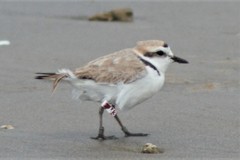
The Kentish plover (Anarhynchus alexandrinus) is a small wader (40–44 g (1.4–1.6 oz)) of the family Charadriidae that breeds on the shores of saline lakes, lagoons, and coasts, populating sand dunes, marshes, semi-arid desert, and tundra. Both male and female birds have pale plumages with a white underside, grey/brown back, dark legs and a dark bill; however, additionally the male birds also exhibit very dark incomplete breast bands, and dark markings either side of their head, therefore the Kentish plover is regarded as sexually dimorphic.

The Kentish plover has a large geographical distribution, ranging from latitudes of 10º to 55º, occupying North Africa, both mainland, such as Senegal, and island, such as the Cape Verde archipelago, Central Asia, for example alkaline lakes in China, and Europe, including small populations in Spain and Austria. Some populations are migratory and often winter in Africa, whereas other populations, such as various island populations, do not migrate. Its common English name comes from the county of Kent, where it was once found, but it has not bred in Britain since 1979.

Kentish plovers are ground-nesting birds, often with a preference for low, open, moist nesting sites away from thick vegetation and human activity. They use a number of materials to build their nests, mainly consisting of shells, pebbles, grass and leaves in a small scrape in the ground. Like most plovers, the Kentish plovers are predominantly insectivores, feeding on a large range of arthropods and invertebrates depending on the environment, by using a run and stop method. Wikipedia →

Sounds

Flight call0:31

Spain · 2025

© Esperanza Poveda · XC1066288 · CC BY-NC-SA 4.0

Call1:14

Mongolia · 2025

© Richard E. Webster · XC1027323 · CC BY-NC-SA 4.0

Nocturnal flight call0:10

Spain · 2023

© BirdingAlbufera · XC814069 · CC BY-NC-SA 4.0

Global Distribution

Parks Where Found

# Park Country Daily sighting probability
1 Yala National Park 🇱🇰 Sri Lanka
~30%
2 Doñana National Park 🇪🇸 Spain
~20%
3 Camargue 🇫🇷 France
~20%
4 Wilpattu National Park 🇱🇰 Sri Lanka
~10%
5 Kiskunság National Park 🇭🇺 Hungary
~10%
6 Sundarbans National Park 🇮🇳 India
~10%
7 Satpura National Park 🇮🇳 India
<5%
8 Udawalawe National Park 🇱🇰 Sri Lanka
<5%
9 Bali Barat National Park 🇮🇩 Indonesia
<5%
10 Ranthambore National Park 🇮🇳 India
<5%
11 Wadden Sea National Park 🇩🇪 Germany
<5%
12 Tangkoko Nature Reserve 🇮🇩 Indonesia
<5%
13 Minneriya National Park 🇱🇰 Sri Lanka
<5%
14 Chitwan National Park 🇳🇵 Nepal
<5%
15 Hortobágy National Park 🇭🇺 Hungary
<5%
16 Keoladeo National Park 🇮🇳 India
<5%
17 Murchison Falls National Park 🇺🇬 Uganda
<5%
18 Sierra de Guadarrama National Park 🇪🇸 Spain
<5%
19 Kaziranga National Park 🇮🇳 India
<5%
20 Jim Corbett National Park 🇮🇳 India
<5%

Cities Where Found

# City Country Daily sighting probability
1 Kuwait City 🇰🇼 Kuwait
~50%
2 Manama 🇧🇭 Bahrain
~50%
3 Quanzhou 🇨🇳 China
~20%
4 Naha 🇯🇵 Japan
~20%
5 Dammam 🇸🇦 Saudi Arabia
~10%
6 Karachi 🇵🇰 Pakistan
~10%
7 Kozhikode 🇮🇳 India
~10%
8 Tunis 🇹🇳 Tunisia
~10%
9 Riyadh 🇸🇦 Saudi Arabia
~10%
10 Manila 🇵🇭 Philippines
~10%

Before you go

What are the chances of seeing a Kentish Plover in Tangkoko Nature Reserve?

Rare

Under 5% of wildlife watchers report a Kentish Plover sighting in Tangkoko Nature Reserve on a given day, based on 21 verified sightings from GBIF citizen-science data from 2019 to 2026. It is the 102nd most-seen of the 138 birds we can rate there. Over three days the chance rises to about 10%, and over a week to about 20%, if each day is a fresh chance.

When is the best time to see a Kentish Plover in Tangkoko Nature Reserve?

February, June and September

In those months about 10% of wildlife watchers report a Kentish Plover in Tangkoko Nature Reserve on a given day, against under 5% in March–May, July–August and October–January, the lowest months.

What time of day is best to see a Kentish Plover?

Between 8 and 11 am

Across all the parks we cover, that three-hour window holds the most Kentish Plover sightings with a recorded time, and about 9 in 10 of them come between 6 am and 6 pm: it is a daytime animal.

Is Tangkoko Nature Reserve the best place to see a Kentish Plover?

12th of 20

Of the 20 parks where we can rate Kentish Plover sightings, Tangkoko Nature Reserve ranks 12th at under 5%. The best odds are in Yala National Park (Sri Lanka, about 30%), Doñana National Park (Spain, about 20%) and Camargue (France, about 20%).

Where does the Kentish Plover sighting chance come from?

GBIF citizen-science records

It is estimated from how often the Kentish Plover is recorded against all the birds logged in Tangkoko Nature Reserve (21 verified sightings from 2019 to 2026), calibrated against known sighting rates. Figures are rounded to the nearest 10% because citizen-science data supports honest approximations, not decimals, and months with records from fewer than five people show "—". How it works.

← Back to Tangkoko Nature Reserve