White-shouldered Triller

White-shouldered Triller

Lalage sueurii

Silhouette: PhyloPic

LCLeast ConcernNTVUENCR
Daily sighting probability <5% · Rare
at Tangkoko Nature Reserve

In 3 days <5% in a week ~10%

8 Verified sightings at Tangkoko Nature Reserve From 2019 to 2026
716 In all 3 parks
October Best month
🌅 Crepuscular When it's spotted

About the White-shouldered Triller

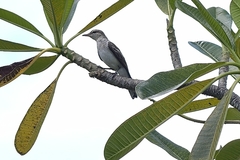
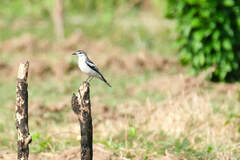
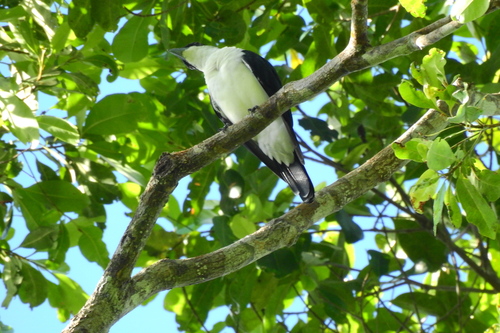
The white-shouldered triller (Lalage sueurii) is a passerine bird belonging to the triller genus Lalage in the cuckoo-shrike family Campephagidae. It is found in Indonesia and East Timor. The white-winged triller (L. tricolor) of Australia and New Guinea was formerly included in this species but is now treated as a separate species.

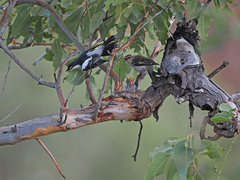
It is a fairly small bird, 17 centimetres in length. The bill is grey with a black tip and the legs and feet are black. The male is mainly black above and white below. It has a grey rump, white stripe over the eye, white wing-patches and white on the outer tail-feathers. Females have a similar pattern to the males but are brown instead of black above and have fine black barring on the underparts.

The pied triller is similar but is slightly smaller with a broader stripe above the eye and more white in the wing. The male white-winged triller has no white stripe over the eye. The song of the white-shouldered triller is a metallic whistling which is sometimes given in flight. It also utters a rapid series of harsh notes.

It occurs in eastern Java, southern Sulawesi, Bali and on the Lesser Sunda Islands. It inhabits open woodland, savannas and agricultural land in dry, lowland areas. It feeds on insects, often swooping down from a perch to catch them on the ground. Wikipedia →
Sounds

Call0:52

East Timor · 2013

© Colin Trainor · XC131356 · CC BY-NC-SA 3.0

Song0:51

Indonesia · 2015

© Mike Nelson · XC292350 · CC BY-NC-SA 4.0

Global Distribution

Parks Where Found

# Park Country Daily sighting probability
1 Bali Barat National Park 🇮🇩 Indonesia
~60%
2 Komodo National Park 🇮🇩 Indonesia
~10%
3 Tangkoko Nature Reserve 🇮🇩 Indonesia
<5%

Cities Where Found

# City Country Daily sighting probability
1 Makassar 🇮🇩 Indonesia
~30%
2 Denpasar 🇮🇩 Indonesia
~20%
3 Surabaya 🇮🇩 Indonesia
~10%

Before you go

What are the chances of seeing a White-shouldered Triller in Tangkoko Nature Reserve?

Rare

Under 5% of wildlife watchers report a White-shouldered Triller sighting in Tangkoko Nature Reserve on a given day, based on 8 verified sightings from GBIF citizen-science data from 2019 to 2026. It is the 128th most-seen of the 138 birds we can rate there. Over three days the chance rises to under 5%, and over a week to about 10%, if each day is a fresh chance.

When is the best time to see a White-shouldered Triller in Tangkoko Nature Reserve?

Any time of year

In every month with enough records, under 5% of wildlife watchers report a White-shouldered Triller in Tangkoko Nature Reserve on a given day, so our monthly data shows no clear season.

What time of day is best to see a White-shouldered Triller?

Between 1 and 4 am

Across all the parks we cover, that three-hour window holds the most White-shouldered Triller sightings with a recorded time, and about 7 in 10 of them come between 6 pm and 6 am: it is most active around dawn and dusk.

Is Tangkoko Nature Reserve the best place to see a White-shouldered Triller?

3rd of 3

Of the 3 parks where we can rate White-shouldered Triller sightings, Tangkoko Nature Reserve ranks 3rd at under 5%. The best odds are in Bali Barat National Park (Indonesia, about 60%) and Komodo National Park (Indonesia, about 10%).

Where does the White-shouldered Triller sighting chance come from?

GBIF citizen-science records

It is estimated from how often the White-shouldered Triller is recorded against all the birds logged in Tangkoko Nature Reserve (8 verified sightings from 2019 to 2026), calibrated against known sighting rates. Figures are rounded to the nearest 10% because citizen-science data supports honest approximations, not decimals, and months with records from fewer than five people show "—". How it works.

← Back to Tangkoko Nature Reserve