


Completed

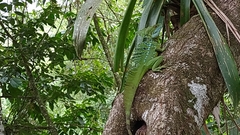
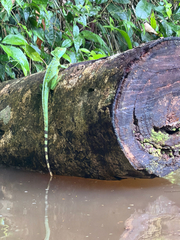
Basiisk Verde
Basiliscus plumifrons
Silhouette: Jose Carlos Arenas-Monroy · PhyloPic
- KingdomAnimalia (Animals)
- PhylumChordata (Chordates)
- ClassSquamata
- FamilyCorytophanidae (Helmeted Lizards)
- GenusBasiliscus (Basilisks)
- SpeciesBasiliscus plumifrons (Basiisk Verde)
In 3 days ~30% in a week ~50%
16 Verified sightings at Tapantí-Macizo de la Muerte National Park From 2019 to 2026
1,482 In all 11 parks
June Best month
☀️ Diurnal When it's spotted
About the Basiisk Verde
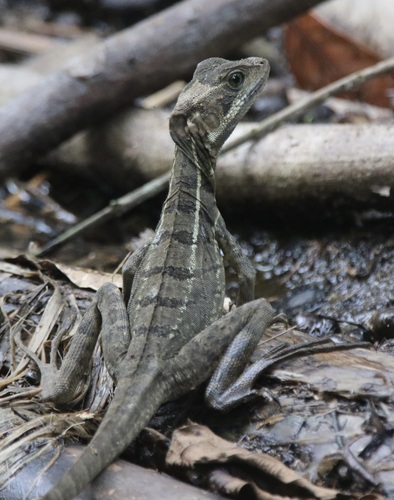
The plumed basilisk (Basiliscus plumifrons), also called the green basilisk, double crested basilisk, or Jesus Christ lizard, is a species of lizard in the family Corytophanidae. The species is native to Central America.
The plumed basilisk's native range spans southern Mexico and northern Colombia. B. plumifrons inhabits hot, humid rainforests that contain streams, rivers or other water bodies. The physical appearance of the plumed basilisk is striking: it sports a bright green color along its body with black and white streaks along its neck and back. Their physical appearance differs by sex, as they are sexually dimorphic; males have a distinct crest on the back and tail and large plumes on top of their heads, while females typically only have a singular, much smaller, crest on their head.
The green crested or plumed lizard is unique in its ability to run across water with speed and the method it employs to do this. It displays the behaviour as a threat response, when fleeing predators. High speed is maintained in order to prevent sinking.
This lizard is extraordinarily territorial and is known for its aggressive behaviour to the extent that multiple male lizards cannot be maintained within the same enclosure. However, they do exist in the wild in large groups that allow for multiple males. Wikipedia →
Recent sightings of Basiisk Verde in Tapantí-Macizo de la Muerte National Park
LIVEiNaturalistGlobal Distribution
Parks Where Found
| # | Park | Country | Daily sighting probability |
|---|---|---|---|
| 1 | Tortuguero National Park | 🇨🇷 Costa Rica | |
| 2 | Cahuita National Park | 🇨🇷 Costa Rica | |
| 3 | Braulio Carrillo National Park | 🇨🇷 Costa Rica | |
| 4 | Arenal Volcano National Park | 🇨🇷 Costa Rica | |
| 5 | Tenorio Volcano National Park | 🇨🇷 Costa Rica | |
| 6 | Gandoca-Manzanillo Wildlife Refuge | 🇨🇷 Costa Rica | |
| 7 | Bastimentos Island National Marine Park | 🇵🇦 Panama | |
| 8 | La Amistad International Park (Panama) | 🇵🇦 Panama | |
| 9 | Tapantí-Macizo de la Muerte National Park | 🇨🇷 Costa Rica | |
| 10 | Manuel Antonio National Park | 🇨🇷 Costa Rica | |
| 11 | Monteverde Cloud Forest Reserve | 🇨🇷 Costa Rica |
Zoos & Centres Where Found
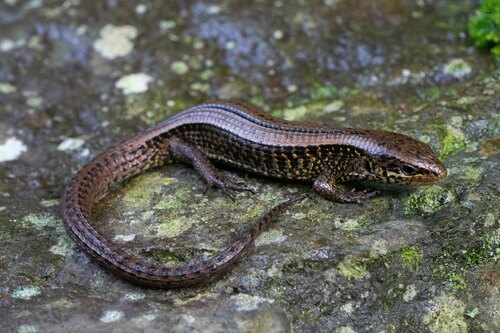
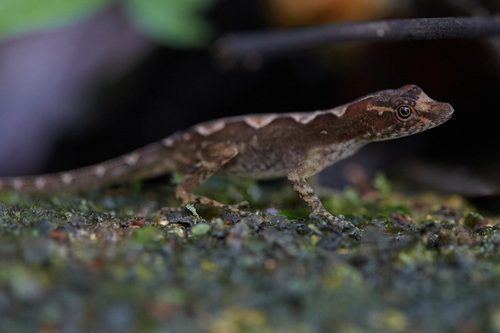
Closest Relatives at Tapantí-Macizo de la Muerte National Park




Before you go
What are the chances of seeing a Basiisk Verde in Tapantí-Macizo de la Muerte National Park?
With luck
About 10% of wildlife watchers report a Basiisk Verde sighting in Tapantí-Macizo de la Muerte National Park on a given day, based on 16 verified sightings from GBIF citizen-science data from 2019 to 2026. It is the 10th most-seen of the 23 reptiles we can rate there. Over three days the chance rises to about 30%, and over a week to about 50%, if each day is a fresh chance.
When is the best time to see a Basiisk Verde in Tapantí-Macizo de la Muerte National Park?
June and December
In those months about 20% of wildlife watchers report a Basiisk Verde in Tapantí-Macizo de la Muerte National Park on a given day, against under 5% in April–May and September–October, the lowest months.
What time of day is best to see a Basiisk Verde?
Between 7 and 10 am
Across all the parks we cover, that three-hour window holds the most Basiisk Verde sightings with a recorded time, and about 8 in 10 of them come between 6 am and 6 pm: it is a daytime animal.
Is Tapantí-Macizo de la Muerte National Park the best place to see a Basiisk Verde?
9th of 11
Of the 11 parks where we can rate Basiisk Verde sightings, Tapantí-Macizo de la Muerte National Park ranks 9th at about 10%. The best odds are in Tortuguero National Park (Costa Rica, about 80%), Cahuita National Park (Costa Rica, about 60%) and Braulio Carrillo National Park (Costa Rica, about 50%). All parks ranked.
Where does the Basiisk Verde sighting chance come from?
GBIF citizen-science records
It is estimated from how often the Basiisk Verde is recorded against all the reptiles logged in Tapantí-Macizo de la Muerte National Park (16 verified sightings from 2019 to 2026), calibrated against known sighting rates. Figures are rounded to the nearest 10% because citizen-science data supports honest approximations, not decimals, and months with records from fewer than five people show "—". How it works.
