
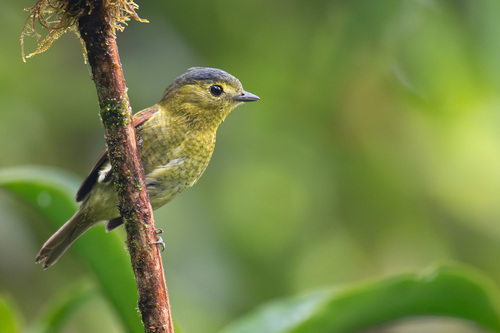
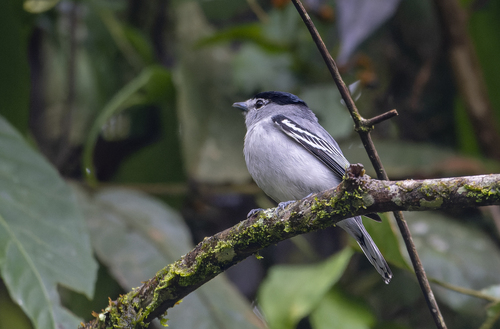
Sharpbill

Sharpbill

Oxyruncus cristatus

Silhouette: Sheatherius · PhyloPic

LCLeast ConcernNTVUENCR
Daily sighting probability <5% · Rare
at Tapantí-Macizo de la Muerte National Park

In 3 days <5% in a week ~10%

107 Verified sightings at Tapantí-Macizo de la Muerte National Park From 2019 to 2026
529 In all 10 parks
October Best month
☀️ Diurnal When it's spotted

About the Sharpbill

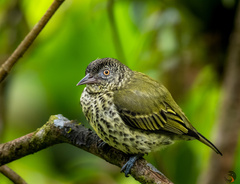
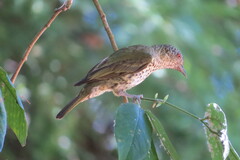
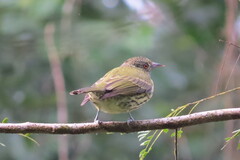
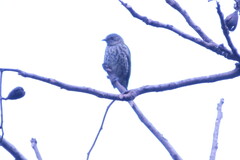
The sharpbill (Oxyruncus cristatus) is a small passerine bird that is placed in its own family Oxyruncidae. It was formerly placed in the family Tityridae. Its range is from the mountainous areas of tropical South America and southern Central America (Panama and Costa Rica).

It inhabits the canopy of wet forest and feeds on fruit and some invertebrates. It has an orange erectile crest, black-spotted yellowish underparts and scaling on the head and neck. As its name implies, it has a straight, pointed beak, which gives its common name.

Sharpbills are most commonly found in tall dense forests but occasionally venture to the forest edge. Their diet consists of primarily of fruit, but they will also take insects, hanging upside down in from twigs to obtain insect larvae. They will also travel in mixed-species feeding flocks with ovenbirds, tanagers, woodpeckers and cotingas. The breeding system employed by this species is polygamous with closely grouped males displaying in from a lek. The nest of the sharpbill is built by the female and is a small cup built on a slender branch. Chicks are fed by regurgitation.

The genus Oxyruncus was erected by the Dutch zoologist Coenraad... Wikipedia →

Sounds

Song0:07

Brazil · 2023

© Marcelo J Feliti · XC843268 · CC BY-NC-SA 4.0

Canto0:27

Brazil · 2017

© Caio Brito · XC427731 · CC BY-NC-SA 4.0

Call0:25

Colombia · 2010

© Myornis · XC104288 · CC BY-NC-ND 2.5

Global Distribution

Parks Where Found

# Park Country Daily sighting probability
1 Darién National Park 🇵🇦 Panama
~10%
2 Serra dos Órgãos National Park 🇧🇷 Brazil
~10%
3 Brownsberg Nature Park 🇸🇷 Suriname
~10%
4 Itatiaia National Park 🇧🇷 Brazil
<5%
5 Tapantí-Macizo de la Muerte National Park 🇨🇷 Costa Rica
<5%
6 Arenal Volcano National Park 🇨🇷 Costa Rica
<5%
7 Braulio Carrillo National Park 🇨🇷 Costa Rica
<5%
8 Iguazú National Park 🇦🇷 Argentina
<5%
9 Iguaçu National Park 🇧🇷 Brazil
<5%
10 Monteverde Cloud Forest Reserve 🇨🇷 Costa Rica
<5%

Before you go

What are the chances of seeing a Sharpbill in Tapantí-Macizo de la Muerte National Park?

Rare

Under 5% of wildlife watchers report a Sharpbill sighting in Tapantí-Macizo de la Muerte National Park on a given day, based on 107 verified sightings from GBIF citizen-science data from 2019 to 2026. It is the 320th most-seen of the 467 birds we can rate there. Over three days the chance rises to under 5%, and over a week to about 10%, if each day is a fresh chance.

When is the best time to see a Sharpbill in Tapantí-Macizo de la Muerte National Park?

October

In that month about 10% of wildlife watchers report a Sharpbill in Tapantí-Macizo de la Muerte National Park on a given day, against under 5% in November to September, the lowest months. That is one of Tapantí-Macizo de la Muerte National Park's wettest months, with about 570 mm of rain against 160 mm in February.

What time of day is best to see a Sharpbill?

Between 8 and 11 am

Across all the parks we cover, that three-hour window holds the most Sharpbill sightings with a recorded time, and about 9 in 10 of them come between 6 am and 6 pm: it is a daytime animal.

Is Tapantí-Macizo de la Muerte National Park the best place to see a Sharpbill?

5th of 10

Of the 10 parks where we can rate Sharpbill sightings, Tapantí-Macizo de la Muerte National Park ranks 5th at under 5%. The best odds are in Darién National Park (Panama, about 10%), Serra dos Órgãos National Park (Brazil, about 10%) and Brownsberg Nature Park (Suriname, about 10%).

Where does the Sharpbill sighting chance come from?

GBIF citizen-science records

It is estimated from how often the Sharpbill is recorded against all the birds logged in Tapantí-Macizo de la Muerte National Park (107 verified sightings from 2019 to 2026), calibrated against known sighting rates. Figures are rounded to the nearest 10% because citizen-science data supports honest approximations, not decimals, and months with records from fewer than five people show "—". How it works.

← Back to Tapantí-Macizo de la Muerte National Park