Sooty Thrush

Sooty Thrush

Turdus nigrescens

Silhouette: Sharon Wegner-Larsen · PhyloPic

LCLeast ConcernNTVUENCR
Daily sighting probability ~40% · Likely
at Tapantí-Macizo de la Muerte National Park

In 3 days ~80% in a week >90%

5,465 Verified sightings at Tapantí-Macizo de la Muerte National Park From 2019 to 2026
11,738 In all 8 parks
March Best month
☀️ Diurnal When it's spotted

About the Sooty Thrush

The sooty thrush (Turdus nigrescens) is a species of bird in the family Turdidae, the thrushes and allies. It is found in Costa Rica and Panama. It was formerly known as the sooty robin. The sooty thrush was originally described in 1861 with its current binomial Turdus nigrescens. It is monotypic.

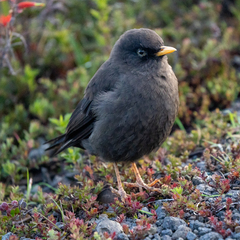
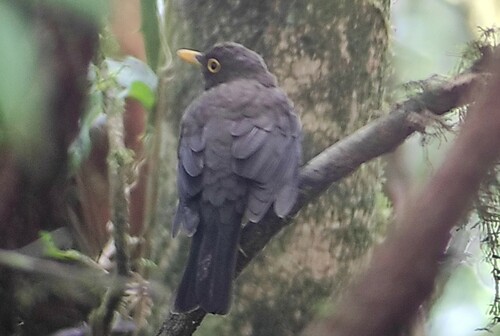
The sooty thrush is 24 to 25.5 cm (9.4 to 10 in) long and weighs about 96 g (3.4 oz). The species is sexually dimorphic. Adult males have a mostly brownish black head and body with sooty black lores and an orange eye-ring. Their wings and tail are also sooty black. Adult females resemble males but are browner overall and sometimes have some darker streaks on the throat. Both sexes have a white iris, a yellow-orange bill, and orange legs and feet. Juveniles have dark brown upperparts with buff streaks and buff underparts with dark brown spots. They have a white chin, a pale iris, and a brownish yellow bill, legs, and feet. The superficially similar mountain thrush (T. plebejus) shares its range but is uniformly brown with dark bare parts. It also resembles the slaty-backed nightingale-thrush (Catharus fuscater) but there is no range overlap... Wikipedia →

Sounds

Call0:08

Costa Rica · 2022

© Brendan Sloan · XC731228 · CC BY-NC-ND 4.0

Song0:30

Costa Rica · 2010

© Peter Boesman · XC274292 · CC BY-NC-ND 4.0

Call0:26

Costa Rica · 2021

© Eric Zawatski · XC615628 · CC BY-NC-SA 4.0

Global Distribution

Parks Where Found

# Park Country Daily sighting probability
1 Irazú Volcano National Park 🇨🇷 Costa Rica
~90%
2 Los Quetzales National Park 🇨🇷 Costa Rica
~40%
3 Tapantí-Macizo de la Muerte National Park 🇨🇷 Costa Rica
~40%
4 Poás Volcano National Park 🇨🇷 Costa Rica
~10%
5 Chirripó National Park 🇨🇷 Costa Rica
<5%
6 Volcán Barú National Park 🇵🇦 Panama
<5%
7 La Amistad International Park (Panama) 🇵🇦 Panama
<5%
8 Braulio Carrillo National Park 🇨🇷 Costa Rica
<5%

Before you go

What are the chances of seeing a Sooty Thrush in Tapantí-Macizo de la Muerte National Park?

Likely

About 40% of wildlife watchers report a Sooty Thrush sighting in Tapantí-Macizo de la Muerte National Park on a given day, based on 5,465 verified sightings from GBIF citizen-science data from 2019 to 2026. It is the 12th most-seen of the 467 birds we can rate there. Over three days the chance rises to about 80%, and over a week to over 90%, if each day is a fresh chance.

When is the best time to see a Sooty Thrush in Tapantí-Macizo de la Muerte National Park?

March and April

In those months about 60% of wildlife watchers report a Sooty Thrush in Tapantí-Macizo de la Muerte National Park on a given day, against about 20% in October, the lowest month.

What time of day is best to see a Sooty Thrush?

Between 10 am and 1 pm

Across all the parks we cover, that three-hour window holds the most Sooty Thrush sightings with a recorded time, and about 9 in 10 of them come between 6 am and 6 pm: it is a daytime animal.

Is Tapantí-Macizo de la Muerte National Park the best place to see a Sooty Thrush?

3rd of 8

Of the 8 parks where we can rate Sooty Thrush sightings, Tapantí-Macizo de la Muerte National Park ranks 3rd at about 40%. The best odds are in Irazú Volcano National Park (Costa Rica, about 90%) and Los Quetzales National Park (Costa Rica, about 40%).

Which relatives of the Sooty Thrush live in Tapantí-Macizo de la Muerte National Park?

Same genus: Turdus

The closest relatives of the Sooty Thrush that you can see in Tapantí-Macizo de la Muerte National Park (genus Turdus, Typical Thrushes) are Clay-colored Thrush (about 60%) and Mountain Thrush (about 50%), with each one's daily chance of a sighting.

Where does the Sooty Thrush sighting chance come from?

GBIF citizen-science records

It is estimated from how often the Sooty Thrush is recorded against all the birds logged in Tapantí-Macizo de la Muerte National Park (5,465 verified sightings from 2019 to 2026), calibrated against known sighting rates. Figures are rounded to the nearest 10% because citizen-science data supports honest approximations, not decimals, and months with records from fewer than five people show "—". How it works.

← Back to Tapantí-Macizo de la Muerte National Park