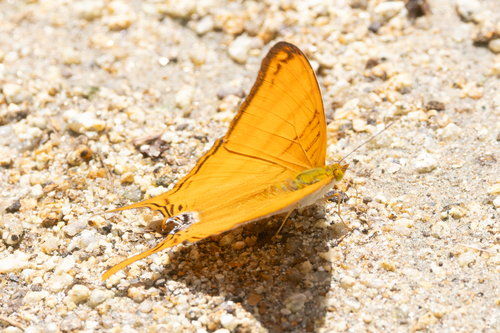
Fig Tree Borer

Fig Tree Borer

Neoptychodes trilineatus

Daily sighting probability ~20% · Possible
at Tayrona National Natural Park

In 3 days ~40% in a week ~70%

8 Verified sightings at Tayrona National Natural Park From 2019 to 2026
38 In all 5 parks
June Best month
☀️🌙 Day & Night When it's spotted

About the Fig Tree Borer

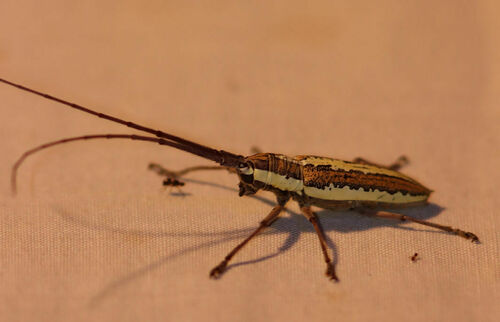
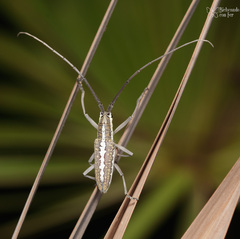
Neoptychodes trilineatus is a species of flat-faced longhorn beetles in the subfamily Lamiinae. Neoptychodes trilineatus can reach a length of about 21–35 millimetres (0.83–1.38 in) in males, of about 19–31 millimetres (0.75–1.22 in) in the females. The body coloration is quite variable through the wide range of this species. Usually the background is greyish or dark brown with orange-brown elytral spots and three white or yellow longitudinal bands (hence the Latin name trilineatus). Main host plants are Ficus carica, Morus microphylla, Salix sp. and Alnus sp.

This species can be found in Belize, Costa Rica, Cuba, Guatemala, Guyana, Honduras, Nicaragua, Suriname, United States and Venezuela. Wikipedia →

Global Distribution

Parks Where Found

# Park Country Daily sighting probability
1 Palo Verde National Park 🇨🇷 Costa Rica
~20%
2 Tayrona National Natural Park 🇨🇴 Colombia
~20%
3 Ostional Wildlife Refuge 🇨🇷 Costa Rica
~10%
4 Corcovado National Park 🇨🇷 Costa Rica
~10%
5 Cumbres de Monterrey National Park 🇲🇽 Mexico
<5%

Cities Where Found

# City Country Daily sighting probability
1 San Pedro Sula 🇭🇳 Honduras
~20%
2 Panama City 🇵🇦 Panama
<5%
3 Houston 🇺🇸 United States
<5%

Before you go

What are the chances of seeing a Fig Tree Borer in Tayrona National Natural Park?

Possible

About 20% of wildlife watchers report a Fig Tree Borer sighting in Tayrona National Natural Park on a given day, based on 8 verified sightings from GBIF citizen-science data from 2019 to 2026. It is the 14th most-seen of the 32 insects we can rate there. Over three days the chance rises to about 40%, and over a week to about 70%, if each day is a fresh chance.

When is the best time to see a Fig Tree Borer in Tayrona National Natural Park?

June

In that month about 40% of wildlife watchers report a Fig Tree Borer in Tayrona National Natural Park on a given day, against under 5% in February, April–May and July–October, the lowest months. That is one of Tayrona National Natural Park's wettest months, with about 150 mm of rain against 5 mm in January.

What time of day is best to see a Fig Tree Borer?

Between 8 and 11 pm

Across all the parks we cover, that three-hour window holds the most Fig Tree Borer sightings with a recorded time, and about half of them come between 6 am and 6 pm: it is seen both by day and at night.

Is Tayrona National Natural Park the best place to see a Fig Tree Borer?

Among the best

Of the 5 parks where we can rate Fig Tree Borer sightings, Tayrona National Natural Park ranks 2nd at about 20%, level with the leaders once rounded. The best odds are in Palo Verde National Park (Costa Rica, about 20%).

Which relatives of the Fig Tree Borer live in Tayrona National Natural Park?

Same order: Coleoptera

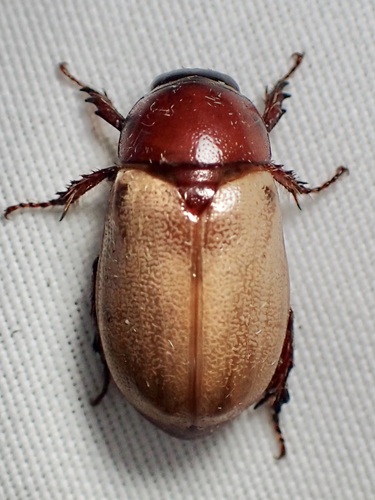
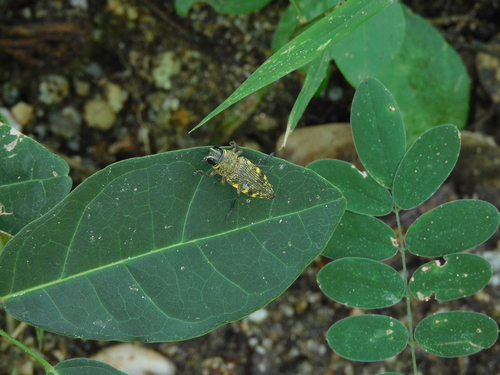
The closest relatives of the Fig Tree Borer that you can see in Tayrona National Natural Park (order Coleoptera, Beetles) are Cyclocephala melanocephala (about 10%) and Lampetis hirtomaculata (about 10%), with each one's daily chance of a sighting.

Where does the Fig Tree Borer sighting chance come from?

GBIF citizen-science records

It is estimated from how often the Fig Tree Borer is recorded against all the insects logged in Tayrona National Natural Park (8 verified sightings from 2019 to 2026), calibrated against known sighting rates. Figures are rounded to the nearest 10% because citizen-science data supports honest approximations, not decimals, and months with records from fewer than five people show "—". How it works.

← Back to Tayrona National Natural Park