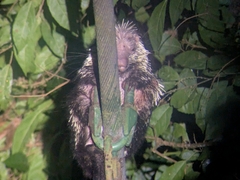
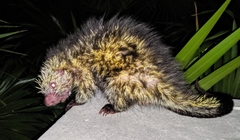
Mexican Hairy Dwarf Porcupine

Mexican Hairy Dwarf Porcupine

Sphiggurus mexicanus

Silhouette: PhyloPic

Daily sighting probability ~30% · Possible
at Tortuguero National Park

In 3 days ~60% in a week ~90%

43 Verified sightings at Tortuguero National Park From 2019 to 2026
227 In all 8 parks
December Best month
☀️🌙 Day & Night When it's spotted

About the Mexican Hairy Dwarf Porcupine

The Mexican hairy dwarf porcupine or Mexican tree porcupine (Coendou mexicanus) is a species of rodent in the family Erethizontidae. It is found in Costa Rica, El Salvador, Guatemala, Honduras, Panama, Mexico, Nicaragua and Belize.

This species was formerly sometimes assigned to Sphiggurus, a genus no longer recognized since genetic studies showed it to be polyphyletic. Its closest relatives are the Andean porcupine (Coendou quichua) and the stump-tailed porcupine (Coendou rufescens).

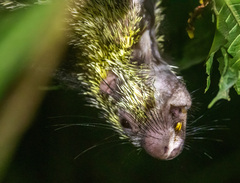
This porcupine has a pale head and a dark-coloured body. The head-and-body length ranges between about 320 and 457 mm (12.6 and 18.0 in), with a tail ranging from 200 to 358 mm (8 to 14 in). The maximum weight is about 2.6 kg (6 lb). This porcupine is covered with short yellowish spines but these are almost entirely obscured by the long black hair on the body. Sometimes the spines on the shoulders and back are visible projecting through the hairs. By contrast, the head is hairless, revealing the yellowish spines. The snout is pink, broad and bulbous, and the eyes are small. The tail is prehensile, spiny and broad at the base, tapering to a point. This porcupine differs from Rothschild... Wikipedia →

Global Distribution

Parks Where Found

# Park Country Daily sighting probability
1 Tortuguero National Park 🇨🇷 Costa Rica
~30%
2 Braulio Carrillo National Park 🇨🇷 Costa Rica
~20%
3 Monteverde Cloud Forest Reserve 🇨🇷 Costa Rica
~20%
4 Manuel Antonio National Park 🇨🇷 Costa Rica
~20%
5 Los Quetzales National Park 🇨🇷 Costa Rica
~20%
6 Tapantí-Macizo de la Muerte National Park 🇨🇷 Costa Rica
~10%
7 Arenal Volcano National Park 🇨🇷 Costa Rica
~10%
8 La Amistad International Park (Panama) 🇵🇦 Panama
<5%

Cities Where Found

# City Country Daily sighting probability
1 San José 🇨🇷 Costa Rica
~10%

Zoos & Centres Where Found

# Zoo / Centre Country
1 Tuzoofari 🇲🇽 Mexico In captivity
2 Zoológico Benito Juárez 🇲🇽 Mexico In captivity
3 Chapultepec Zoo 🇲🇽 Mexico In captivity
4 Hemsley Conservation Centre 🇬🇧 United Kingdom In captivity

Before you go

What are the chances of seeing a Mexican Hairy Dwarf Porcupine in Tortuguero National Park?

Possible

About 30% of wildlife watchers report a Mexican Hairy Dwarf Porcupine sighting in Tortuguero National Park on a given day, based on 43 verified sightings from GBIF citizen-science data from 2019 to 2026. It is the 8th most-seen of the 19 mammals we can rate there. Over three days the chance rises to about 60%, and over a week to about 90%, if each day is a fresh chance.

When is the best time to see a Mexican Hairy Dwarf Porcupine in Tortuguero National Park?

February, May and October–December

In those months about 40% of wildlife watchers report a Mexican Hairy Dwarf Porcupine in Tortuguero National Park on a given day, against under 5% in April and June, the lowest months.

What time of day is best to see a Mexican Hairy Dwarf Porcupine?

Between 7 and 10 pm

Across all the parks we cover, that three-hour window holds the most Mexican Hairy Dwarf Porcupine sightings with a recorded time, and about 6 in 10 of them come between 6 am and 6 pm: it is seen both by day and at night.

Is Tortuguero National Park the best place to see a Mexican Hairy Dwarf Porcupine?

Yes

Of the 8 parks where we can rate Mexican Hairy Dwarf Porcupine sightings, Tortuguero National Park has the highest daily chance: about 30%. Next come Braulio Carrillo National Park (Costa Rica, about 20%) and Monteverde Cloud Forest Reserve (Costa Rica, about 20%).

Which relatives of the Mexican Hairy Dwarf Porcupine live in Tortuguero National Park?

Same order: Rodentia

The closest relatives of the Mexican Hairy Dwarf Porcupine that you can see in Tortuguero National Park (order Rodentia, Rodents) are Central American Agouti (about 40%) and Variegated Squirrel (about 20%), with each one's daily chance of a sighting.

Where does the Mexican Hairy Dwarf Porcupine sighting chance come from?

GBIF citizen-science records

It is estimated from how often the Mexican Hairy Dwarf Porcupine is recorded against all the mammals logged in Tortuguero National Park (43 verified sightings from 2019 to 2026), calibrated against known sighting rates. Figures are rounded to the nearest 10% because citizen-science data supports honest approximations, not decimals, and months with records from fewer than five people show "—". How it works.

← Back to Tortuguero National Park