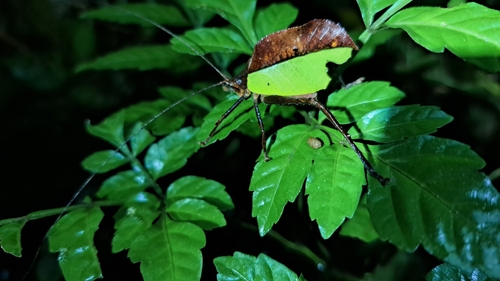
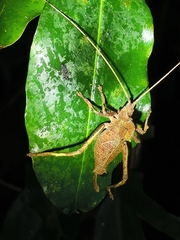
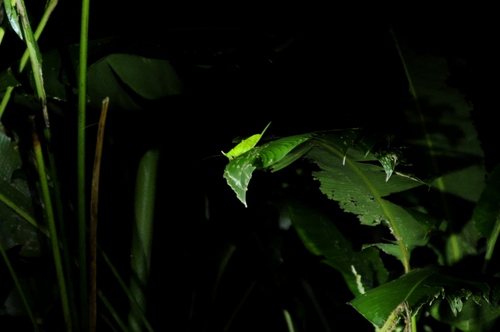
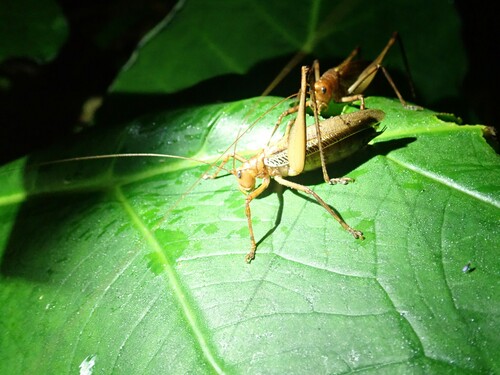
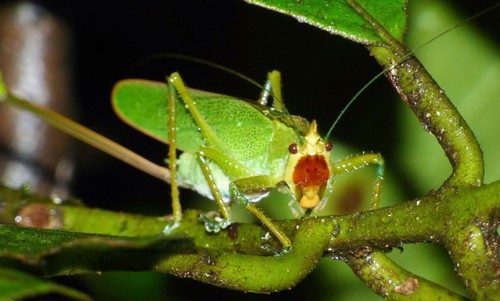
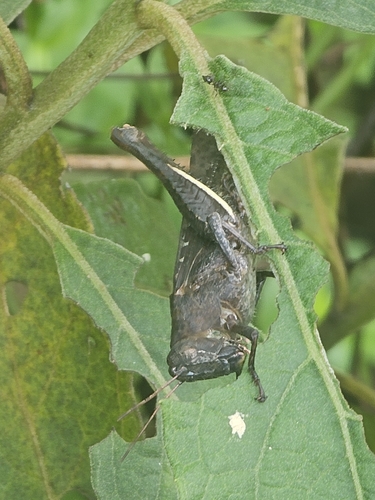
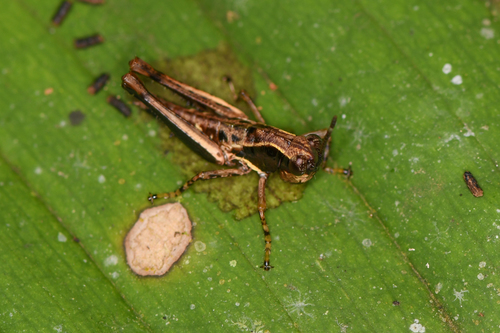
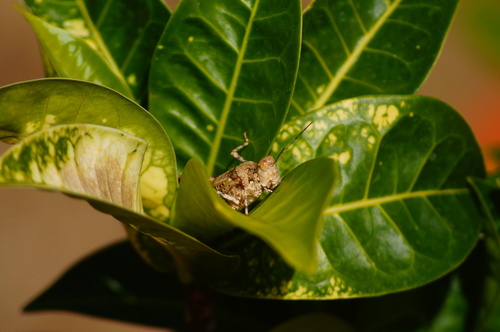
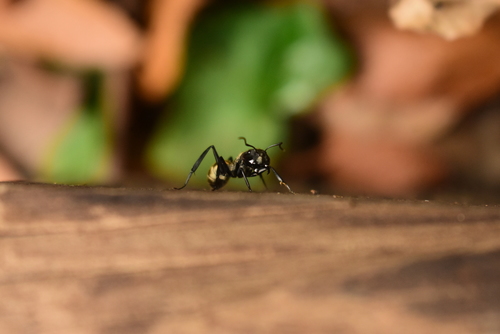
Mimetica incisa
Daily sighting probability ~10% · With luck
at Tortuguero National Park

In 3 days ~30% in a week ~60%

9 Verified sightings at Tortuguero National Park From 2019 to 2026
160 In all 8 parks
February Best month
🌙 Nocturnal When it's spotted

About the Mimetica incisa

Mimetica incisa is a species of katydid described by Stål in 1875. Mimetica incisa was first scientifically described by Carl Stål in the genus Cycloptera, with the name Cycloptera incisa. Stål published his description in an article in the Appendix to the Proceedings of the Royal Swedish Academy of Sciences in 1875, along with descriptions of many other new species. He discovered M. incisa in Chiriquí Province, in western Panamá.

In 1898 Henri de Saussure and Alphonse Pictet described what they considered a new species of katydid and named it Mimetica marmorata. The description was based on specimens collected in Cachí, Costa Rica and Tolé District in Chiruquí, Panama. In 1924, however, Paul Vignon synonymized M. marmorata with Cycloptera incsia. Stål's species was given taxonomic priority but was transferred to the genus Mimetica, thus yielding two synonyms: C. incisa (homotypic) and M. marmorata (heterotypic).

American entomologist Morgan Hebard later suggested in a 1927 paper that M. marmorata might be synonymous with Mimetica viridifolia. Hebard noted that the degree of individual variation in the species was not well understood, nor was the degree of sexual dimorphism... Wikipedia →

Global Distribution

Parks Where Found

# Park Country Daily sighting probability
1 Monteverde Cloud Forest Reserve 🇨🇷 Costa Rica
~20%
2 Chirripó National Park 🇨🇷 Costa Rica
~10%
3 Piedras Blancas National Park 🇨🇷 Costa Rica
~10%
4 Tortuguero National Park 🇨🇷 Costa Rica
~10%
5 Braulio Carrillo National Park 🇨🇷 Costa Rica
~10%
6 Tenorio Volcano National Park 🇨🇷 Costa Rica
~10%
7 Arenal Volcano National Park 🇨🇷 Costa Rica
~10%
8 La Amistad International Park (Panama) 🇵🇦 Panama
~10%

Before you go

What are the chances of seeing a Mimetica incisa in Tortuguero National Park?

With luck

About 10% of wildlife watchers report a Mimetica incisa sighting in Tortuguero National Park on a given day, based on 9 verified sightings from GBIF citizen-science data from 2019 to 2026. It is the 43rd most-seen of the 80 insects we can rate there. Over three days the chance rises to about 30%, and over a week to about 60%, if each day is a fresh chance.

When is the best time to see a Mimetica incisa in Tortuguero National Park?

February–March and May

In those months about 20% of wildlife watchers report a Mimetica incisa in Tortuguero National Park on a given day, against under 5% in July and September–January, the lowest months.

What time of day is best to see a Mimetica incisa?

Between 6 and 9 pm

Across all the parks we cover, that three-hour window holds the most Mimetica incisa sightings with a recorded time, and about 9 in 10 of them come between 6 pm and 6 am: it is mostly seen at night.

Where does the Mimetica incisa sighting chance come from?

GBIF citizen-science records

It is estimated from how often the Mimetica incisa is recorded against all the insects logged in Tortuguero National Park (9 verified sightings from 2019 to 2026), calibrated against known sighting rates. Figures are rounded to the nearest 10% because citizen-science data supports honest approximations, not decimals, and months with records from fewer than five people show "—". How it works.

← Back to Tortuguero National Park